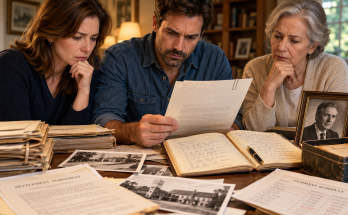
The court’s decision arrived on a clear morning near the beginning of summer. Rebecca called Ellie before the official documents were delivered, explaining that the judge had accepted the independent administrator’s findings regarding the disputed property and ordered the trust to proceed under a transparent review of its original terms. The forged deed could not establish Daniel’s ownership of the pump-house strip, and his claim to the house had been rejected. The beneficiary question had been addressed using the verified genetic evidence and the original trust language, rather than the altered hospital records.
Eleanor was recognized as the biological daughter of Clara Mercer, the child whose relationship to the trust could be considered under its terms. The administrator was authorized to complete the remaining accounting and distribute any funds due under the court’s interpretation. Ellie would retain possession of the house under Samuel’s estate arrangements, subject to the ordinary legal requirements. The ruling did not resolve every question about the original hospital misconduct, but it ended Daniel’s attempt to claim the property through the falsified documents.
Ellie listened to Rebecca explain the decision, feeling relief mixed with a strange emptiness. For months, the house had been the center of every conflict. She had feared losing it, then feared that keeping it would mean remaining trapped in the investigation. Now the court had separated the property from Daniel’s claim, and the house could return to being a home.
“What about the money?” Ellie asked.
“The administrator will complete the accounting and carry out the court’s order,” Rebecca said. “Any distribution will follow the trust terms and the findings. The ruling is not a judgment that one sister is more deserving than the other. It is a legal determination based on the document and the verified identities.”
Eleanor called soon afterward. She had received the same news and sounded overwhelmed. She said she was relieved that the court had recognized the truth, but she did not want the outcome to become a wall between them.
“It won’t,” Ellie replied. “The trust can determine what happens to the money. It doesn’t get to decide what we are to each other.”
Eleanor laughed softly, then began to cry. Ellie invited her to the house, and they spent the afternoon in the garden, talking about what they wanted to do next. Eleanor planned to continue working and to use any funds she received carefully. She did not want to make a sudden decision simply because the money had become available. After a lifetime of learning that adults could use financial arrangements to control identity, she wanted to make her own choices without pressure.
Daniel received the ruling through his attorney. Aaron later told Ellie that Daniel had not challenged the decision regarding the deed, though the separate review of the falsified records and financial transactions continued. The prosecutor was still determining the appropriate legal action based on the evidence. The ruling did not erase Daniel’s conduct, and his cooperation did not guarantee that he would avoid consequences.
Ellie received another letter from him several weeks later. This one was longer than the first. Daniel wrote that he had spent years telling himself the trust was the only reason he had kept the hospital records hidden. He now admitted that the trust had become an excuse to avoid acknowledging what he had done. He had wanted the family to remain intact in the eyes of outsiders, but his choices had destroyed the possibility of honest relationships inside the family.
He wrote that he did not expect forgiveness and would not ask Ellie to meet him. He said he understood that she might never want him in her life again. The final paragraph acknowledged that he had treated her as a problem to be managed rather than a person entitled to know her own history.
Ellie read the letter, folded it, and placed it in the case folder. She did not answer. She was no longer waiting for Daniel to provide the final explanation that would make her life understandable. His letter could be part of the record without becoming the authority over what she felt.
The legal proceedings continued in the months that followed. Peter Lang’s cooperation helped investigators reconstruct the movement of the original hospital correspondence, while the financial records supported further examination of the suspicious payments. Martin Hale’s actions were reviewed separately, including his alteration of the agreement and his decision to withhold the beneficiary file. The hospital’s surviving administrative records were preserved for the ongoing inquiry.
The outcome was not perfect justice. Some details could not be established with certainty, and the people who had died could not be questioned. Thomas Rusk’s role remained a mixture of negligence, concealment, and attempts to preserve evidence. Samuel’s decisions could be understood but not undone. The legal process could assign responsibility for specific acts, but it could not return the years the children had lost.
Ellie accepted that limitation more easily than she once would have. She had learned that the truth was not a machine that restored everything to its original condition. It was a foundation on which people could make better decisions, even when the past remained damaged.
She began turning the house into a place where people could gather without being drawn into the investigation. The study remained private, with Samuel’s letters and a carefully organized archive of the case documents. The rest of the rooms became lighter. She repaired the kitchen cupboards, replaced the old curtains, and painted the hallway a warm cream color. The changes were modest, but each one was a decision made for the present rather than a response to someone else’s demands.
Laura visited more frequently. Their relationship grew slowly, built through shared meals, conversations, and small discoveries. Laura learned that Ellie liked quiet mornings and disliked being surprised by visitors. Ellie learned that Laura kept old postcards in a tin box and always watered plants before leaving for a trip. They did not try to imitate the relationship they might have had if the hospital records had remained intact. They built the relationship they could have now.
One afternoon, Laura brought a small wooden frame containing the hospital photograph she had kept for decades. She placed it on the mantel in the sitting room, then stepped back to look at it.
“I used to think this photograph was all I would ever have,” she said. “I kept it because I was afraid that if I threw it away, I would be admitting that I had lost you forever.”
Ellie stood beside her. “You don’t have to keep it as proof anymore.”
“I know,” Laura replied. “But I still want to keep it as a memory of the day you were born.”
Ellie smiled. The photograph no longer had to identify a child or prove a disputed claim. It could simply be what it had always been to Laura: a small image of a beginning that had been followed by decades of uncertainty.
Clara and Eleanor also began rebuilding their relationship. Clara learned to answer questions without insisting that she remembered every detail, and Eleanor learned that she could ask those questions without rejecting the people who had raised her. Their conversations were sometimes painful, but they were no longer governed by Daniel’s version of the story.
Eleanor visited Willow Creek often. She and Ellie developed their own traditions, including Sunday lunches in the garden and occasional trips to the archive when the investigators needed a statement or clarification. They joked about how differently they had been raised, but they never used those differences to question whether they belonged together. The genetic report had established their biological connection; their growing friendship gave it a life beyond the laboratory.
One evening, they sat on the back steps watching the sky turn orange behind the trees. Eleanor asked Ellie whether she had ever considered selling the house now that the legal dispute was over.
“I thought about it,” Ellie admitted. “For a while, every room reminded me of what Samuel had hidden and what Daniel wanted to take. But now I think the house can be more than the place where the evidence survived.”
“What would you make it?”
Ellie looked toward the garden, where new flowers had grown along the fence. “A home. Maybe a place where people can come and talk honestly, even when the truth is difficult. I don’t mean an official center or anything complicated. Just a place where nobody has to hide what they know because they’re afraid of what someone else might do.”
Eleanor smiled. “That sounds like something Samuel might have wanted, even if he didn’t know how to make it happen.”
Ellie considered that. Samuel had preserved the evidence, but he had not trusted Ellie with it. His intention had been to protect her, yet his silence had left her vulnerable to the very story he hoped to prevent. If the house was to carry his legacy, Ellie wanted that legacy to include the lesson he had learned too late: protection without honesty can become another kind of harm.
She decided to create a small archive in the study, not hidden behind false panels or locked beneath the floorboards, but organized and accessible to those with a legitimate reason to examine it. The original documents would remain under the care of the authorities where required, and copies of the family records would be preserved with clear notes distinguishing verified facts from unresolved questions. She included a statement explaining that the archive existed to document what happened, not to dictate what anyone should believe about the people involved.
Rebecca helped her prepare the collection. They included the original trust correspondence, copies of the hospital records, the forensic reports, the genetic findings, and the letters that showed how the identity dispute had unfolded. Ellie also included Samuel’s final letter and a short account of her own experience, written in her own words rather than assembled from the documents.
She did not call the collection a monument to Samuel or a record of Daniel’s wrongdoing. She titled the folder The Willow Creek Record, because the house had held the evidence and because the truth belonged to everyone whose life had been shaped by it.
On the anniversary of the day she found the first envelope, Ellie invited Laura, Eleanor, Clara, Margaret, and Rebecca to dinner. Aaron stopped by briefly to deliver a final copy of a document that had been released from the investigation’s working file. The gathering was quiet and ordinary. They ate together, shared stories, and spoke about plans for the coming year. There were still painful subjects, but no one insisted that every conversation end with a complete resolution.
Before the guests left, Ellie went into the study and brought out the envelope Samuel had hidden beneath the sugar jar. She had preserved it in a protective sleeve, and the paper was beginning to show its age. She placed it on the table beside the family photographs.
“This was where everything began,” she said.
Laura touched the edge of the sleeve. Eleanor leaned closer, and Clara watched with a solemn expression. The envelope had once been a warning, a demand to investigate, and a sign that someone had known the truth was dangerous. Now it was part of the history they could examine together.
Ellie did not read the letter aloud. Everyone present already knew its central message. Instead, she explained what had changed since she found it: the identities had been established through independent evidence, the hospital records had been examined, the property claim had been rejected, and the trust was being administered according to the court’s decision. The legal consequences of the concealment were still being addressed, but the truth no longer depended on one person’s willingness to reveal it.
When the guests had gone, Ellie stood alone in the kitchen. The sugar jar sat in its usual place, and the table was clear. Outside, the garden moved gently in the evening breeze. The house was quiet, but it no longer felt as if it were guarding a secret.
She thought about the child she had been, growing up in a home where love and silence existed side by side. She thought about Laura, who had searched and then been told to stop. She thought about Eleanor, who had discovered that the history she had been given was incomplete. She thought about Samuel, whose love had been genuine even when his choices were wrong, and Daniel, whose fear had hardened into a scheme that harmed the people he claimed to protect.
None of them could return to the beginning and make different decisions. But Ellie could choose what the story meant now. She could keep the memories without accepting the lies, preserve the evidence without hiding it, and build relationships without forcing anyone to pretend the past had been painless.
She switched off the kitchen light and walked through the hallway toward the study. The framed photographs caught the last glow from the windows. Samuel stood outside Saint Agnes in one picture, his face tense with a worry Ellie could now understand. In another, Ellie and Eleanor sat together in the garden, laughing at something neither of them could remember afterward.
The photographs did not cancel each other out. They showed a life that had contained fear, affection, betrayal, courage, and change. The house had remembered all of it, but Ellie no longer needed the house to speak for the people who had remained silent.
She closed the study door gently and went upstairs, leaving the lights in the sitting room on for a little longer. Tomorrow, she would call Laura and ask whether she wanted to visit the garden again. She would meet Eleanor for lunch, continue her work, and make plans that had nothing to do with the trust or the hospital.
The truth had not restored the life she might have lived. It had given her the chance to live the one she had, without allowing other people’s secrets to decide who she was.
And at Willow Creek, where so many years had been spent protecting the past from the light, the windows finally stood open.
The End
Read more original stories on Feel Every Story.
The Morning My Parents Returned, They Brought a Moving Truck and a Lawyer Who Wouldn’t Meet My Eyes
Part 35 of 35