Spring arrived slowly at Willow Creek. The first warm days softened the ground beneath the trees, and the garden Samuel had tended for decades began to recover from a long winter. Ellie repaired the broken fence, cleared dead branches, and planted new flowers near the back steps. She worked without rushing, discovering that caring for the house could be an act of remembrance without becoming an act of obedience.
The legal proceedings continued, but their rhythm had changed. Aaron still called when there were developments, and Rebecca still sent documents for Ellie to review, yet the investigation no longer occupied every hour of her day. The prosecutor had received the complete evidence file, and the trust administrator was preparing the materials needed for the court’s determination. Daniel’s role in the concealment remained under review, while Lang and Martin faced separate scrutiny for their actions in the document and financial trail.
One afternoon, Rebecca visited with a draft statement from the independent administrator. The statement described the trust’s original purpose, the uncertainty surrounding the beneficiary schedule, and the evidence that the hospital’s records had been manipulated. It recommended that the court reject any attempt to rely solely on the replacement certificates and instead consider the verified genetic findings alongside the original trust language.
“The administrator is not deciding who deserves the money,” Rebecca explained. “The question is what the trust legally requires now that the original assumptions have been disproved. The court must apply the document, not reward the person who argued most forcefully for a particular result.”
Ellie read the draft carefully. It referred to Eleanor as Clara’s biological daughter and Ellie as Laura’s biological daughter. It also noted that the hospital’s identification labels had been altered, making the original number assignments unreliable. The report did not suggest that the DNA findings alone could answer every question about the trust, but it established a sound basis for determining the children’s identities.
“Does this mean Eleanor will receive the trust?” Ellie asked.
“Not automatically,” Rebecca replied. “It means the court can consider her claim based on verified evidence. The original trustee’s intent, the exact wording, and the legal effect of the identity switch will all matter. The administrator is recommending a transparent decision rather than another private arrangement.”
Ellie nodded. She was relieved that the process had become more open, even though she could not control the outcome. She had begun to understand that fairness did not always mean receiving the result she wanted. It meant that no one would again decide her identity or Eleanor’s future by manipulating a document and insisting the question was settled.
Later that week, Eleanor visited the house with Clara. Ellie had not seen Clara in person since their conversation about the genetic report. Clara looked nervous as she entered the kitchen, pausing to look at the sugar jar beneath which Ellie had found Samuel’s first envelope. The ordinary object seemed to hold the weight of the entire investigation.
“I keep thinking about how close I came to never knowing,” Clara said. “If Daniel had taken the house and removed the records, I don’t know whether any of this would have been found.”
Ellie poured tea for everyone. “We might have found the truth another way. But the records survived, and we know more now than we did before.”
Clara sat at the table and folded her hands. She said she had spoken with Eleanor about the circumstances surrounding her birth and had apologized for accepting Daniel’s explanation without asking more questions. Eleanor had told her that she was willing to build a relationship, but she needed Clara to answer honestly when she did not remember something rather than filling the gaps with assumptions.
“I can do that,” Clara said. “I can’t change what happened, but I can stop pretending I know more than I do.”
Ellie appreciated the distinction. For much of her life, the adults around her had treated certainty as a form of protection. They had filled gaps with explanations because uncertainty frightened them. Now, as the truth emerged, Ellie found that honesty often began with a simple admission: I don’t know.
Clara looked toward the study. “May I see the room where Samuel kept the documents?”
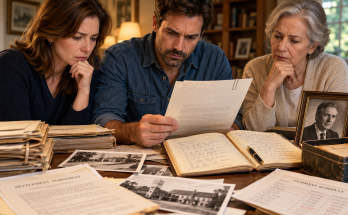
Ellie hesitated, then agreed. She led Clara and Eleanor through the hallway and opened the door. The room was tidier now. The blue ledger had been transferred to secure storage, and the original hospital documents were held by the investigators. What remained were copies, photographs, Samuel’s letters, and the notebooks Ellie had used to record the investigation.
Clara stood by the desk for a long time. “He must have been afraid every day,” she said. “Afraid that Daniel would find the records, afraid that the truth would destroy the family, afraid that you would be taken away.”
“Maybe,” Ellie replied. “But fear became his reason for keeping everything from me. I can understand why he was afraid without deciding that he was right.”
Clara nodded. She did not ask Ellie to defend Samuel or to forgive him. Instead, she looked at the photograph of him outside Saint Agnes and admitted that she had relied on his silence because it was easier than confronting Daniel. She had allowed herself to believe that the problem was over, even when the records showed that it was not.
“I was a mother to you in those first years,” Clara said. “But I also failed you by accepting a story that I had no right to accept without proof.”
Ellie felt the old ache return, but this time it did not turn into anger. “I remember you reading to me,” she said. “I remember the yellow blanket you kept in the living room. Those memories are real. So is what happened later. I don’t want to erase either part.”
Clara began to cry quietly. Eleanor took her hand, and Ellie remained beside them. The three women did not solve their relationship that afternoon, but they created space for it to become something more honest than the arrangement that had shaped their lives.
After Clara left, Eleanor stayed behind. She helped Ellie sort the remaining photographs and identify which ones should be preserved with the case file. They found a picture of Samuel teaching Ellie to ride a bicycle, another of Daniel standing beside the old pump house, and a family photograph taken shortly before the parents abandoned Ellie. The images captured moments of affection and ordinary life that could not be explained away by the later discoveries.
“Do you want to keep this one?” Eleanor asked, holding up the photograph of Daniel.
Ellie studied it. Daniel looked younger, almost carefree, with one arm resting on the pump-house railing. “Yes,” she said. “I want to remember what happened, but I don’t want the photograph to become proof that he was always cruel. People are more complicated than the worst thing they’ve done.”
Eleanor returned it to the box. “That doesn’t mean you have to let him back into your life.”
“No. It means I get to decide what happens next without pretending the past was simpler than it was.”
A few days later, Aaron informed Ellie that the prosecutor had formally referred the financial records and the falsified-document evidence for further legal action. The referral included the altered consent form, the recovered discharge page, the original bands, the correspondence sent to Laura, and the transfers involving the legal services company and Vale Holdings. The prosecutor would determine the appropriate charges and procedures, and the investigation into the hospital’s administrative failures would continue.
Aaron also confirmed that Lang had supplied the location of additional archived files. The documents were being examined to determine whether they contained further evidence about the missing page and the payment authorizations. Lang’s cooperation did not erase his role, but it helped investigators establish how the documents had moved from Saint Agnes into private hands.
“Will the truth ever be complete?” Ellie asked.
“Probably not in every detail,” Aaron said. “Some people are gone, some memories have faded, and some records may never be recovered. But we have enough evidence now to establish the central facts. We know the identities were manipulated, we know who helped conceal the records, and we know the trust was used as leverage. The remaining questions concern the exact responsibilities of each person and the legal consequences.”
Ellie thanked him. She had once believed that closure meant finding every answer. Now she understood that closure might mean knowing which questions could be answered, accepting which ones could not, and refusing to let uncertainty become an excuse for another person to control her life.
That weekend, Ellie and Eleanor organized a small gathering in the garden. Laura came, as did Clara and Rebecca. Margaret joined them by video call because travel was difficult, and Aaron stopped by briefly to return a personal document that had been copied for the case file. The gathering was not a celebration of the investigation. It was a chance for the people who had become connected through the truth to sit together without needing to defend a version of the past.
Laura brought the hospital photograph she had preserved and gave Ellie a copy. Clara brought a box of childhood pictures of Eleanor. They compared the images, noticing similarities and differences without treating them as evidence of anything beyond family resemblance. For once, the conversation was not about which child belonged to which name. It was about the lives the women had lived.
Margaret spoke about the night of the births and admitted that she still wished she had done more to stop the records from being changed. Ellie told her that the investigation had established how much she had tried to preserve and that the responsibility did not belong to her alone. Margaret accepted the reassurance but did not pretend her own decisions had been perfect.
As the evening drew to a close, Laura walked with Ellie along the garden path. She said she was grateful for the chance to know her daughter, but she did not want Ellie to feel responsible for repairing the years they had lost.
“We can build something from now,” Laura said. “It doesn’t have to look like the life we might have had.”
Ellie looked at the house, its windows glowing in the evening light. “I think that’s what I want. Not to recreate the past. Just to have a future that isn’t controlled by it.”
Laura smiled and took her hand. They stood together for a moment, not as strangers trying to recover a missing relationship, but as two people beginning one.
After everyone left, Ellie returned to the study and opened Samuel’s final letter. She read the words one last time, then placed the letter in a protective folder with the other personal documents. She would preserve it, but she would not hide it. If future generations wanted to understand what had happened, they would be able to read the truth without having to discover it beneath a drawer or behind a wall.
The house had been built to shelter a family, not to imprison its secrets. Ellie began to understand that preserving its history did not require preserving the silence that had surrounded it.
Click here to continue reading: PART 35: A Home Without Secrets
The Morning My Parents Returned, They Brought a Moving Truck and a Lawyer Who Wouldn’t Meet My Eyes
Part 34 of 35