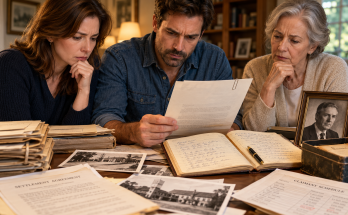
The county archive occupied the oldest building on the courthouse grounds, a red-brick structure with narrow windows and a stone staircase worn smooth by generations of footsteps. Eleanor drove behind Rebecca and me the following morning. None of us spoke much during the journey. We had agreed to examine the original hospital register together, but I could tell that Eleanor was carrying the same private fear I was: that the documents would reveal something irreversible, and still leave us without the certainty we needed.
A records supervisor named Helen Porter met us at the entrance. She had spent more than thirty years working with historical documents and seemed unimpressed by the drama surrounding our request. After checking Rebecca's authorization and reviewing the court reference, she led us into a climate-controlled room where several archival boxes rested on a long table.
"Saint Agnes transferred its surviving administrative records here when it closed," Helen explained. "Some files are complete. Others were damaged, removed, or destroyed before the transfer. We cannot promise that the register will answer every question."
Rebecca thanked her and presented the reference numbers from the documents we had recovered. Helen disappeared into the storage area and returned with a gray archival box bearing the hospital's name and the year of our births.
I watched her remove a thick volume wrapped in protective paper. Its dark cover had cracked along the spine, and several pages bore faint water stains. A handwritten label identified it as the maternity ward admission and discharge register.
My hands began to sweat.
Helen placed the book on a foam support and opened it to the relevant month. The pages were filled with names, dates, hospital numbers, and brief medical notes. Some entries had been written in blue ink, others in black. Several corrections had been made in the margins.
Rebecca photographed each relevant page before we examined the entries. She insisted that we preserve the register's condition and document every mark. Eleanor stood beside me, her arms folded tightly across her chest.
Then we found the date.
October seventeenth.
Two births had been recorded within forty minutes of each other. The first entry listed a mother named Laura Vale and a daughter assigned the temporary identification number 6142. The second listed a mother named Clara Mercer and a daughter assigned number 6143.
I looked at Eleanor.
"Laura was the woman who died," she whispered.
I nodded.
Helen leaned closer to the register. "There are corrections here, but the ink appears to be from a later date. Someone changed the names associated with these identification numbers."
The original entries were faint but still legible beneath the alterations. Number 6142 had been crossed out beside Laura's name and replaced with a different number. Number 6143 had received a similar correction.
Rebecca photographed the page under a portable examination light.
"Can you tell when the alterations were made?" she asked.
"Not precisely," Helen replied. "But the ink is different, and the handwriting doesn't match the original entries. A document examiner might be able to establish more."
We followed the numbers into the discharge column.
There, the records appeared to confirm what Grandpa had suspected. Number 6142 had been discharged to Samuel Mercer. Number 6143 had been discharged to Daniel and Clara Mercer.
But the names beside the numbers had been altered.
Someone had written Ellie Mercer beside one entry and Eleanor Vale beside the other, then crossed them out and reversed them.
I felt a strange mixture of relief and dread. We had found evidence that the identities were switched, but the alterations meant we still couldn't establish which infant had gone home with Grandpa.
"Is there a separate record of the bracelets?" Eleanor asked.
Helen turned several pages and found a reference to the nursery inventory. The original identification bracelets had been issued in numerical order, with 6142 assigned a white band and 6143 assigned a blue one.
The three bracelets Grandpa had hidden included both names, but the dates and numbers had not been fully preserved on the plastic. One bracelet bore the number 6142. Another bore 6143. The third, with my name, had been added later in a different hand.
I stared at it.
"Why would there be a third bracelet?"
Helen examined the entry.
"Possibly a replacement. Hospitals sometimes reissued identification bands when one became damaged or illegible."
"Could someone have changed the name after the baby left the hospital?"
"That is possible, but the register alone cannot establish it."
Rebecca asked whether the archive retained staff duty rosters for the same night. Helen searched the index and located a separate volume documenting the maternity ward's staff assignments.
Margaret Vale's name appeared beside the overnight shift.
A second name appeared beneath it: Thomas Rusk, administrative supervisor.
I recognized neither name.
Rebecca wrote them down. "We should find out whether Mr. Rusk is still alive and whether his employment records survived."
Helen checked the archive's catalog.
"His personnel file was transferred to the county's legal records collection," she said. "It may contain correspondence or disciplinary notes, but those files require a separate request."
We were about to arrange that request when Eleanor pointed toward the lower corner of the register.
"There is a page missing."
A narrow strip of paper remained attached to the binding between the discharge entries and the following day's records. The edge was ragged, and small fibers protruded from the seam.
Helen's expression grew serious.
"That page was removed before the book came here. We have no transfer record explaining when or why."
"Could it have contained the final discharge signatures?" I asked.
"It could have contained anything recorded on that page. We cannot infer its contents from the missing paper alone."
Rebecca photographed the damaged binding and asked Helen to note the condition in the archive report.
For the first time, I understood why Grandpa had hidden the evidence in so many places. Even the original register could not be trusted to tell the whole story. Someone had altered it, and someone had removed a page that might have resolved the central question.
As we prepared to leave, Helen returned with a slim folder she had discovered in a separate box of hospital correspondence.
It contained a memorandum dated three days after our births.
The memo referred to an "irregularity in newborn identification" and instructed staff to submit all related documents directly to the hospital administrator. A handwritten note at the bottom read, "Resolved at the request of D. Mercer."
My father had not merely benefited from the altered records. His name appeared in the official paperwork connected to the decision.
Rebecca requested a certified copy.
Helen agreed, warning that any legal conclusions would have to be made by the appropriate authorities.
Outside, the wind had strengthened, sweeping dry leaves across the courthouse steps. Eleanor remained beside the car while Rebecca called the investigator handling our case.
I stood with her, looking at the photographs on my phone.
"We know the names were switched," Eleanor said. "We know someone removed a page. But we still don't know which of us was born to which mother."
"Not yet."
She looked toward the road.
"Do you think our parents knew?"
"I think some of them knew more than they admitted. I don't know exactly what each person understood at the time."
Eleanor rubbed her silver bracelet with her thumb. "If I'm Laura's daughter, then my entire childhood was built around a lie. If I'm Clara's daughter, the same is true."
I wanted to tell her that family was more than a name on a document, but the words seemed inadequate. Neither of us had asked for this uncertainty, and neither of us could simply choose to ignore it.
Rebecca ended her call and approached us.
"The investigator wants to meet us this afternoon. He has found the original correspondence concerning Thomas Rusk."
"Does it mention the missing page?" I asked.
"Not directly," she replied. "But there is evidence that Rusk objected to the changes in the register."
Eleanor straightened.
"Then perhaps he can tell us what happened."
Rebecca hesitated.
"There's one complication. Thomas Rusk died eight years ago. His personnel file includes a sealed statement he gave to a lawyer shortly before his death."
She handed me a copy of the archive's preliminary index.
The statement had been filed under a reference number connected to the Mercer estate.
Beneath it was a handwritten note.
Do not release until both children have been identified.
Click here to continue reading: PART 10: A Dead Hospital Supervisor Had Left One Last Statement, and My Father’s Name Appeared Beside a Warning About the Children
The Morning My Parents Returned, They Brought a Moving Truck and a Lawyer Who Wouldn’t Meet My Eyes
Part 9 of 35