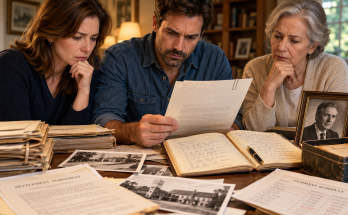
The letter from Daniel remained in Ellie’s study for nearly a week before she decided what to do with it. She had read it several times, looking for something beyond the careful admissions and restrained apologies. He acknowledged that he had concealed the uncertainty surrounding her birth, but he still avoided explaining why he had allowed that uncertainty to become a weapon against two children. Each time Ellie reached the final paragraph, she felt the same disappointment. Daniel seemed to understand that his actions had consequences, yet she could not tell whether he understood the people who had suffered them.
On Monday morning, Aaron Bell called to tell her that the prosecutor had completed an initial review of the evidence. The matter would proceed through formal legal channels, including an examination of the falsified consent document, the removal and concealment of hospital records, the suspicious financial transfers, and Daniel’s attempted claim to the pump-house property. The prosecutor had not made a final decision on every potential charge, but the evidence was considered substantial enough to justify further proceedings.
Ellie listened quietly. She had once imagined that uncovering the truth would lead to a single confrontation in which Daniel would finally admit everything and the family’s history would become understandable. Instead, the truth was being established through reports, sworn statements, financial records, and decisions that would take months to complete. There would be no single moment when all the damage vanished.
“What happens to the trust?” she asked.
“The independent administrator will continue reviewing the original terms,” Aaron explained. “The court will determine how the beneficiary clause applies to the verified biological relationships. The property will remain protected while that process continues. Daniel cannot simply claim the house because he believes the trust should benefit Clara’s biological child.”
Ellie thanked him and ended the call. The news brought relief, but it also forced her to confront the question she had avoided: what did she actually want from the house? Samuel had left it to her as a home and a repository for the evidence. Daniel had treated it as an asset he could use to recover his position. The trust had made it a financial prize. Ellie wanted to keep the house, but she did not want to spend the rest of her life defending it against the past.
Later that afternoon, Rebecca Shaw visited with the independent administrator’s preliminary report. The report confirmed that the original beneficiary schedule could not be relied upon without considering the hospital’s altered records and the final genetic findings. Eleanor’s biological relationship to Clara was established, and Ellie’s relationship to Laura was supported by the independent genetic report. The trust’s language, however, had been drafted around an assumption that the hospital’s records would accurately identify the child born to Clara.
“The court will need to decide whether the original intention of the trust can be carried out now that the identity switch has been established,” Rebecca said. “The administrator will not release the funds based on a reconstructed schedule alone. Every beneficiary claim must be supported by the original terms and verified evidence.”
Eleanor had been invited to submit a statement explaining her position. She told Rebecca that she wanted the trust administered according to its lawful terms, but she did not want the dispute to destroy the relationship she was building with Ellie. She had spent too many years being treated as a name in a file, and she refused to turn her sister into a rival over money.
“I won’t pretend the inheritance means nothing,” Eleanor said. “It could affect my future, and I understand that. But I don’t want to win something by repeating the same mistake that was made when we were babies. Our identities are not bargaining chips.”
Rebecca included Eleanor’s statement in the file. She also asked Ellie whether she wanted to make a statement of her own. Ellie agreed, but she refused to frame it as a claim against Eleanor. Instead, she wrote that she wanted the property protected until the legal questions were resolved and that she did not believe either sister should be pressured into accepting an arrangement simply because it would be convenient for the trust.
While the legal process continued, Aaron arranged another interview with Daniel. This time, the questions focused on the instruction sent to the legal office that had contacted Laura. The handwriting examiner’s report had found strong similarities between the disputed notes and Daniel’s known writing. The prosecutor wanted to establish whether Daniel had knowingly instructed the office to tell Laura that the hospital matter had been resolved.
Daniel arrived with his attorney and appeared less confident than he had during the earlier interview. Aaron showed him the letter sent to Laura and the accompanying instruction. Daniel said he remembered asking for a legal opinion, but he claimed he had not intended to prevent Laura from finding her child. He said he believed the hospital had already settled the identity question and that the legal office had merely communicated the result.
Aaron placed the recovered discharge page beside the instruction. “This page shows that the identity correction was still unresolved. The original labels were later found to have been removed and replaced. What evidence did you have that the matter had been settled when you instructed the legal office to tell Laura to stop pursuing it?”
Daniel looked at the documents for a long time. Eventually, he admitted that he had relied on Rusk’s verbal assurances and the replacement records. He could not produce a signed verification proving that the two children had been correctly identified. He also acknowledged that he knew the original discharge page was missing when the legal office prepared its letter.
“Then why did you say the matter was resolved?” Aaron asked.
“Because I thought the situation had gone too far to reverse,” Daniel replied. “I believed that if Laura continued asking questions, the hospital would be exposed, the trust would be frozen indefinitely, and everyone would lose what they had.”
“You were not protecting everyone,” Aaron said. “You were preventing people from examining the evidence.”
Daniel did not answer. His attorney requested that the interview move to the next subject, but the admission had been recorded. It did not establish every element of the suspected wrongdoing, yet it supported the conclusion that Daniel had continued to promote a claim of certainty despite knowing that the original records were incomplete.
When Aaron told Ellie about the interview, she felt no satisfaction. She had wanted Daniel to explain why he had done it, but his explanation was the same one she had heard before: he had been afraid of what the truth would cost. The difference was that he had been willing to let other people pay that price.
That evening, Ellie met Laura for dinner. Their first meeting had been tentative, but this time Laura seemed more comfortable asking questions about Ellie’s life. She wanted to know about Samuel, about the house, and about the years Ellie spent believing that her biological parents had chosen to leave her. Ellie answered honestly, including the parts that made Samuel appear less noble than she had once believed.
Laura listened without interrupting. “I don’t want you to feel that you have to defend him to me,” she said. “He raised you. Whatever else he did, he gave you a life. I can be grateful for that and still wish he had told you the truth.”
Ellie looked at her mother across the table. The word still felt unfamiliar, but it no longer felt impossible. “I don’t know how to feel about him some days,” she admitted. “I miss him, and then I remember that he knew there was a chance I wasn’t the child everyone thought I was. I feel angry all over again.”
“You’re allowed to feel both things,” Laura replied. “You don’t have to turn him into a villain to acknowledge what he did wrong. And you don’t have to excuse him just because you loved him.”
They spoke about the photograph Laura had kept and the letter she had sent to the legal office. Laura explained that she had stopped searching actively after receiving the official closure letter, not because she stopped caring, but because she believed continuing could expose her to legal trouble and permanently close the only route she had left. She had kept her records in a box through several moves, unable to throw them away.
“I sometimes wondered whether you were happy,” Laura said. “I hoped someone had loved you. I never knew that Samuel was the person raising you until your letter arrived.”
Ellie reached across the table and took her hand. The gesture felt awkward for a moment, then natural. It did not erase the years they had lost, but it established a connection that neither Daniel nor the hospital could control.
When Ellie returned home, Eleanor was waiting in the kitchen with two mugs of tea. She asked how dinner had gone, and Ellie told her about Laura’s letter and the photograph. Eleanor smiled when Ellie described the way Laura had listened without demanding that she choose between the people who had shaped her life.
“I think I’m learning something too,” Eleanor said. “I can love Clara and still ask her hard questions. I can be grateful to my adoptive parents and still want to know what happened before they brought me home. None of those things has to cancel the others.”
Ellie sat beside her. “And we can be sisters without agreeing on every part of the past.”
For the first time since the investigation began, the two women laughed together without the sound being interrupted by another discovery or accusation. They talked about their jobs, the food they had grown up eating, and the different ways their families celebrated birthdays. Their histories had been intertwined before either of them knew it, but their relationship was beginning to grow from choices they made themselves.
The next morning, Rebecca called with an update from the independent administrator. The court had agreed to continue protecting the property while the beneficiary question was reviewed. Daniel’s attempted deed would not be accepted as evidence of ownership, and the disputed transfers would be examined separately from the inheritance determination. The administrator also recommended that the house remain in Ellie’s possession under the temporary arrangement because she had maintained the property and preserved the evidence.
Ellie stood in the doorway of Samuel’s study as Rebecca explained the decision. It was not a final judgment, and she knew more legal steps remained. Still, the house would not be taken from her while the case proceeded.
“Thank you,” she said. “I want to keep it, but I don’t want it to remain a battlefield.”
“Then you should begin deciding what kind of home you want it to become,” Rebecca replied. “The legal process will determine ownership and the trust. It cannot determine how you choose to live here.”
After the call, Ellie opened the curtains throughout the house. She removed several boxes of duplicate documents from the sitting room and arranged for them to be transferred to the secure archive. The originals would remain protected, but she no longer needed every room to remind her of the investigation. She began clearing space for ordinary things: books, photographs, fresh flowers, and the small objects that made a house feel lived in.
At the back of the study, she found the old photograph of Samuel standing outside Saint Agnes with Margaret. She placed it in a frame beside a more recent picture of herself and Eleanor. The photographs told different stories, but she no longer felt compelled to choose one over the other. Samuel’s choices had harmed her, yet he had also given her a home. Eleanor had entered her life through a painful discovery, but she had become someone Ellie could trust. Laura had been absent from her childhood, but she had never knowingly chosen to abandon her.
That night, Ellie wrote a final note for the case file. She recorded the date of the latest legal decision and the location of every original document that remained in the house. Then she wrote a sentence for herself, not for the investigators: The truth has a price, but silence had a price too. I will not keep paying for the silence.
She closed the notebook and switched off the study lamp. For the first time in months, she did not feel that she had to remain awake in case someone came looking for the next hidden document.
The house was quiet, and the quiet no longer felt like a warning.
Click here to continue reading: PART 34: What the House Was Meant to Keep
The Morning My Parents Returned, They Brought a Moving Truck and a Lawyer Who Wouldn’t Meet My Eyes
Part 33 of 35