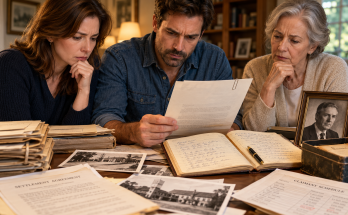
Aaron Bell met us at Rebecca's office the next morning. He had brought a financial investigator named Nina Cole, who had spent the previous day tracing the reference number from the ledger. Nina was direct and unsentimental. She explained that the payment to Rebecca could have been legitimate, but the date and the wording justified a closer examination.
Rebecca placed her invoices, bank statements, and the original engagement letter on the conference table. The records showed that Samuel Mercer had hired her to review several property transactions and prepare a legal strategy for preserving the estate. The payment had gone through a company associated with the trust, not through Grandpa's personal account.
"Why would he pay through the trust?" I asked.
Nina compared the account number on the invoice with the one in the ledger. "The company may have been used to cover expenses without drawing attention to the beneficiary dispute. That doesn't automatically make the payment improper. We need to establish who authorized it and whether the trust permitted those expenses."
Rebecca's engagement letter stated that she had been asked to investigate a possible conflict between the trust's terms and the property deeds. It did not mention the hospital records or the identities of the children. However, a handwritten note on the final page referred to "the October discharge discrepancy."
I looked at Rebecca.
"You knew about the hospital case fourteen years ago."
"I knew that there was a dispute over a discharge record," she replied. "I did not know the full circumstances. Samuel asked me to examine whether the trust could be settled while the beneficiary's identity remained uncertain. I advised him that it could not."
"Why didn't you tell me?"
"Because your grandfather instructed me not to discuss the underlying dispute unless the records could be authenticated. I believed he was trying to protect you. I should have explained that a dispute existed, even if I couldn't disclose every detail."
Her admission hurt, but it was different from the evasions I had heard from my parents. She was acknowledging a choice she had made rather than pretending the choice had never existed.
Nina turned to the next document. It was a copy of an agreement signed by Samuel Mercer, Martin Hale, and the representative of a company called Vale Holdings. The agreement had been executed fourteen years earlier, shortly before Daniel closed his safe-deposit box.
The terms were brief. Vale Holdings would relinquish its claim to a strip of land bordering the Mercer property. In exchange, the trust would cover the legal costs of reviewing the estate's ownership records. A final clause prohibited the parties from destroying or altering any documents connected to the transaction.
"Who represented Vale Holdings?" Aaron asked.
Rebecca pointed to the signature at the bottom.
"Daniel Mercer."
Nina placed the agreement beside the ledger. The payment to Rebecca matched the legal expenses described in the agreement, but the ledger also showed a second transfer to Vale Holdings three weeks later. That transfer was much larger and had no corresponding invoice.
"That second payment is the one we need to trace," Nina said. "If it was made under the same agreement, there should be supporting documentation. If it wasn't, someone may have used the transaction to move money without proper authorization."
I asked whether the money could have been connected to the hospital records.
"It could have been," Nina said. "But we cannot establish that from the ledger alone."
Aaron explained that the agreement gave us a reason to request the company's remaining records. Although Vale Holdings had been dissolved, some of its financial documents were held by a successor firm that had acquired its assets.
Nina had already contacted the firm's records department. A representative had confirmed that a box of archived correspondence still existed and would be released under a formal request.
We spent the rest of the morning reviewing the property deeds. Several showed that Daniel had attempted to use the land as collateral for loans. The transactions had been reversed after Grandpa challenged them, but the legal fees had been paid through the trust. One document included a note stating that the disputed strip of land was essential to maintaining access to a secondary structure on the Mercer property.
The structure was marked on an old survey map.
It was a small stone building behind the barn, partly hidden by the apple trees.
I had seen it many times as a child. Grandpa called it the pump house, though the well it served had been sealed decades earlier. Its door was secured with a rusted hasp, and he had always told me that there was nothing inside worth exploring.
I remembered the brass key stamped seventeen.
The same number had appeared on the barn compartment and on the back door of Margaret's former house. It was also marked beside the pump house on the survey map.
"Why would a trust agreement involve a pump house?" I asked.
Nina examined the map. "The land around it may have been used as a separate parcel. If the company needed access to the structure, it would explain the boundary dispute."
Rebecca looked toward me. "Did your grandfather ever mention a separate deed for the pump house?"
"No. He said the land had belonged to the family for generations."
Aaron photographed the map and asked whether we had a key to the building. I showed him the brass key from the barn. He suggested we arrange an inspection with the investigator present rather than enter the structure alone.
We returned to the house that afternoon. Aaron and Nina arrived shortly afterward, bringing a camera, document bags, and a small tool kit. The pump house stood behind a line of overgrown shrubs. Its stone walls were damp, and the roof sagged slightly along the eastern side.
The key turned in the lock.
Inside, we found a disused pump, several rusted tools, and shelves crowded with empty jars. The floor was made of uneven stone, and the air smelled of wet earth. At first, nothing suggested that the building had any connection to the trust.
Then Nina noticed a metal cabinet bolted to the wall behind the pump.
Its lock had been painted over several times. Aaron photographed it before using a small tool to open the mechanism. Inside lay a packet of property documents wrapped in waxed cloth, along with a sealed envelope bearing Samuel Mercer's signature.
The first document was a deed transferring the pump house and the surrounding strip of land to Vale Holdings. The transfer had been signed by Daniel, but the grantor's signature appeared to have been forged.
The second document was a declaration that the land had been held in trust for a child whose identity could not be established from the surviving records.
The beneficiary was described only as "the child discharged under identification number 6142."
I felt my stomach tighten.
"That's one of the babies," Eleanor said.
Aaron nodded. "It appears to be."
The envelope contained a letter from Grandpa dated fourteen years earlier.
He wrote that he had discovered the forged deed after Daniel attempted to use the land as collateral. He had confronted Daniel, who claimed that the transfer was necessary to secure funds for the family. Grandpa refused to accept that explanation and arranged for the trust to reclaim the property.
But the final paragraph was different.
If the child identified as 6142 cannot be established with certainty, the land must remain protected until the original records are recovered. No beneficiary should be permitted to sell or transfer it on the strength of the altered register.
The letter explained why Grandpa had kept the property. It was not simply a place to live or an inheritance to defend. It was a piece of land tied directly to the disputed trust, and whoever controlled it might gain leverage over the beneficiary question.
Nina checked the deed against the ledger. The larger transfer to Vale Holdings had been recorded shortly after the trust reclaimed the land. The payment had no clear legal justification.
"Someone may have been compensated for relinquishing a claim they never lawfully held," she said. "We need the company's records to determine who received the money."
Aaron sealed the documents for examination.
As we left the pump house, I looked back at the stone walls. Grandpa had hidden the agreement there because he believed the land would protect the evidence. Yet the deed had been altered, the payments were unexplained, and the trust's beneficiary remained uncertain.
I was beginning to understand that the house had been kept intact for a reason far more complicated than sentiment.
Someone had built an entire financial arrangement around a child whose identity could not be proved.
And my father had spent years trying to make that uncertainty work in his favor.
Click here to continue reading: PART 15: A Forgotten Company Record Exposed the Money Trail, but the Name at the Center of It Was Not My Father’s
The Morning My Parents Returned, They Brought a Moving Truck and a Lawyer Who Wouldn’t Meet My Eyes
Part 14 of 35