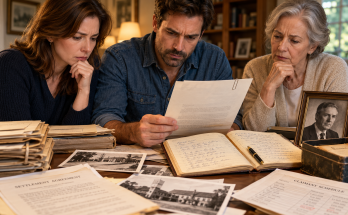
The archived correspondence from Vale Holdings arrived two days later. Nina Cole reviewed it at Aaron's office while Rebecca and I sat across the table. Eleanor joined us by video because she needed to remain at her accounting firm that morning, but she insisted on seeing every page as it was examined.
The packet contained invoices, bank instructions, and several letters exchanged between Daniel Mercer and a company director named Peter Lang. Most concerned property transactions, but a group of documents referred to the trust and the hospital records. The language was indirect, using phrases such as "the original identification problem" and "the unresolved beneficiary matter."
One letter from Daniel requested that the company hold a payment until the trustee confirmed the beneficiary's identity. Another, written six days later, instructed the company to release the money regardless of whether the records had been corrected.
Nina placed the two letters side by side.
"These instructions conflict," she said. "We need the payment records to see which one was followed."
The bank statements showed that the money had been transferred to a separate account, not to Daniel personally. The account belonged to a small legal services company that had been dissolved several years earlier.
Its director was listed as Peter Lang.
I looked at the documents. "So Daniel didn't receive the money?"
"Not directly," Nina said. "That doesn't tell us who ultimately benefited. We need to trace the subsequent transfers."
The account had been used to pay several expenses, including legal fees, a property loan, and a payment to an individual identified only by initials. The initials were R.S.
Rebecca looked at the page for a long moment.
"Those could belong to anyone," she said.
Nina agreed. She would not speculate without evidence. She requested the bank's archived transaction details and asked Aaron to preserve the records as part of the ongoing investigation.
The correspondence also included a letter from Peter Lang to Martin Hale. It was dated fourteen years earlier and referred to the sealed beneficiary file. Lang wrote that he had been instructed to obtain a certified copy of the hospital discharge record but had been unable to do so because the identification number had been altered.
A handwritten note beneath the letter stated, "The original may be held by S.M."
Samuel Mercer.
Grandpa had possessed the discharge form, the ledger, and the agreement concerning the pump house. The evidence suggested that he had been trying to preserve the records while preventing the trust from being settled under a false identity.
But another letter complicated the picture.
In it, Lang accused Samuel of withholding a document that could resolve the dispute. He claimed that the delay was costing the trust money and preventing the rightful beneficiary from receiving the inheritance.
The letter had been returned to sender, marked "address unknown."
"Lang believed Grandpa had the answer," Eleanor said through the video call.
"Or he believed Grandpa had a document he wanted," Rebecca replied. "Those are not necessarily the same thing."
I thought of the note Grandpa had left in the safe-deposit box. He had admitted that he failed to discover where the second child went. Perhaps he had also failed to determine which child he had taken home. The evidence suggested that he had spent years trying to correct the mistake, but I could no longer assume that he had known more than he told me.
Nina turned to the final item in the packet. It was a receipt signed by Peter Lang, acknowledging delivery of a sealed envelope from an unidentified person. The receipt was dated one day after Daniel closed his safe-deposit box.
The description of the envelope matched the missing beneficiary schedule.
I leaned forward.
"Can we identify who delivered it?"
"The receipt doesn't name the person," Nina said. "But the company records include a visitor log from that week."
She placed a photocopy on the table. Three names appeared beside the relevant date: Daniel Mercer, Martin Hale, and Rebecca Shaw.
No one spoke.
Rebecca read the page twice.
"I met with Martin that week," she said. "Samuel asked me to review the proposed property agreement. I have a calendar entry and an invoice documenting the meeting."
"Did you see the beneficiary schedule?" Aaron asked.
"No. I remember discussing the trust's suspended status, but I don't recall a separate schedule."
"Could you have received an envelope without knowing what it contained?"
"I suppose it's possible, but I have no memory of doing so."
Nina checked the receipt again. The signature was not Rebecca's, and there was no evidence that she had delivered or received the envelope. Her name in the visitor log established only that she had been at the company office that day.
Still, the discovery made it clear that the missing schedule had passed through the hands of people who knew about the trust.
Aaron asked Rebecca to provide her calendar records and bank statements for the relevant period. She agreed, then turned to me.
"I know this is difficult," she said. "But I will not ask you to trust me without verification."
I nodded, though the strain of the investigation was beginning to affect every relationship I had. Each new document made one person appear less trustworthy and another more complicated. I had spent years believing that my grandfather's home was the one place where I was safe from my parents' choices. Now even the people who had tried to protect me were connected to decisions they had not fully explained.
That evening, Eleanor came to the house. She had closed her office early and driven through heavy rain to be with me. We sat in the kitchen with the hospital bracelets between us.
"I keep thinking about the name on my bracelet," she said. "If it was changed, then even the object we've treated as evidence may be part of the deception."
"That's possible."
"How do we know anything is real?"
I looked toward Grandpa's empty chair.
"We compare everything. We don't decide based on one document. That's what Rebecca keeps telling us."
Eleanor turned the bracelet over.
"My adoptive parents loved me. Whatever the records say, they were my parents in every way that mattered. But I still want to know who gave birth to me."
"I want to know who I am, too."
She was quiet for a while.
"Do you think Daniel knew which baby he took?"
"I think he knew more than he admitted. Whether he knew everything is another question."
The next morning, Aaron called with the results of the first financial trace. The payment from Vale Holdings had not gone to Daniel, Martin, or Rebecca. It had been transferred through the legal services company into an account controlled by someone named Peter Lang, then divided into smaller payments.
One payment went to a property lender. Another covered legal expenses. A third was sent to a private account that had been closed shortly afterward.
The account holder was Margaret Vale.
I felt a sudden wave of confusion.
"Why would Margaret receive money from the company?"
Aaron explained that the payment could have been compensation for legal expenses, reimbursement for work she had done, or something connected to the hospital dispute. The records did not specify its purpose.
I called Margaret.
When I told her about the payment, she went silent.
"Margaret, do you know why Vale Holdings sent you money?"
"I received money once," she said finally. "It was sent by Samuel. He said it would cover the cost of leaving town and finding a lawyer. I refused to take anything from Daniel."
"Did you receive a payment from Peter Lang's company?"
"I don't remember the name. I would have to check my records."
She promised to look through her old papers and call me back.
An hour later, she sent a photograph of a bank receipt. The amount matched the payment in the ledger, but the date was different by three days.
The receipt showed that the money had been deposited into Margaret's account under a reference number associated with legal expenses.
At the bottom, someone had written a note.
Payment on behalf of the witness. No direct contact.
Margaret had not known who arranged it. She had assumed Grandpa had paid the lawyer, as he had promised. The money had been used to cover her relocation expenses and the cost of consulting an attorney after she left Saint Agnes.
The payment was not evidence that Margaret had been bribed. It appeared to have been intended to help her escape the pressure surrounding the hospital dispute.
But the financial records revealed something else. The money had been routed through the same company that handled the trust's disputed transactions.
Someone had deliberately connected the witness's expenses to the trust.
Nina believed that this could have been an attempt to conceal the source of the money or make the payment appear to be a legitimate trust expense. Either way, the transaction required further examination.
That afternoon, Rebecca received confirmation that the court had approved the request for Martin's sealed beneficiary file. An independent examiner would collect it the next morning and create a complete inventory before anyone reviewed its contents.
For the first time, we had a definite path toward identifying the children.
Then Aaron called again.
The bank had located a final document from Daniel's closed safe-deposit box. It was a receipt for the removal of the original hospital correspondence.
The receipt bore a signature that did not match my father's.
It was signed by Peter Lang.
Click here to continue reading: PART 16: The Missing Beneficiary Schedule Finally Resurfaced, and Its Handwritten Correction Threatened to Undo Everything We Had Learned
The Morning My Parents Returned, They Brought a Moving Truck and a Lawyer Who Wouldn’t Meet My Eyes
Part 15 of 35