Daniel’s attorney contacted Aaron three days after Helen Price’s interview. Daniel was prepared to provide a further statement, the attorney said, but only if the investigators clarified whether his cooperation would be considered when the prosecutor reviewed the case. Aaron explained that he could make no promises about charging decisions. Daniel could provide truthful information, identify relevant documents, and correct previous statements, but any legal consideration would be determined by the appropriate authorities.
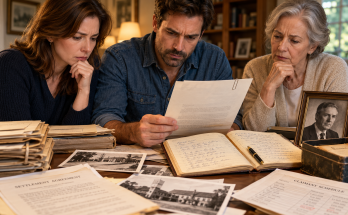
Ellie learned of the offer from Aaron that afternoon. She was sitting with Eleanor at the kitchen table, organizing the documents that had accumulated since the investigation began. The recovered discharge page, the genetic report, the bank timeline, and the forensic analysis of the labels lay in separate folders. Each represented a different part of the story, but together they formed a picture Daniel could no longer dismiss as a misunderstanding.
“He wants a deal,” Eleanor said.
“He wants to control what happens next,” Ellie replied. “That’s what he’s been doing from the beginning.”
Aaron warned them that Daniel’s cooperation might still be useful. He had been present for some of the family discussions, had handled trust correspondence, and might know who had authorized the payments. But any new account would have to be checked against the existing evidence. “We cannot let him trade one carefully selected admission for immunity from everything else,” Aaron said.
Daniel agreed to meet at the investigative office the following morning. His attorney attended, along with Aaron and a second investigator. Ellie and Eleanor listened from the adjoining room, where the conversation could be heard through the authorized monitoring system. Rebecca joined them, bringing a copy of the original trustee’s letter that had rejected Daniel’s request for a beneficiary determination.
At first, Daniel repeated the explanation he had given before. He said the hospital had made an error, the families had wanted privacy, and he had tried to ensure the correct child received the trust. He claimed he had returned to the Mercer house because Samuel’s death created uncertainty about the property and because he believed the estate documents had been mishandled.
Aaron placed the final genetic report on the table. “The report establishes that Ellie is Laura Vale’s biological daughter and Eleanor is Clara Mercer’s. The original records show that the identity labels were altered. The discharge page documents an unresolved correction. The financial trail connects you to the legal services company and to Peter Lang’s collection of hospital correspondence. How do you explain that sequence?”
Daniel looked at the report without picking it up. “I didn’t perform the genetic testing. I couldn’t have known what it would say.”
“That doesn’t answer the question.”
Daniel’s attorney touched his arm, reminding him to answer carefully. Daniel then admitted that he had known from the beginning that the two children’s identities had become confused. He said the hospital had discovered the discrepancy after the births and that Rusk had told him the original labels could not be trusted. Daniel claimed he believed the issue could be corrected by agreement between the families.
“Which family agreed?” Aaron asked. “Who gave informed consent to switching the children’s identities?”
Daniel hesitated. “I believed Clara would agree once she understood the consequences.”
“Did she agree?”
“She signed a form.”
“Clara says she believed the form concerned administrative correction, not a deliberate identity switch. The handwriting examiner has found evidence that the consent document was altered.”
Daniel’s jaw tightened. “She was exhausted. She didn’t read everything. That was her decision.”
In the adjoining room, Eleanor turned away from the speaker. Ellie felt her own hands curl into fists. Daniel was still trying to shift responsibility onto the people who had been vulnerable, frightened, or unaware. Even now, he described a newborn’s identity as an administrative choice that adults could make for convenience.
Aaron asked whether Daniel had directed Lang to collect the original discharge page. Daniel initially denied giving a specific instruction, then admitted that he had asked Lang to retrieve “the relevant correspondence” because he feared the trust would be frozen permanently. He said he wanted the trust to benefit Clara’s biological child and believed the original page might support that outcome.
“Why did you tell Lang not to request the page through the hospital again?” Aaron asked, showing him the recovered note.
Daniel read it. “I don’t remember writing that.”
“Did you instruct anyone to remove the page from the archive?”
“No.”
“Did you benefit financially from the transfers to Vale Holdings?”
Daniel said the payments had been intended to cover legal expenses and preserve the property. He denied receiving money personally. Aaron showed him the loan application involving the forged deed for the pump-house strip. Daniel claimed he had believed the property description was accurate, despite the survey showing a smaller parcel.
“Who prepared the deed?” Aaron asked.
“Peter Lang handled the paperwork.”
“Did you know the deed described more land than the survey covered?”
Daniel did not answer immediately. His attorney asked for a break, and the interview was paused. In the adjoining room, Ellie looked at Rebecca. The pattern was familiar: Daniel admitted only what the documents already made difficult to deny, then tried to narrow the meaning of each admission.
When the interview resumed, Aaron asked about Samuel. Daniel said his father had taken the baby home under the hospital’s authorization, but he had suspected that the baby was not the child everyone believed her to be. He claimed Samuel had later refused to return the child because he feared that doing so would expose the family to scandal and legal consequences.
“Did you know Ellie was Laura’s daughter?” Aaron asked.
“I suspected it.”
“When did you first suspect?”
“Within the first few months. The records didn’t match, and Rusk could never explain the discrepancy.”
“Why didn’t you tell Ellie?”
Daniel looked down. “Because by then it would have destroyed everything.”
The answer was so simple that Ellie almost laughed. Everything meant the family’s public reputation, the trust, the property, and Daniel’s own position. It did not mean the truth that Ellie had been denied, or the years Laura might have spent wondering what happened to her child.
Aaron asked whether Daniel had ever attempted to locate Laura. Daniel said he had made inquiries but claimed he had been told she had left the area and did not want contact. He could not produce any letter from Laura stating that she had abandoned her child or refused to search for her. The investigators had no independent evidence that Laura had known where Ellie was raised.
“Did you tell Samuel that Laura did not want the child?” Aaron asked.
Daniel nodded. “I told him she had moved on.”
“Was that true?”
“I don’t know.”
It was the first answer Daniel gave that sounded less like a defense and more like an admission of how much he had allowed himself not to know. But it was not enough. He had helped preserve an identity switch, withheld the truth from his family, and used the trust’s uncertainty to justify controlling the property.
Aaron asked about the original trustee’s agreement. Daniel admitted he had discovered that Martin had altered one clause and had used that knowledge to pressure him into releasing the beneficiary file. He said he wanted the file because he believed it would prove Clara’s biological child was entitled to the trust. He did not explain why he had expected the file to support him when the original register was incomplete.
“Because you wanted the record to say what you needed it to say,” Aaron replied. “You were trying to force a conclusion that the evidence could not support.”
Daniel’s attorney interrupted, objecting to the characterization. Aaron acknowledged the objection and returned to specific questions about the documents, payments, and communications. The interview continued for another hour, during which Daniel confirmed several dates but denied instructing anyone to falsify the labels or forge Clara’s consent.
Afterward, Aaron met Ellie and Eleanor in a private room. “He has admitted knowledge of the identity discrepancy and his role in obtaining the records,” he said. “He has also admitted that he suspected Samuel took the wrong child home. He denies personally altering the bands or directing the falsification of the consent form. We will need the remaining evidence to establish exactly what he did.”
“Does he understand that I’m not a beneficiary because he says I am?” Eleanor asked.
“Yes. The trust’s terms require proof, not preference. The genetic report establishes the biological relationship, but the legal determination still depends on the trust document and the court’s review.”
Ellie asked whether Daniel’s statement could lead investigators to Laura. Aaron said they were continuing to search for her, using the records from Saint Agnes and the information Margaret had preserved. There was no guarantee that they would find her quickly, but the genetic evidence had narrowed the possibilities and given them a solid basis for renewed inquiries.
That evening, Daniel called Ellie directly. She considered ignoring the call, but she answered because she wanted to hear what he would say without his attorney or Aaron in the room.
“I suppose you think you’ve won,” Daniel said.
“I don’t think this is a contest.”
“You’ve got the report, the records, the house. You have everything you wanted.”
“I wanted to know who I was. That isn’t the same as wanting your property.”
“You don’t understand what would have happened if I had let the truth out years ago.”
“Then explain it to me without talking about the trust. Explain why you let me believe my mother abandoned me when you knew the records were wrong.”
Daniel was silent for several seconds. “I thought I could fix it later.”
“You had decades.”
“I was trying to protect Clara’s child.”
“And what about me?”
“I didn’t know what else to do.”
Ellie felt the familiar ache of being a child in a room full of adults who claimed they were making difficult decisions for her own good. “You could have told the truth. You could have let the hospital investigate. You could have let Samuel tell me. You could have looked for Laura. You had choices, Daniel. You just kept choosing the one that protected you.”
He began to say something, then stopped. When he spoke again, his voice was quieter. “I never thought you would find all of it.”
“That was the problem. You thought the truth belonged to whoever could keep it hidden.”
Ellie ended the call before he could respond. Her hands shook, but she felt no regret. For years, Daniel had treated the uncertainty surrounding her birth as a problem he could manage. Now the genetic report, the original records, and the financial evidence had stripped away his ability to define her identity.
The following morning, Aaron informed her that the prosecutor would review Daniel’s admissions alongside the financial trail and the document examination. The trust’s administration would also be examined independently, and Martin’s conduct would be reviewed because his alteration of the agreement and withholding of the beneficiary file had helped prolong the uncertainty.
Ellie returned to the study and opened Samuel’s final letter. She no longer read it as a request for forgiveness. She read it as an acknowledgment that the truth had been entrusted to her, even though she had been denied it for too long.
Outside, the moving truck that Daniel had brought to the house weeks earlier was gone. The driveway was empty, and the windows reflected the pale morning sky. The house no longer felt like a prize waiting to be claimed. It was a home containing evidence, memories, and painful choices—but it was also a place Ellie could decide how to use.
Daniel had spent years believing he could keep the truth from destroying his plans. Now he was learning that a truth hidden too long does not disappear. It waits, sometimes in a ledger, sometimes in a sealed envelope, and sometimes in the hands of the person everyone assumed would never ask the right questions.
Click here to continue reading: PART 29: The Mother Who Never Stopped Looking
The Morning My Parents Returned, They Brought a Moving Truck and a Lawyer Who Wouldn’t Meet My Eyes
Part 28 of 35