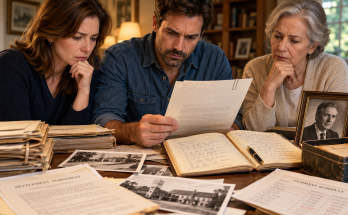
The prosecutor’s review began the following week. Aaron informed Ellie that the case file now contained the final genetic report, the handwriting analysis, the recovered discharge page, the forensic examination of the original identification bands, the financial timeline, Helen Price’s statement, Laura’s correspondence, and Daniel’s recorded admissions. The evidence had been organized into a chronology so that the prosecutor could distinguish the original hospital events from the later efforts to conceal them.
The review would take time, and Aaron warned Ellie not to expect an immediate resolution. Some conduct might support criminal charges, while other actions could be addressed through civil proceedings or the trust’s independent administration. The legal process would also need to consider the rights of the people whose records had been altered and the proper handling of the trust’s assets.
Ellie understood that the case could not be resolved by a single dramatic confrontation. The truth had emerged through careful examination, and its consequences would require the same patience. She had spent her life believing that a family could be defined by the names written on official documents. Now she knew that documents could be manipulated, signatures could be misrepresented, and a child’s identity could be treated as a means to an end.
Rebecca arranged for an independent trust administrator to review the original terms and determine how the beneficiary clause applied to the established relationships. The clause referred to the first biological child born to Clara Mercer, but it did not clearly explain what should happen if the hospital’s records had been deliberately falsified and the intended beneficiary could not be identified at the time. The court would need to interpret the clause in light of the original trustee’s instructions and the verified evidence.
Eleanor told Ellie that she did not want the trust to become another reason for the sisters to be divided. “If the court decides I’m entitled to something because I’m Clara’s biological daughter, that’s one question. It doesn’t mean I want the house or that I think you should lose it.”
Ellie was relieved to hear her say it, though she knew neither sister could decide the trust’s legal outcome on her own. “I don’t want the money to determine what we are to each other. We’ve spent enough of our lives being treated like names on a schedule.”
The independent administrator confirmed that the trust’s property would remain protected while the review continued. The disputed deed for the pump-house strip would not be accepted as evidence of Daniel’s ownership, and the lender’s file would be included in the legal assessment. The house itself would remain in the estate until the court determined the proper disposition, but Ellie would be permitted to stay there under a temporary arrangement.
For the first time since Daniel’s return, Ellie could make plans without expecting a moving truck to appear at the end of the drive. She began repairing the back gate and clearing the garden beds Samuel had neglected during his final illness. The work was ordinary and reassuring. It reminded her that the house had been a home long before it became a repository for evidence.
Laura agreed to meet Ellie in person after several more phone calls. They chose a quiet public garden halfway between their locations, with Aaron aware of the meeting but not present. Ellie arrived early and waited near a stone bench, carrying no documents and no questions written on paper. She wanted to meet Laura as a person rather than as the next witness in the investigation.
Laura approached slowly, holding a small handbag with both hands. She was older than Ellie had imagined, with silver beginning to show at her temples and a cautious expression that softened when she saw Ellie standing. For several seconds, they looked at each other without moving. Ellie noticed similarities in their eyes and the shape of their mouths, but she also knew that resemblance could not account for the years between them.
“Hello,” Laura said.
“Hello.”
Laura began to apologize, but Ellie shook her head gently. “We don’t have to start with apologies. We can start by sitting down.”
They walked to the bench and sat with a little space between them. Laura told Ellie about the years after the hospital, the jobs she had taken, and the places she had lived. She spoke about the uncertainty without claiming to have understood everything. She had believed at different times that the hospital had made a mistake, that the family raising the child had been told the truth, and that she might never learn what had happened. Each belief had been based on something someone had told her, not on evidence she could verify.
Ellie told Laura about Samuel. She described the garden, the study, the stories he used to read aloud, and the way he always checked the locks before bed. She also told her about the letters and the hidden notebook, about the day she learned that her biological mother might be alive, and about the anger she felt when she discovered how long the truth had been withheld.
Laura listened without trying to defend Samuel or condemn him. “I don’t know what he believed,” she said. “I can only imagine that he was afraid. But I’m sorry that you had to discover all of this after he died, when you couldn’t ask him questions directly.”
“I am too,” Ellie replied. “I love him. I’m angry with him. I don’t know how to separate those feelings, and I’m not sure I have to.”
Laura nodded. “You don’t.”
They spoke for nearly two hours. Laura showed Ellie a copy of the small hospital photograph she had preserved. It depicted a newborn wrapped in a pale blanket, with no visible identification label. The photograph could not establish the child’s identity, but it had been the one tangible connection Laura had kept through the years. Ellie looked at it carefully, then returned it to her mother.
“Would you like to keep a copy?” Laura asked.
“Yes, if that’s all right.”
Laura promised to send one. Before they parted, she asked whether Ellie might be willing to meet again. Ellie said she would, though she wanted to move slowly. They were not going to recover decades of lost time in a single afternoon, and neither of them wanted to pretend otherwise.
When Ellie returned home, Eleanor was waiting in the kitchen. Ellie told her about the meeting, including the photograph and Laura’s memories. Eleanor listened, then admitted that she had been nervous about the sisters becoming close to Laura in different ways. She worried that her own relationship with Clara would become more complicated if Ellie found a place with Laura.
“I don’t want you to feel you have to choose,” Ellie said. “You’re Clara’s daughter. I’m Laura’s. We’re sisters. None of those facts has to cancel another.”
Eleanor smiled faintly. “I think I’m beginning to understand that.”
The prosecutor’s office contacted Aaron the next day. The review had identified sufficient evidence to pursue formal action related to the falsified consent document, the concealment of hospital records, and the attempted property claim. The prosecutor was also examining the financial transfers and the role of Peter Lang and Martin Hale. No final decision had been made about every possible charge, but the case would proceed rather than being closed as an unresolved family dispute.
Aaron told Ellie that Daniel’s cooperation had not prevented the review. His admissions had helped establish the timeline, but the independent documents remained central. Lang’s account was being checked against the archived records, while Martin’s conduct would be examined separately. The prosecutor intended to avoid treating the entire scheme as the work of a single person when the evidence showed several distinct decisions and responsibilities.
Daniel sent Ellie a letter through his attorney. It was short, without legal language or references to the trust. He wrote that he had believed he could contain the hospital problem until it no longer threatened the family. He admitted that he had used the trust as a reason to delay telling the truth and that he had allowed Ellie to believe Laura had abandoned her. He did not ask for forgiveness, but he said he understood why Ellie might never trust him again.
Ellie read the letter twice. It was the closest Daniel had come to acknowledging the harm he had caused, but she could not tell whether the admission came from genuine understanding or from the realization that the evidence had left him little room to deny it. She did not respond immediately. She placed the letter in the case folder and decided that any future conversation would have to happen on her terms.
The house began to change as Ellie stopped treating every room like a crime scene. She kept the study and the evidence cabinets secure, but she opened the curtains, repaired the broken latch on the back door, and brought fresh flowers into the kitchen. The blue ledger and hospital records had been copied and transferred to the appropriate authorities. The originals were no longer hidden in the walls or tucked beneath floorboards. They were documented, preserved, and available for examination.
Rebecca visited one afternoon to review the temporary property arrangement. She told Ellie that Samuel had left no instruction requiring the house to remain a private archive forever. His final letters showed that he wanted the evidence preserved until the identities could be established, not that he wanted the home to become a monument to the dispute. Once the legal review concluded, Ellie would have choices about what to keep, what to share, and how to use the property.
“What would you do?” Ellie asked.
Rebecca considered the question. “I would keep the parts of the house that matter to you and let the rest become a home again. You do not have to preserve every painful object to prove you remember what happened.”
Ellie began by clearing the kitchen table of legal folders and returning the sugar jar to its usual place. The gesture was small, but it marked a boundary between the investigation and her daily life. She would not erase what had happened. She would simply stop allowing every hour to be governed by it.
Eleanor visited more often. Sometimes they talked about the investigation; other times they cooked dinner, compared childhood photographs, or argued over which of Samuel’s old recipes had been written down incorrectly. Their bond grew through ordinary moments rather than through shared trauma alone. They were learning how to be sisters without making the mystery the center of every conversation.
One evening, they sat on the back steps as the sun sank behind the trees. Eleanor asked whether Ellie regretted opening the first envelope Samuel had left in the drawer.
“No,” Ellie said. “I regret that the truth was hidden. I regret that people made decisions for us. But I don’t regret finding out. If I had never opened that envelope, I would still be living inside a story that someone else wrote for me.”
Eleanor rested her head against Ellie’s shoulder. “Then maybe that’s what the house gave you. Not the answers themselves, but a way to start asking the questions.”
Ellie looked toward the study window, where the last light reflected off the glass. The house had remembered what its occupants tried to forget. It had held the letters, the ledger, the photographs, and the missing pieces until someone was ready to examine them. Now the records were out in the open, and the house no longer needed to carry the entire burden of the truth.
There would still be legal proceedings, difficult conversations, and decisions about the trust. Daniel would have to face the consequences of his choices. Martin and Lang would have to answer for their roles, and the hospital’s records would remain part of an official review. Ellie could not promise that every wrong would be repaired or every relationship restored.
But she could decide what happened next in her own life. She could meet Laura again. She could build a relationship with Eleanor. She could remember Samuel without pretending he had been perfect, and she could remain angry with him without denying the love he had given her. She could keep the house because it was her home, not because it was the final piece of evidence in someone else’s scheme.
Before going inside, Ellie looked once more at the garden Samuel had planted. Some branches were tangled, some beds needed work, and a few flowers had withered beyond saving. But new growth had begun along the fence where the soil had been cleared.
For the first time, the house did not feel as though it were waiting for someone to return and claim it. It felt as though it belonged to the people who were finally willing to live honestly within its walls.
Click here to continue reading: PART 33: The Price of the Truth
The Morning My Parents Returned, They Brought a Moving Truck and a Lawyer Who Wouldn’t Meet My Eyes
Part 32 of 35