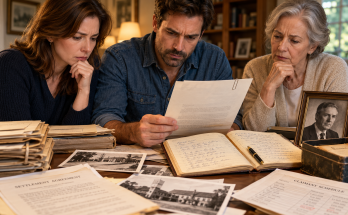
I read Peter Lang's letter three times before I could accept that the words were actually there. You took the wrong child home, and Samuel knows it. The sentence was short, but it seemed to reach backward through every memory I had of Grandpa, turning familiar moments into questions I had never thought to ask.
Rebecca took the letter from the evidence sleeve and examined the handwriting through the clear plastic. Aaron Bell had already photographed it, recorded its location among Lang's papers, and arranged for the document to be authenticated. None of us was permitted to handle the original without supervision.
"Could Lang have been mistaken?" I asked.
"Certainly," Rebecca replied. "The letter establishes that he believed Samuel took the wrong child. It doesn't establish that he was correct."
"But he kept the photograph of the baby with the white bracelet."
"Which may explain why he believed it. We still need to determine whether the bracelet number remained attached to the same infant."
Eleanor stood beside the dining table, looking at the two photographs. She had placed her own hospital bracelet next to the picture of the baby with the crescent-shaped birthmark. Her expression was distant, as though she were comparing the face in the photograph with a memory that had never belonged to her.
"If that baby was me," she said, "then Grandpa may have taken you home believing he was saving me."
I looked at her.
"And if the bracelet had already been changed, he might have taken me home believing I was you."
Neither possibility offered comfort.
Aaron explained that the letter would become part of the investigation into the altered records and the trust. He also wanted to interview Margaret again, this time with the photograph and the letter available for comparison. Margaret had agreed to cooperate, although she was understandably reluctant to revisit the events that had forced her to leave Saint Agnes.
Before Aaron departed, I asked him whether my father knew about Lang's accusation.
"We don't know yet," he said. "But the date suggests Daniel received the letter shortly after the children were discharged. If he kept it, it could help establish what he understood at the time."
The investigator promised to examine Lang's correspondence for any evidence that Daniel had responded. Then he left with the documents secured in a case.
That evening, I sat alone in Grandpa's study. His glasses were still beside the newspaper on the desk, and a faint ring from his coffee mug remained on the wooden surface. I had spent the last several weeks searching this room for evidence of his secrets, but I had never considered that the secrets might include mistakes he had made while trying to protect me.
I opened the old photograph album again.
The picture of the newborn had been taken at Saint Agnes, judging by the faded hospital emblem stamped in the corner. Grandpa had written my name on the back, but the handwriting was younger and less steady than the writing in his final letters. He had probably labeled the photograph soon after bringing the baby home.
That label could have reflected what he had been told, not what he knew.
I searched the album for other photographs from the same period. There were pictures of Grandpa holding a baby in the garden, sitting beside a crib, and standing outside the hospital with a small blanket folded over his arm. None showed the baby's face clearly enough to compare it with the archival photograph.
At the back of the album, however, I found a photograph I had never noticed before. It showed Grandpa standing beside a woman outside the hospital entrance. Her face was turned away, but she wore the same yellow dress as the woman in the photograph of my parents.
Margaret.
On the reverse, Grandpa had written a date and a short note: The day we brought her home.
I stared at the sentence.
The date matched the day recorded on my birth certificate, but it was one day later than the date in the hospital register. If Grandpa had collected the baby after the records were altered, the photograph might show the moment the child was brought to the house.
I called Margaret.
She answered after several rings, sounding tired but alert. I described the photograph and read the note aloud.
"I remember that day," she said. "Samuel came to the hospital after the dispute. He was carrying a blanket, and he was furious. He said the records had been changed and that he would not leave either child in Daniel's control."
"Did he take one baby home?"
"Yes."
"Which one?"
Margaret was quiet for so long that I thought the call had dropped.
"He believed he was taking the child Daniel had tried to claim," she finally said. "But I never saw the baby clearly after the replacement bracelets were issued. I cannot tell you whether he took the right one."
"Did you warn him?"
"I told him the identification numbers might have been compromised. He said he understood, but he believed that leaving the baby there would be more dangerous than taking the risk."
I looked at the photograph in my hand.
"Did Grandpa know he might be taking the wrong child?"
"I believe he did."
The answer hurt more than Lang's letter.
Margaret explained that Grandpa had returned to the hospital twice after taking the baby home. On the second visit, he asked her whether the original bracelet numbers could be recovered from the nursery register. She told him that the register had been altered and that the discharge page was missing.
"He was devastated," she said. "He told me he had promised to protect a child whose identity he could no longer prove."
"Why didn't he tell me?"
"Because he loved you. He believed that if he raised you safely and corrected the records later, the uncertainty would never become your burden."
I pressed my fingers against my forehead.
"He knew the truth might be different from the story he told me."
"Yes."
I wanted to blame him. I wanted to ask why he had allowed me to grow up under a name he could not verify, why he had hidden the hospital bracelets, and why he had never explained the possibility that another child might have been taken from her family.
But I also remembered the way he had sat beside my bed when I was ill, the patience with which he taught me to read, and the quiet pride in his face when I graduated. Whatever mistake he had made at Saint Agnes, he had spent the rest of his life caring for the child he brought home.
That did not erase the deception. It made the truth harder to bear.
The next morning, Eleanor and I met Margaret at a small medical clinic where an independent specialist had agreed to examine the birthmark photographs. The specialist explained that the images were too old and too limited to establish identity conclusively, but the crescent-shaped mark was distinctive enough to justify further investigation.
Eleanor provided medical records from her childhood showing that the birthmark had been documented during a routine examination when she was four years old. The records described its location and approximate shape. The description was consistent with the mark in the photograph of the baby wearing bracelet 6142.
My childhood medical records contained no corresponding mark.
The specialist cautioned that the comparison was not a substitute for DNA testing, but it strengthened the possibility that Eleanor was the child originally assigned number 6142.
Margaret listened carefully.
"If the original bracelet number was accurate," she said, "then Eleanor may have been Laura's daughter, and Ellie may have been Clara's."
"But the discharge records were altered," I replied.
"Yes. And Samuel may have taken the child he believed he was protecting without knowing which mother had given birth to her."
Eleanor looked down at her hands.
"Then Daniel may have known all along that the child he wanted wasn't the one he received."
No one answered.
We had spent weeks assuming my father had altered the records to obtain the trust. The new evidence suggested that his actions might have begun with a different objective: securing a particular child, perhaps for reasons connected to the inheritance, then concealing the mistake when the plan went wrong.
The distinction mattered, but it did not excuse what he had done.
As we left the clinic, Margaret caught my arm.
"There's something I should have told you sooner," she said. "After Samuel brought the baby home, Daniel came to see me. He wanted to know whether I could prove which child had been discharged under each name."
"What did you tell him?"
"That I couldn't."
She looked toward the road.
"He said that if I couldn't prove it, then the child belonged to whoever could control the records."
My stomach tightened.
"Did he threaten you?"
"He told me to leave town and never speak about Saint Agnes again. A few days later, I received the money that helped me move."
The payment traced through Vale Holdings.
Margaret had accepted it because she believed Grandpa had arranged it to protect her. Now we knew that the money had traveled through a company connected to the disputed trust, but we still did not know who had authorized it or why.
I looked at Eleanor.
Our identities had been treated as negotiable pieces in a financial arrangement. Even the money meant to protect a witness had been routed through the same network that concealed the records.
For the first time, I began to wonder whether my father had been trying to erase the truth because he knew he had taken the wrong child home—or because he knew that, without the truth, he could claim either child as his own.
Click here to continue reading: PART 18: My Father’s Old Correspondence Revealed Why He Wanted One Particular Child, and the Answer Was Buried in the Trust’s Original Terms
The Morning My Parents Returned, They Brought a Moving Truck and a Lawyer Who Wouldn’t Meet My Eyes
Part 17 of 35