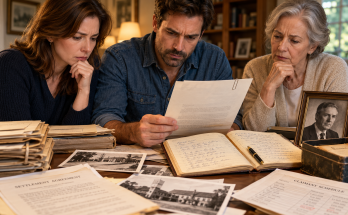
Martin Hale agreed to meet them that afternoon, but he insisted that the discussion take place in the conference room at his law office. When Ellie arrived with Rebecca and Aaron, she noticed that Martin had removed the framed certificates from the wall behind his desk and stacked several boxes beside a filing cabinet. He looked as though he had spent the morning preparing to leave, although his coat remained draped over the back of his chair.
“I assume you’ve received the final genetic report,” he said.
“We have,” Ellie answered. “It confirms what the other evidence suggested. Eleanor is Clara’s daughter, and I am Laura’s. Now we need to know who signed the agreement before the trust was frozen.”
Martin glanced at Aaron, then at Rebecca. “You found the message.”
“Someone sent it to Ellie shortly after the report arrived,” Aaron said. “We are treating it as an investigative lead, not as established fact. You can help us verify it by producing the complete agreement and explaining every signature.”
For several seconds, Martin said nothing. Then he unlocked a drawer and removed a thin folder wrapped in a faded paper cover. He placed it on the table but kept one hand resting on it. “This was prepared after the original trustee became concerned that the trust might be used to reward a beneficiary whose identity had been falsified. The agreement was supposed to preserve the property and the records until the correct child could be identified.”
“Who signed it?” Eleanor asked.
Martin opened the folder. Three names appeared beneath the agreement: Samuel Mercer, Thomas Rusk, and Martin Hale. A fourth signature, belonging to the original trustee, appeared at the bottom. Daniel’s name was absent, but a handwritten note in the margin referred to him as the person whose conduct had triggered the review.
Ellie studied Samuel’s signature. It was familiar from the letters he had left her, although seeing it beneath a legal agreement made her feel as though she were looking at a stranger’s handwriting. “My grandfather agreed to preserve the property, but he didn’t agree to hide my identity forever.”
“No,” Martin said. “He agreed to keep the house and the pump-house land outside Daniel’s control until the beneficiary could be identified. He believed that if Daniel gained access to the property, he would remove or destroy the evidence. Samuel’s mistake was believing he could protect you by keeping you away from the entire truth.”
Rebecca turned to the second page. It contained a clause requiring all parties to disclose any evidence of interference with the hospital records. Someone had crossed out the clause in blue ink and replaced it with narrower language about preserving the trust’s assets. The alteration had been initialed by Martin.
“You changed this,” Rebecca said.
“I did,” Martin replied. “I told myself the broader clause could expose the trust to litigation before the beneficiary’s identity was established. I wanted to keep the property safe. But I also wanted to protect myself from questions about the original trustee’s instructions and the money that had passed through my office.”
Aaron leaned forward. “Did Daniel know about the alteration?”
“He discovered a copy of the original agreement years later. He threatened to accuse me of concealing evidence and misusing trust funds unless I helped him obtain the beneficiary file. He knew I had made a serious mistake. I thought I could contain the damage by refusing to certify the altered records while still keeping the file from him.”
“You withheld the file from everyone,” Ellie said. “That left Daniel room to keep telling his version of the story.”
Martin lowered his eyes. “Yes.”
The admission hung in the room. Ellie had expected Martin to defend himself, to describe every choice as necessary and every omission as unavoidable. Instead, he seemed exhausted by the burden of having built his life around a decision he had never fully corrected.
Rebecca examined the final page. Attached to it was a bank instruction authorizing a transfer to a legal services company that had later paid Vale Holdings. The amount was larger than the fees listed in the official trust account. A handwritten reference identified the payment as a “records reconciliation expense,” the same phrase that appeared in the financial investigation.
“Who approved this transfer?” Aaron asked.
Martin turned the paper around. Beside the authorization was Thomas Rusk’s signature. A second signature appeared underneath, but it was partly obscured by a dark photocopy line.
“Nina may be able to recover the original banking image,” Rebecca said. “The copy is too poor to identify the second signer.”
Martin nodded. “I kept the original trustee’s correspondence in a separate archive. I never destroyed it. I thought it would be safer if no one knew it existed.”
“Safer for whom?” Ellie asked.
Martin did not answer immediately. He opened another folder and removed a letter addressed to him by the original trustee. The letter stated that no funds were to be transferred to Vale Holdings without written authorization from all parties, and that no individual could change the beneficiary schedule merely by producing a replacement birth certificate. The trustee had added a final warning: If Daniel Mercer seeks control of the house before the original identities are established, notify the court and the independent investigator.
“Did you notify anyone?” Aaron asked.
“No,” Martin said. “I believed I could manage Daniel privately. I was afraid the arrangement itself would be examined, including my changes to the agreement. I delayed until the trust was suspended, and by then I had convinced myself that silence was the only way to keep the property intact.”
Ellie felt anger rising, but beneath it was disappointment. Martin had been entrusted with the very documents that could have corrected the record. He had not created Daniel’s scheme, but he had allowed his own fear to become part of its protection.
“What about Rusk?” Eleanor asked. “His statement says he refused to sign a false memo. Yet his signature is on this payment authorization.”
Martin rubbed his forehead. “Rusk was complicated. He objected to the altered hospital records, but he also believed the trust would collapse if the dispute became public. He helped preserve some documents and concealed others. I think he was trying to buy time, but I cannot say what he intended when he authorized the transfer.”
Aaron asked whether Martin had any other communications with Rusk. Martin hesitated, then reached into the folder and produced a sealed envelope bearing Rusk’s name. It had never been opened. On the front, in Rusk’s handwriting, were the words: For the independent examiner if the children are ever identified.
Rebecca carefully inspected the seal. It appeared intact. Aaron photographed it before opening it, documenting its condition and the chain of custody. Inside was a short statement, several bank references, and a list of dates corresponding to the weeks when the hospital’s records had been altered.
Rusk’s statement admitted that he had authorized a payment described as a reconciliation expense after Daniel presented him with a document claiming both families had consented to the identity changes. Rusk said he had not verified the consent and had later discovered that Clara’s signature had been copied from another form. He had preserved the original payment record but failed to report the forged consent immediately.
The statement also named Peter Lang as the person who collected the hospital correspondence. Lang had claimed he was acting under instructions from the trust’s legal representatives, but Rusk had never received written confirmation of that authority. The original discharge page disappeared soon afterward.
“So Rusk helped the concealment,” Ellie said, “even though he later tried to preserve evidence of it.”
“That is what the documents indicate,” Aaron replied. “We’ll need to corroborate the statement and examine the payment records. His death doesn’t remove the need to distinguish what he admitted from what the evidence independently proves.”
Martin handed over the folder without another objection. He signed a receipt acknowledging that the original agreement and correspondence were being transferred to Aaron for examination. Rebecca made copies for the trust’s legal file, while Eleanor photographed the pages that listed the dates and payment references.
Before they left, Martin spoke directly to Ellie. “Your grandfather trusted me to protect the evidence. I thought protecting it meant keeping it quiet. He understood eventually that the truth had to be preserved, but I continued to believe I could control when it emerged.”
“You controlled it for fourteen years,” Ellie said. “That was long enough to change people’s lives.”
“I know.”
Ellie did not forgive him, but she accepted the folder he offered. It contained the first direct evidence that the trust’s concealment had involved more than Daniel’s actions and Samuel’s silence. It also contained the trail to the missing money, the forged consent, and the person who had collected the original hospital records.
As they reached the corridor, Aaron’s phone rang. Nina Cole had located an archived bank image matching the transfer authorization. The second signature was not Martin’s, nor did it belong to Samuel. It appeared to be Peter Lang’s.
Aaron stopped walking. “If Lang signed the authorization, then he may have been more than a courier.”
Ellie looked back toward Martin’s closed office door. The arrangement had been designed to protect the truth, yet every person entrusted with it had made a different compromise. Now the documents were finally moving into the open, and the next question was no longer who had altered the records.
It was who had paid to make sure they stayed altered.
Click here to continue reading: PART 23: The Money That Changed Hands
The Morning My Parents Returned, They Brought a Moving Truck and a Lawyer Who Wouldn’t Meet My Eyes
Part 22 of 35