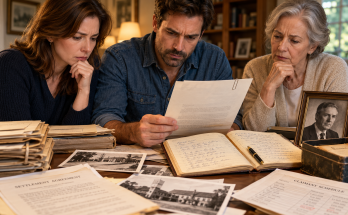
Nina Cole arrived at Aaron’s office the following morning carrying two binders, a laptop, and a paper cup of coffee that had gone cold before she set it down. She had spent most of the night comparing the trust’s financial records with archived banking data and the accounts connected to Vale Holdings. The results were more complicated than she had expected, but one pattern had emerged: the suspicious payments were not isolated transactions. They formed a sequence.
“Every transfer has a paper explanation,” Nina said, spreading copies across the conference table. “Legal review, record reconciliation, relocation expenses, property preservation. On their own, several of these payments look ordinary. The problem is the timing, the recipients, and the fact that the supporting documents were created or amended after the money moved.”
Ellie sat beside Eleanor while Aaron reviewed the first set of statements. One transfer went from the trust to a legal services company, then to Vale Holdings. A second payment reached an account controlled by Peter Lang. A third had been recorded as an expense for preserving the pump-house land, even though the corresponding work had never been completed.
“Was any of this money paid to Samuel?” Ellie asked.
“No evidence of that so far,” Nina answered. “The records show that Samuel paid legitimate legal expenses from his personal account on several occasions. Those payments appear to have been reimbursed through the trust, but the amounts match the invoices. I have not found a direct transfer to him that would support the claim that he profited from the scheme.”
Ellie felt a measure of relief, though it did not erase the fact that Samuel had concealed the truth. She had feared that his decision to keep the house might have been driven by money or personal gain. The evidence instead suggested that he had tried to preserve the property as a place where the original records could survive.
Nina pointed to a date on the first binder. “This transfer happened three days before the discharge record was altered. The recipient was a hospital administrative services company. Two days later, the hospital issued a replacement document using the altered identity numbers. The amount is too large for the stated administrative work, and there is no detailed invoice.”
“Who controlled the company?” Aaron asked.
“Officially, it was owned by a management firm. That firm was registered to a lawyer who had worked with Peter Lang. The lawyer denies knowing what the payment was for, but the account records show that most of the money was withdrawn shortly after it arrived.”
Eleanor leaned over the paperwork. “Could it have been payment for switching the bracelets?”
“It could have been connected to the record changes,” Nina said. “But the financial trail alone cannot prove what was purchased. We need messages, instructions, or testimony linking the money to a specific act.”
Aaron made a note to request the company’s archived correspondence and to interview the lawyer again. The investigation had to establish not only where the money went, but who knowingly authorized it and why.
The next document was a receipt signed by Peter Lang. It stated that he had collected original hospital correspondence on Daniel’s behalf. The date matched the week the missing discharge page was last recorded in the archive. Beneath the signature, Lang had written a short instruction: Deliver sealed materials directly. No duplicate copies.
“Was this receipt among the documents we found in Daniel’s safe-deposit box?” Ellie asked.
“No,” Aaron said. “It was in Martin’s archive, attached to Rusk’s statement. That suggests at least one person preserved a copy of the collection record after the original documents disappeared.”
Nina opened the second binder and removed a list of payments to Margaret Vale. The transactions had initially looked suspicious because they were routed through a company linked to the trust. But the amounts matched relocation costs, legal advice, and a series of small payments made after Margaret left town.
“Those transfers appear to have been intended to support Margaret while she was away,” Nina explained. “I have found no evidence that she received money to change her testimony. In fact, the payments stopped shortly after she refused to sign a statement claiming both families had approved the switch.”
Ellie remembered Margaret sitting across from her in the café, describing the night when the bracelets were changed. Margaret had carried guilt for years, but the records now supported her claim that she had resisted the deception. The payments had helped her survive, yet their opaque route had made her look complicit.
“Could Daniel have arranged the relocation to keep her safe and still used the payments to hide what happened?” Eleanor asked.
“Yes,” Nina replied. “Those motives are not mutually exclusive. We need to avoid turning every action into proof of innocence or guilt. The evidence shows Margaret was relocated, but the reason must be established from the communications and testimony.”
Aaron placed the payment schedule beside Martin’s agreement. “The critical period is the week Daniel and Samuel separated from the original records. We need the complete timeline. Who accessed the hospital archive, who approved the payments, who collected the documents, and when the trust learned the beneficiary identities could not be verified.”
Nina showed them a spreadsheet she had reconstructed from bank timestamps and archived transaction notices. It indicated that the administrative payment had been authorized by Rusk, processed through the legal services company, and partially transferred to Vale Holdings. A separate instruction had been signed by Peter Lang. The surviving copy did not prove whether Daniel had personally approved the payment, but Lang’s receipt and correspondence connected him to the collection of the records.
“There’s one more item,” Nina said. “The trust paid for a property survey of the pump-house strip. The survey was completed, but the deed filed afterward described a larger parcel than the survey covered. That larger parcel was later used as collateral in a loan application associated with Daniel.”
Ellie recalled the forged property deed and the way Daniel had treated the house as though it were already his. The land had never been merely a family asset. It was a leverage point: if Daniel could claim ownership of the strip, he could pressure the trust and potentially force the sale of the house where the evidence remained hidden.
“Was the loan approved?” Eleanor asked.
“No,” Nina said. “The lender flagged a discrepancy between the deed and the survey. The application was withdrawn before funds were released. But the deed was still used to make a claim against the property, and that could be relevant to proving intent.”
Aaron arranged for the lender’s file to be preserved. He also asked Nina to prepare a financial timeline that could be shared with the prosecutor reviewing the case. The purpose was not to prove every element through accounting records, but to show how the money, documents, and property claims converged around the same period.
While Nina worked, Ellie stepped into the hallway and called Clara. She had avoided speaking to her mother since the DNA report arrived. The word mother still felt uncertain when applied to Clara, even though Clara had raised her for the first five years of her life. Their relationship was built on a shared history that the genetic findings had complicated but not erased.
Clara answered after several rings. “I heard the report came in,” she said quietly.
“It did. Eleanor is your daughter. I’m Laura’s.”
A long silence followed. “I’m sorry,” Clara finally said. “I know I have said it before, but I am sorry I let Daniel tell me what I wanted to believe. I was frightened of losing the child I had been raising, and I convinced myself that asking questions would only make everything worse.”
“You were frightened,” Ellie replied. “But I was a child. I needed the adults around me to find out who I was, not to decide that it was safer not to know.”
“I understand that now.”
Ellie wanted to ask whether Clara had ever looked at her and wondered if she belonged to someone else. Instead, she asked whether Clara remembered the hospital paperwork Daniel had brought home. Clara said she had signed a form believing it confirmed the family’s consent, but she had not read every page. The signature on the altered consent document, she said, did not look like the one she remembered making.
“Keep any original papers you still have,” Ellie told her. “Aaron may need them.”
“I will. And Ellie?” Clara’s voice broke. “I know the report changes what you can call me. But I hope it doesn’t mean I have to become a stranger to you.”
Ellie closed her eyes. “I don’t know what it means yet. I’m not ready to promise anything, but I’m not saying you have to disappear from my life.”
When she returned to the conference room, Aaron had received a call from the prosecutor’s office. The financial timeline would be reviewed alongside the handwriting analysis and the final genetic report. The evidence now supported a formal inquiry into the falsified hospital records, the suspicious payments, and the attempted property transfer.
Then Nina turned her laptop toward them. She had found a final archived transaction linked to the legal services company. The payment had been divided into two amounts: one went to Vale Holdings, while the other was deposited into an account opened under the name of a company connected to Peter Lang. The account had been closed shortly afterward.
“Who withdrew the money?” Aaron asked.
Nina enlarged the scanned banking record. The signature on the withdrawal form was faint, but the account identification number matched an archived client file.
“Peter Lang,” she said. “And the date is two days after he collected the hospital correspondence.”
Ellie looked at the signature. It was the same sharp, slanted writing as the one on the receipt. It did not prove that Lang had changed the bracelets himself, but it placed him at the center of the financial and documentary trail.
Aaron gathered the papers. “We have enough to request a formal interview and seek any remaining records. Daniel’s involvement is increasingly supported, but Lang may be the missing link between the money and the physical removal of the documents.”
Ellie looked at the photograph of the infant with bracelet 6142. For so long, everyone had argued about which child the number represented. Now the number was less important than the people who had used it as a weapon, turning two newborns into competing entries in a trust document.
The money had moved from account to account, but the consequences had stayed with the children. One grew up believing she had been abandoned by her birth parents. The other was raised without knowing that her biological mother had been searching through a history she could not understand. And every payment had helped preserve the fiction that the paperwork was correct.
Click here to continue reading: PART 24: The Man Who Carried the Records
The Morning My Parents Returned, They Brought a Moving Truck and a Lawyer Who Wouldn’t Meet My Eyes
Part 23 of 35