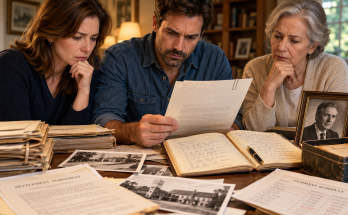
The legal office that had sent Laura the closure letter no longer existed under its original name, but Aaron located a successor firm that had inherited some of its archived files. The firm’s records manager confirmed that a box containing correspondence from the relevant period had been transferred to secure storage. The box included billing statements, client instructions, and copies of letters sent on behalf of the hospital and the trust.
Nina reviewed the financial records first. The payment described as “family matter closure” had been made by the legal services company connected to Peter Lang, then charged back to a trust-related account. The invoice described a review of hospital correspondence and preparation of a letter to Laura Vale. There was no record of a genetic test, a verified discharge record, or a meeting with the family raising the child.
“That means the letter told Laura the matter was resolved without evidence that the identities had actually been established,” Nina said. “It may have been a careless legal conclusion, or it may have been a deliberate attempt to stop her asking questions. The instructions will matter.”
Aaron requested the original client instruction. It had been filed under a reference number rather than a name, but the accompanying billing notes included the initials D.M. The first page instructed the legal office to state that the hospital had completed its review and that no further action was required. A second note said the child’s identity was “not to be discussed beyond the approved family arrangement.”
Ellie read the copy in Aaron’s office and felt the old anger return. Laura had received a letter that sounded official and final, even though the underlying documents remained incomplete. The legal office had used the authority of its letterhead to turn uncertainty into a conclusion. If Laura had continued asking questions, she would have been challenging not just Daniel’s account but a statement that appeared to come from the institution responsible for the records.
“Can we prove Daniel wrote these instructions?” Ellie asked.
“The initials are not enough,” Aaron replied. “We’ll compare the handwriting with his known letters and examine whether the file contains a signature or other authentication. We also need the legal office’s testimony about who provided the instructions and whether they were told the identities had been verified.”
The handwriting examiner compared the notes with Daniel’s correspondence to Peter Lang and the trust manager. The writing showed several similarities, including distinctive letter formations and spacing, but the examiner reserved a final conclusion pending analysis of the originals. Meanwhile, the firm’s former administrator agreed to an interview. She remembered receiving instructions from a man who said he represented the Mercer family and wanted the matter closed quickly.
“He told us the hospital had already settled the identity question,” the administrator said. “We were not asked to investigate the hospital records ourselves. We were asked to prepare a letter confirming that the matter had been resolved and that the family should not continue pursuing it.”
“Did you know the original discharge page was missing?” Aaron asked.
“No. We were given a summary that said the original records had been reviewed. We had no reason to assume the summary was false.”
The administrator produced a copy of the summary, which had been attached to the instruction. It stated that the hospital had reconciled the two infant records and that both families had agreed to the resulting placements. The summary contained no supporting documents and did not identify the person who had prepared it. A reference number in the corner matched a file held by Martin Hale.
Rebecca recognized the reference. It had appeared in Martin’s archive among the documents he had withheld for years. She contacted him and asked whether he knew who had prepared the summary. Martin said he had seen the document before but had believed it came from the hospital. He had not verified its origin, and he now acknowledged that he had relied on it when he decided not to release the beneficiary file.
“Everyone passed the responsibility to someone else,” Eleanor said when Rebecca told them. “Daniel said the hospital had corrected the records. The hospital said the families had agreed. The legal office said the matter was resolved. Martin said the file could not establish the beneficiary. And Laura was left believing she had no right to ask.”
Ellie nodded. “The lie survived because every person who received it treated the previous person’s claim as proof.”
Aaron’s team searched Martin’s archive again, this time using the reference number from the legal summary. They found a ledger entry that had not been included in the earlier financial analysis because the page had been folded beneath a binding strip. The entry recorded a payment for “identity reconciliation and correspondence closure.” Beside it was a notation indicating that the service had been approved by the trust’s original trustee, but the trustee’s surviving letters showed that he had refused to release the beneficiary funds until the identities were independently established.
Nina examined the ledger page and found that the entry had been written in a different ink from the surrounding transactions. The paper had not been replaced, but the writing appeared to have been added later. The handwriting examiner compared the entry with known samples from Martin, Daniel, and the original trustee. The preliminary assessment suggested that the entry was not written by the trustee whose approval it claimed to record.
Martin was asked to explain the entry. He admitted that he had added a note to the ledger after the payment was questioned, intending to clarify which account should bear the expense. He denied inventing the payment or forging the trustee’s approval, but he acknowledged that his annotation had made the transaction appear more formally authorized than it had been.
“I was trying to reconcile the accounts,” Martin said during his recorded statement. “The payment had already occurred, and I believed it had been made for legal work related to the trust. I should have recorded the uncertainty instead of making the entry look complete.”
Aaron asked whether Daniel had requested the annotation. Martin said Daniel had urged him to close the accounts and warned that an unresolved financial record could trigger an audit. Martin had believed the legal office’s letter supported the claim that the identity issue was settled. He now understood that the letter itself had been based on an unverified summary.
The new evidence did not make Martin the architect of the original identity switch, but it showed how his actions had helped the deception survive. He had withheld the beneficiary file, altered the agreement, and added a ledger note that made an uncertain payment appear properly authorized. His fear of exposure had led him to protect the arrangement rather than investigate it.
Rebecca told Ellie that the trust’s independent review would include Martin’s conduct and the questionable payments. The trust could no longer rely on the old beneficiary schedule, and the court would need to determine how its terms applied to the verified biological relationships. No funds would be released until that process was complete.
Ellie was less concerned with the money than with what the ledger revealed about the people who had shaped her life. The trust had given Daniel a motive, but the real harm came from the way he and others treated the children’s identities as pieces of a financial arrangement. The money did not create the uncertainty; it gave people reasons to exploit it.
The final page of the blue ledger contained an entry dated shortly before Samuel died. It recorded a small payment for document preservation and a note that the original hospital records had been returned to secure storage. Beside the entry, Samuel had written: Do not release until both identities are independently established. The house must not become the price of the truth.
Ellie recognized the handwriting immediately. Samuel had not been trying to sell the evidence or profit from it. He had been trying to preserve it until the truth could be established, though he had failed to share that burden with her. The final ledger entry also showed that he had continued paying for document storage long after the trust was suspended.
“Why didn’t he simply take the records to the authorities?” Eleanor asked.
Rebecca thought carefully before answering. “He may have believed that the original documents were incomplete and that a public accusation without proof would allow Daniel to challenge everything. He may also have feared losing control of the house and exposing you to a legal battle. Those concerns help explain his decision, but they do not make every part of it right.”
Ellie placed the ledger beside Samuel’s letter. She was no longer trying to decide whether he had been a good man or a bad one. He had been a person who loved her, made mistakes, and carried a secret he should not have carried alone. She could honor what he had done to protect the evidence without repeating his mistake of deciding what another person was allowed to know.
That afternoon, Aaron received the examiner’s final report on the legal instruction notes. The handwriting showed strong similarities to Daniel’s known writing, and the examiner concluded that Daniel was the probable author of the instructions that led to Laura receiving the closure letter. The report did not establish who had drafted the unverified summary attached to the instructions, but it placed Daniel directly in the effort to stop Laura’s inquiries.
Aaron forwarded the report to the prosecutor and arranged a follow-up interview. Daniel would be asked to explain the instruction and the claim that the hospital had completed a reconciliation. The evidence now suggested that he had not merely hidden records from the trust; he had also helped prevent Laura from learning whether her child had been correctly identified.
When Ellie heard the news, she sat alone in the study for a long time. She had wanted to believe that Daniel’s actions were driven by confusion and fear, that he had made one wrong choice and spent years trying to correct it. The new documents made that explanation harder to accept. He had known the records were uncertain, yet he had sent Laura a letter telling her the matter was resolved.
Eleanor came in and sat across from her. “You don’t have to decide what Daniel means to you now,” she said. “You can let the evidence establish what he did and decide later what, if anything, you want from him.”
Ellie looked at the ledger. “I used to think the truth would give me a single answer. One person to blame, one person to forgive, one explanation that made everything fit. But it keeps showing me that people can do something loving in one moment and something harmful in the next.”
“Maybe the truth isn’t supposed to make everyone simple,” Eleanor said. “Maybe it’s supposed to let us stop living inside the stories they made for us.”
That night, Ellie made a complete inventory of the records Samuel had left. She photographed each page, recorded where it had been found, and prepared a duplicate set for the independent legal review. She did not hide anything in the house, and she did not keep a document from Eleanor because she feared how Eleanor might react. For the first time, the evidence was being preserved through transparency rather than secrecy.
At the bottom of the inventory, Ellie wrote: The records belong to the truth, not to the person who found them. She signed her name beneath the sentence, then closed the ledger.
The final page had not solved every mystery, but it had exposed the mechanism that allowed the deception to continue. Daniel had supplied the false certainty. The legal office had given it official language. Martin had accepted it to protect himself. And the trust had become the reason everyone feared asking whether the records were true.
Now the ledger was open, the money was being traced, and the people who had once relied on silence were being asked to explain their choices in public.
Click here to continue reading: PART 32: The House Opens Its Doors
The Morning My Parents Returned, They Brought a Moving Truck and a Lawyer Who Wouldn’t Meet My Eyes
Part 31 of 35