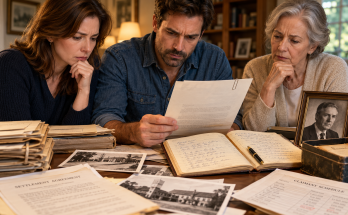
The laboratory report lay between Eleanor and me on the table, its pages neatly aligned, its language clinical and precise. There was no room in the document for the years we had lived under different names, the parents who had raised us, or the grandfather who had tried to protect a child whose identity he could not establish.
Eleanor was Clara's biological daughter.
I was not.
Those two facts were enough to overturn the story we had been told, but they did not yet establish who had given birth to me. The geneticist explained that the next step would be to compare my sample with a verified biological relative of Laura Vale. Margaret's relationship to Laura was documented, but the laboratory needed additional reference material before it could reach a reliable conclusion.
I asked whether the results could have been affected by contamination or a labeling error.
The specialist explained the safeguards used during collection and testing. The samples had been coded, independently checked, and processed according to standard procedures. The results were sufficiently strong to establish the relationship between Eleanor and Clara.
I looked at my mother, who had come to the meeting at my request.
She was crying quietly.
"I knew there was a possibility," she said. "I knew the records might be wrong, but I never imagined the truth would be this clear."
I wanted to comfort her, but I couldn't ignore the years she had spent avoiding the question. She had not created the altered records, yet she had allowed the uncertainty to remain hidden while I grew up believing I belonged to a family whose history had been deliberately rewritten.
Eleanor took my hand.
"Whatever the next test says, you are still my sister in the way we have become family through this," she said. "I don't want you to think that the result changes what we've built."
I appreciated the kindness, but I knew that our relationship was still new. We had met only days earlier, and much of our connection had been formed through shared confusion and the discovery of a common history. I could not ask her to replace the family she had lost with a bond neither of us had chosen.
"We don't have to decide what we are to each other today," I said. "We just have to find out the truth."
The geneticist arranged for additional testing using Margaret's sample and the available records concerning Laura's relatives. She also recommended that we obtain a certified copy of the original hospital register and the surviving medical records from the two mothers.
Aaron Bell helped us request the documents through the appropriate channels. He explained that the DNA evidence had strengthened the investigation, but the legal case still depended on establishing how the hospital records had been altered and who had benefited from the changes.
Nina continued tracing the financial transactions. She discovered that the beneficiary protection reserve had been transferred to an account controlled by a company that provided administrative services to Saint Agnes. The company had received money from Daniel's father before the births and made several payments to the hospital during the same period.
The payments did not prove that the hospital had participated in a deliberate exchange of children, but they established a financial connection that warranted further investigation.
One transaction was particularly troubling. It was dated three days before the births and described as a "records reconciliation fee." The amount was unusually large for an administrative service, and no corresponding invoice had been found.
Nina requested the company's archived records.
Two days later, she found a memorandum from the hospital administrator stating that the fee covered "special handling of family records and beneficiary documentation." The memo was signed by Thomas Rusk, the same supervisor who had approved the replacement identification bracelet.
The evidence suggested that Rusk had been involved in more than a routine correction. Whether he had understood the full purpose of the arrangement remained uncertain, but he had signed documents connected to the financial transaction.
Aaron asked the investigator to compare the memorandum with Rusk's later statement. The handwriting and signature appeared consistent, and the date matched the week the children were born.
I thought of Margaret's description of the hospital: the rushed staff, the frightened parents, the administrator who insisted that everything had been handled legally. Perhaps the deception had depended on a network of people, some knowingly involved and others willing to accept explanations that allowed them to avoid asking difficult questions.
But the evidence against my father was becoming harder to dismiss.
A letter from Daniel to Peter Lang stated that the trust could not be released until the child born to Clara was identified. Another document showed that Daniel had requested the original discharge records after the hospital dispute began. The altered schedule, the missing page, and the financial transfers all pointed toward a sustained effort to control the outcome.
I called my father.
He answered on the fourth ring.
"Ellie."
I had not heard him say my name in that tone before. It sounded almost gentle, as though he believed he could return to the role of a father simply by speaking softly.
"The DNA results are in," I said.
Silence.
"Clara is Eleanor's biological mother."
He exhaled slowly.
"Then the records have finally been corrected."
"No. The records still haven't been corrected. We know Eleanor is Clara's daughter. We don't yet know who gave birth to me."
"Your grandfather should never have taken you home."
The sentence struck me with such force that I had to sit down.
"You knew?"
"I suspected."
"You suspected that Grandpa had taken the wrong baby, and you let him raise me without telling anyone?"
"Samuel made his own decision. I didn't force him to keep you."
"You changed the records."
"I tried to protect the family."
"Which family?"
He said nothing.
I asked whether he had known that Eleanor was Clara's daughter before the DNA results. He admitted that he had believed it for years but had never been able to prove it. He had also believed that the trust would remain suspended until the original records could be recovered.
"Why did you want Clara's child?" I asked.
"Because the trust was intended for her child."
"Then why did you let me grow up believing I was yours?"
He sounded irritated now.
"Because the alternative would have destroyed everything."
"What alternative?"
He ended the call.
I stared at the phone, my hands trembling.
For years, I had imagined that my parents abandoned me because they didn't love me. The evidence suggested something more complicated and more disturbing. My father had been trying to control a trust, and the uncertainty surrounding my identity had become a tool he could use to keep the money within his reach.
He had not returned to reclaim a daughter.
He had returned to reclaim the outcome he believed he was owed.
Rebecca told Aaron about the call and documented my father's admission that he had suspected Grandpa took the wrong baby. The investigator warned us not to contact Daniel again until he could arrange a formal interview.
That evening, Eleanor came to the house. She brought a box of papers she had found among her adoptive mother's belongings. The documents included a letter from Laura Vale, written shortly before her death.
Laura had never named the father of her child, but she described the baby as having a small crescent-shaped birthmark near the left shoulder. The same mark appeared in the photograph of the infant wearing bracelet 6142.
The letter also referred to a promise made by Margaret.
If anything happens to me, make sure my daughter grows up knowing that she was wanted.
I read the sentence aloud, then placed the letter beside the photograph.
The evidence increasingly suggested that Eleanor was the child originally assigned number 6142, and that she had been born to Clara rather than Laura. But the birthmark and the altered records created another possibility: the hospital might have switched the babies before the identification numbers were attached, or the numbers might have been deliberately reassigned after birth.
The next test would have to resolve that uncertainty.
Margaret agreed to provide additional family records and help the laboratory locate a verified relative of Laura. A surviving cousin was found through the family tree, and the specialist arranged a comparison.
We waited four days.
On the fifth morning, the geneticist called.
The result was ready.
She explained that the comparison established a close biological relationship between me and Laura's family. The pattern was consistent with me being Laura's daughter, though the laboratory was preparing a final report to document the statistical findings and verify the family relationships.
I sat very still.
If the result held, then the child Grandpa had raised was not Clara's daughter. I was Laura's child, the baby whose mother had died before she could explain what had happened.
Eleanor was Clara's daughter, the child Daniel had wanted to claim for the trust.
We had been raised under identities that had been exchanged, and the deception had separated us from the mothers who gave birth to us.
The geneticist said the final report would arrive the next day.
I thanked her and ended the call.
Then I went to Grandpa's study and opened the drawer where I had found the first photograph. Beneath the empty envelope lay another folded note, one I had overlooked because it was tucked into the narrow space beside the drawer runner.
The note contained a single sentence in Grandpa's handwriting.
If the tests prove Ellie is Laura's daughter, tell her I am sorry I could not return her to her mother.
Click here to continue reading: PART 20: My Grandfather’s Final Apology Revealed the Promise He Had Broken, and My Father’s Last Chance to Tell the Truth Was Slipping Away
The Morning My Parents Returned, They Brought a Moving Truck and a Lawyer Who Wouldn’t Meet My Eyes
Part 19 of 35