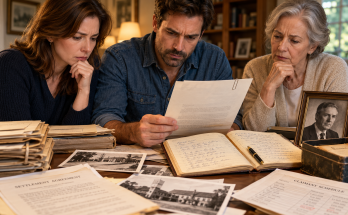
The call came just after eight the following morning. Ellie was standing in Samuel’s kitchen, holding a mug of coffee she had forgotten to drink, when Aaron Bell told her that the investigators had opened the archived box recovered from Peter Lang’s storage facility. Most of the contents were ordinary legal correspondence, but one sealed envelope bore the Saint Agnes case number and a handwritten notation matching the reference in Samuel’s final letter. Inside, they had found several original hospital documents, including a discharge record that might be the missing page.
“Is it the original?” Ellie asked.
“We’re treating it as a potential original until the examiner finishes comparing it with the hospital’s surviving records,” Aaron replied. “The paper, ink, and typeface are consistent with the period. The document also has a fold and a damaged corner that match a description in an old inventory. But we need to establish where it came from and whether anything has been altered.”
Ellie closed her eyes. For weeks, the investigation had moved through scraps of paper, faded photographs, handwritten notes, and bank statements. Every answer had produced another question. Now the missing page might finally connect the hospital’s original record to the people who had carried the two babies away. She asked Aaron whether she and Eleanor could examine a copy once the document had been authenticated.
“Absolutely,” he said. “But I want to warn you that the page may not identify the children as clearly as you hope. It could show who signed for the babies without establishing whether the bracelets were correct. We need to keep the difference between a record of what someone did and proof of what was biologically true.”
After the call, Ellie contacted Eleanor. Her sister arrived at the house within half an hour, still wearing the coat she had pulled on over her work clothes. She had been sleeping badly since receiving the genetic report, caught between the relief of finally knowing who her mother was and the sorrow of imagining what Clara had endured. Ellie told her about the recovered envelope, and Eleanor sat at the kitchen table without removing her coat.
“If the page proves Samuel took you home, that still won’t tell us whether he knew who you were,” Eleanor said.
“No,” Ellie answered. “But it might tell us who handed him the baby and what they believed they were doing.”
They waited until Aaron called again. In the meantime, Ellie searched Samuel’s study for anything that might clarify his final movements around the hospital records. She found his old appointment book in a cabinet beneath the desk. Most entries were ordinary: repairs, legal meetings, medical appointments, and visits to the bank. But several entries from the months after the births had been marked with the initials T.R., followed by dates and short phrases such as copy received, original retained, and not safe to discuss at home.
Eleanor leaned over the book. “T.R. must be Thomas Rusk.”
“That’s what I think,” Ellie said. “Samuel kept meeting him long after the hospital incident. Maybe Rusk was trying to correct what he had done.”
One entry, dated nearly a year after Ellie’s birth, stood out. Samuel had written: Rusk confirms the register is incomplete. No proof of discharge identity. Do not let Daniel see the copy. Beneath it, in different ink, someone had added a single word: Lang.
Ellie photographed the page and sent it to Aaron. He replied that the notation could be important because it placed Lang in Samuel’s awareness earlier than the recovered receipt had suggested. It did not prove Samuel knew Lang had taken the discharge page, but it showed he had been concerned about Lang’s access to the records.
By late morning, Aaron sent a secure copy of the recovered document. The page had been photographed beside a scale and reference marker, and the examiner’s preliminary note appeared on the first sheet. The paper was consistent with Saint Agnes’s forms from the relevant year. The printed hospital heading and form number matched a surviving blank form. The signatures and handwritten entries still required comparison.
Ellie opened the image. At the top were two discharge entries, one for a baby identified by the number 6142 and another for a baby identified by 6143. The names beside the numbers were faint, partly obscured by a crease. One line listed Laura Vale as the mother; the other listed Clara Mercer. The discharge column contained initials, a date, and a notation indicating that both babies had been released within a short interval.
Below the entries was a separate authorization box. The signature beside it was Thomas Rusk’s. Another signature appeared beside a note that read: Identity correction acknowledged; original bands retained for verification. The words looked innocuous at first, but the handwriting examiner had highlighted the phrase because the ink appeared different from the surrounding entries.
“What does that mean?” Eleanor asked.
“It sounds like the hospital was supposed to preserve the original bands so someone could verify which child was which,” Ellie said. “But if the bands were switched, the verification would only work if the original labels and the babies had stayed together.”
The page contained one more notation, written at the bottom in a different hand: Mercer collection authorized pending reconciliation. There was no first name, no explanation of the authorization, and no explicit statement of which baby had been given to Samuel. The document suggested that Samuel had collected a child under an arrangement approved by Rusk, but it did not settle whether the hospital had handed him Laura’s daughter or Clara’s.
Aaron called shortly afterward. The handwriting examiner had compared the disputed phrase with Rusk’s known writing and found strong similarities, but the second signature was more difficult to identify. The examiner was examining samples from Lang, Daniel, and hospital staff. Meanwhile, Aaron had asked the hospital’s surviving records custodian to search for a transfer log that might identify who removed the page from the archive.
“Does it help Daniel’s case?” Ellie asked.
“Not in the way he might claim,” Aaron replied. “The page shows an identity correction was recorded, but it doesn’t show the correction was legitimate. In fact, the note about retaining original bands raises a question: if the hospital believed everything had been corrected properly, why was there a need for later reconciliation?”
Ellie understood. Daniel might argue that the page proved the hospital had recognized a mistake and authorized the changes. But it could just as easily prove that someone knew the identities remained uncertain and had promised to preserve evidence that would resolve the uncertainty. The distinction would depend on the surrounding records and the people who had handled them.
Aaron asked them to come to his office that afternoon. When they arrived, Rebecca was already there with copies of the trust agreement and Martin’s newly surrendered correspondence. Aaron had placed the discharge page beside the original register and the financial timeline. A clear line connected the hospital records, the administrative payment, Lang’s collection receipt, and the trust’s later suspension.
“We have a sequence,” Aaron said. “Rusk authorized a reconciliation process. Daniel supplied or relied on consent paperwork that appears to have been falsified. Lang collected original correspondence. The page disappeared from the hospital archive. Payments were made through an administrative company and routed onward. And years later, Daniel tried to use the property deed to gain leverage over the trust.”
“Can you prove they all acted together?” Rebecca asked.
“Not yet. The evidence supports a coordinated pattern, but we still need to distinguish the people who knowingly participated from those who were negligent, pressured, or misled.”
Eleanor studied the recovered page. “Where does Samuel fit?”
Aaron turned to the appointment-book photograph. “It appears he was trying to preserve copies of records while avoiding Daniel’s access. He may have believed that the only way to keep the evidence safe was to keep the original question unresolved until someone could prove the identities independently.”
Ellie thought about the years Samuel had spent at the house, protecting the notebook and ledger, hiding letters, and leaving instructions for a future he hoped he would never have to explain. She could now see the difference between protecting evidence and protecting a person. He had done the first, but his silence had harmed her in the second.
Rebecca pointed to the notation about the original bands. “If those bands were preserved, they may still exist somewhere. Did Saint Agnes have a policy for storing them?”
Aaron said the hospital had closed its maternity unit years earlier, and most records had been transferred to a regional archive. Physical medical artifacts were not routinely preserved for decades, but the examiner had found a reference to a sealed evidence packet in the administrative correspondence. The packet was listed as transferred to an off-site archive during a later records consolidation.
“Is there an inventory?” Ellie asked.
“There is a reference number, but no confirmed location yet. We’ve requested the transfer records.”
The recovered page had opened another door. If the original bracelets survived, they might clarify which child had worn which number at discharge. They still would not replace DNA evidence, but they could establish how the hospital’s identification process had failed and whether anyone had deliberately moved the labels.
Before they left, Aaron showed Ellie a final item from Lang’s box: a short note addressed to Daniel, dated several days after the missing page disappeared. It read, The original is secured. Do not request it through the hospital again. Any further attempt will create a record of your involvement.
The note had no signature, but the handwriting resembled Lang’s. Aaron cautioned that the comparison was preliminary. Even so, the message suggested that whoever wrote it understood that the original page could implicate Daniel if he continued trying to obtain it.
Ellie felt the old anger return, sharper now because the evidence was no longer abstract. Someone had taken a page that could have helped identify two newborns and hidden it to protect a scheme. Daniel had then returned to the house, acting as though the property and the family’s history belonged to him.
“He knew we might find the truth,” Ellie said. “That’s why he came back for the house.”
“Possibly,” Aaron replied. “The evidence points in that direction, but we’ll need to establish his intent through the correspondence and financial records. What matters now is that the page survived, and we can examine it without relying on anyone’s memory.”
That evening, Ellie returned to the study and placed Samuel’s final letter beside a copy of the recovered discharge page. The two documents belonged to different stages of the same story: one written by a man who had tried to protect a child by keeping the truth hidden, the other created by an institution that had allowed identity to become a negotiable entry in a register.
She did not know whether the original bands would ever be found, or whether the second signature would be identified. But for the first time, the investigation had moved beyond reconstructing the past from fragments. The missing page had returned, and its words were finally being read by people determined to understand what they meant.
Click here to continue reading: PART 26: The Names on the Original Bands
The Morning My Parents Returned, They Brought a Moving Truck and a Lawyer Who Wouldn’t Meet My Eyes
Part 25 of 35