The diner wasn't much to look at.
I could tell that before we reached it.
A low roadside building.
An old sign.
Gravel instead of pavement.
The kind of place where the air conditioner had to work harder than it should.
I had stopped at hundreds of places like it.
Most were forgotten before I reached the next town.
This one stayed with me.
I still remember the sign.
MAGGIE'S ROADHOUSE DINER.
The lettering had faded.
The sign leaned between two rusted supports.
Beneath the name, someone had painted three simple promises.
COFFEE.
PIE.
BREAKFAST ALL DAY.
That was enough for me.
After hours on the road, I wasn't looking for anything special.
I wanted coffee.
A place out of the sun.
A few minutes without the engine vibrating beneath me.
Nothing more.
Mason had been the one to point it out.
I saw his signal.
Then I looked toward the building.
It sat just beyond the highway.
Easy to miss.
Easy to pass.
I eased off the throttle.
The engine responded immediately.
I checked the road.
Then I lifted one hand.
The men behind me understood.
I didn't need to turn around and explain.
We had ridden together enough to know the signals.
The formation began to shift.
Seven motorcycles.
One after another.
Moving away from the highway.
I could feel the difference as soon as we reached the gravel.
The road surface changed beneath the tires.
The sound became rougher.
Small stones moved under the weight of the bikes.
Dust lifted behind us.
I kept my speed low.
There was no reason to hurry.
We were stopping for coffee.
I looked toward the diner entrance.
The building seemed tired.
Not abandoned.
Not empty.
Just old.
The sort of place that had weathered years of sun and passing traffic.
A road sign stood nearby.
The paint had lost its brightness.
I wondered how long the diner had been there.
Then I forgot the question.
It didn't matter.
The gravel required my attention.
I guided the motorcycle into the parking area.
Behind me, the others followed.
One by one.
Engines rumbling.
Tires shifting over pale stones.
I could hear the different sounds of the motorcycles even through my helmet.
That was one of the things years of riding had taught me.
Machines developed their own voices.
You learned them.
You noticed when something changed.
I had spent enough time as a mechanic to trust those sounds.
A slight difference could tell you when something needed attention.
But nothing seemed wrong with the bikes that afternoon.
We were just stopping.
I brought mine into position.
My hand settled on the controls.
I turned off the engine.
The sound ended beneath me.
The other engines kept running for another moment.
Then one went quiet.
Another.
Another.
Until all seven were silent.
I liked that part of a ride.
Always had.
There was a strange feeling when the engines stopped.
A second before the world returned.
When your body still seemed to carry the vibration.
When the road was no longer moving beneath you.
When everything around you seemed unusually still.
That afternoon, the silence was broken by ordinary sounds.
Cicadas.
The rattle of an aging air conditioner.
A screen door squeaking somewhere behind the building.
I could hear the heat in the insects.
That's how it felt.
The sun pressed down on everything.
The gravel looked pale.
The highway shimmered beyond the lot.
I stayed seated.
Just for a moment.
I had developed the habit years earlier.
Finish the ride.
Let the engine go quiet.
Take a second.
Then get off.
I didn't know why I liked that pause so much.
Maybe because so much of my life had been spent rushing from one bad decision to another.
Maybe because I had learned the value of doing nothing for a few seconds.
Or maybe because the silence gave me a chance to remember I had arrived somewhere safely.
Whatever the reason, I stayed there.
One boot near the ground.
My hands resting on the handlebars.
The leather vest warm against my back.
I could feel the afternoon sun on my shoulders.
I looked toward the diner again.
Nothing about it announced what was waiting.
The old sign.
The windows.
The entrance.
That was all I noticed.
I didn't see the situation the way I would later remember it.
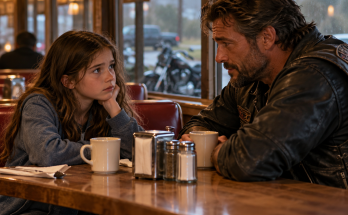
I didn't understand that a child had spent her morning there.
Waiting.
Watching.
Holding her money.
Looking for a stranger she believed might help her mother.
Ava Miller.
Eight years old.
Her cheek was bruised.
Seven dollars and forty-three cents in her fist.
I didn't know how she had chosen that amount.
I didn't know whether she had counted it more than once.
I didn't know what she expected a biker to charge.
Those details weren't mine to invent.
What I knew afterward was simple enough.
She had the money.
She had waited.
And she wanted to hire a biker.
A little girl trying to arrange protection with the savings she could carry in one hand.
Even now, that thought makes me uncomfortable.
Because I knew what it meant to make bad choices when you were frightened.
I had done it as a grown man.
More than once.
I had reacted to pain with anger.
To shame with drinking.
To disappointment with promises I didn't keep.
But Ava's decision wasn't the same kind of thing.
She wasn't looking for trouble.
She was trying to find help.
And she was doing it in the only way she believed might work.
I wondered afterward what she thought when the motorcycles came into the parking lot.
Seven of them.
Engines loud enough to hear before the riders appeared.
Men in leather vests.
Dark helmets.
Tattooed arms.
I wondered whether she was relieved.
Or frightened.
Or both.
I never forgot the contradiction.
Her mother had warned her against strangers like us.
Yet Ava had gone looking for one.
I had spent years being the kind of man mothers warned their children about.
And years afterward trying to prove that a frightening appearance did not have to mean a frightening heart.
Those two histories were approaching each other in a gravel parking lot.
Neither one of us had planned it.
I thought about the money again.
Seven dollars.
Forty-three cents.
I had wasted more than that without even remembering what I bought.
There had been years when I treated money like something that would always come back.
Something to spend without thinking.
Something that could smooth over problems if I had enough of it.
I had been wrong.
Money could pay a bill.
It could buy a meal.
It could replace a broken part.
But there were things it couldn't repair.
I knew that because I had spent years wishing I could buy back one ordinary afternoon with Lily.
Just one.
A chance to listen.
A chance to be present.
A chance to let her remember me differently.
There wasn't enough money in the world for that.
Ava had seven dollars and forty-three cents.
And whatever she wanted from a biker mattered enough that she had stood waiting through the morning.
I don't need to imagine anything more to understand how desperate that was.
She was a child.
She shouldn't have been responsible for finding protection for her mother.
Adults should have noticed.
Adults should have helped.
But somehow she had reached the point where her plan involved hiring a stranger.
A man on a motorcycle.
A man whose vest looked frightening.
A man who might have ridden right past.
I don't know what would have happened if we had kept going.
I don't like thinking about it.
There is no truthful way for me to describe that other version of the day.
We stopped.
That's what happened.
Mason pointed.
I turned.
The others followed.
And seven motorcycles rolled into Maggie's parking lot.
That was the whole decision.
It didn't seem brave.
It didn't seem meaningful.
It wasn't made with any knowledge of Ava.
I wanted coffee.
The men wanted a break.
The diner was there.
Sometimes I think people make stories harder to understand by pretending every important choice feels important when it happens.
Most don't.
Sometimes the choice is ordinary.
A turn signal.
A parking space.
A few minutes away from the road.
You only understand its weight afterward.
I had made bad choices that looked harmless at the time.
One more drink.
One more promise to change tomorrow.
One more moment spent somewhere other than home.
I had lived long enough to understand that ordinary decisions could leave permanent marks.
But I hadn't learned to expect the opposite.
That an ordinary choice could place you near someone who needed help.
That a stop made for coffee could matter to a frightened child.
That a small movement of the handlebars could change what happened before the sun went down.
I remained seated on the motorcycle.
I looked toward the dusty highway.
The other engines had stopped.
My friends were nearby.
The diner waited in the heat.
I could feel the leather vest against my back.
The patch was there.
IRON SAINTS.
The winged skull.
The thing strangers noticed before they noticed me.
I wondered sometimes what people would think if they knew about the men wearing those patches.
The things they had survived.
The people they had lost.
The hours they had spent helping at veterans' shelters.
The effort it took some of them just to remain steady.
Nobody could see those things from across a parking lot.
They saw the patches.
They saw our faces.
They decided.
I had stopped being offended by that.
I knew what my appearance suggested.
But I also knew that a man's worst years didn't have to decide every year afterward.
That belief had become important to me.
Without it, I didn't know how I would have kept going.
I had lived through addiction.
Prison.
Grief.
The loss of my daughter.
And the long, difficult work of trying to change.
I could not make any of those things disappear.
But I could decide what happened next.
That was the part of life still available to me.
The next action.
The next conversation.
The next choice.
I didn't know Ava's name yet.
I didn't know the money she carried.
I didn't know the bruise on her cheek.
I didn't know she had a plan involving my club.
I only knew I had arrived at a roadside diner in eastern Texas.
And I was ready for a cup of coffee.
I took another second on the bike.
The air conditioner rattled.
The cicadas buzzed.
The old sign stood beside the road.
The world had not announced that anything was different.
But the little girl who had waited all morning was no longer waiting for motorcycles that might never arrive.
Seven had come.
And mine was at the front.
Click here to continue reading: PART 4: I SAT ON MY SILENT MOTORCYCLE OUTSIDE MAGGIE’S DINER, UNAWARE THAT A BRUISED LITTLE GIRL HAD CHOSEN US AS HER LAST HOPE
I DIDN’T KNOW A LITTLE GIRL WAS WAITING FOR ME WITH SEVEN DOLLARS, AND I ALMOST RODE PAST THE DINER
Part 3 of 20