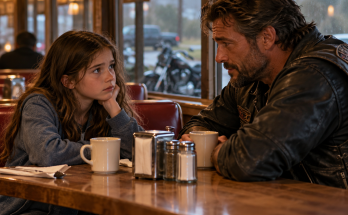
I asked the Hollow Creek Riders to help me look for Mara.
It wasn't a decision I made lightly.
I'd spent years riding with those men.
I knew their strengths.
I knew their tempers.
And I knew that a group of motorcycles arriving somewhere could attract attention even when nobody intended trouble.
That wasn't what I wanted.
Mara was missing.
The police were investigating.
We had information about a security contractor who'd followed her and confronted her over Cedar House records.
There was already enough anger surrounding the situation.
I didn't want the riders adding more.
I wanted them to help search.
Nothing else.
Doc understood that immediately.
He was the first person I trusted to organize the effort properly.
I told him what I had in mind.
Rural roads.
Abandoned driveways.
Ditches and places a driver might have pulled off the road.
Areas where Mara could have traveled after leaving the gas station.
I didn't pretend to know her route.
We had no confirmed answer about where she went.
But there were roads worth checking.
And there were people willing to spend time looking.
Doc listened while I explained.
Then he began doing what he did best.
He made the idea practical.
We weren't going to send men riding wherever they pleased.
There had to be assignments.
There had to be limits.
And everyone needed to understand that anything suspicious belonged to the police.
Not to us.
I agreed.
Doc organized the volunteers in pairs.
That mattered.
Two people could keep each other from making a careless decision.
They could check what the other person thought they'd seen.
They could make sure nobody wandered off alone in a place where help might be difficult to reach.
I knew some of the men would have preferred to work independently.
I had been that kind of man myself.
But this wasn't a normal ride.
We were looking for someone.
A real person.
A woman with an eleven-year-old daughter waiting for her.
And mistakes could matter.
Doc used maps to assign the areas.
He wanted people to know which roads were being checked.
He wanted to avoid unnecessary overlap.
Most importantly, he wanted every volunteer to understand the difference between looking for evidence and interfering with it.
"If you see something that doesn't belong, leave it where it is," he told them.
Nobody argued.
"Call it in. Don't start picking things up."
The men listened.
I could tell they understood the seriousness of it.
There was no joking about being detectives.
No pretending we'd solve everything because we had motorcycles and time.
We were volunteers.
The investigators had the authority and responsibility to examine evidence.
Our job was to help identify anything that might deserve their attention.
I appreciated Doc for making that clear.
It kept me from having to explain the same thing while fighting my own impatience.
I stood with the others, looking at the maps.
There were more roads than I'd realized.
Routes cutting through rural areas.
Places with little traffic.
Turnoffs that could easily be missed.
I wondered whether Mara had driven along any of them.
I wondered whether she'd been trying to lose the truck.
Or whether she'd already gotten away from Rusk and was going somewhere else.
The possibilities were endless.
I didn't know which one was right.
That was the hardest part.
Searching meant choosing places to look without knowing whether they mattered.
Every road could be the wrong one.
Every driveway could lead nowhere.
And every hour spent looking somewhere empty was an hour I couldn't recover.
I told myself not to think that way.
An unsuccessful search didn't mean the effort was wasted.
It meant we'd checked another place.
That was still information.
But I wanted so badly to find Mara that anything short of seeing her felt like failure.
I had to keep reminding myself what we were doing.
Looking carefully.
Following the plan.
Reporting anything relevant.
The motorcycles were ready.
Their engines filled the air with a sound I'd known for most of my adult life.
Usually, that sound meant freedom to me.
A road ahead.
The company of men I trusted.
A chance to leave ordinary worries behind for a while.
That day, it meant something different.
We weren't riding to escape our problems.
We were riding straight into one.
I looked at the men around me.
Some had been part of the Hollow Creek Riders for years.
They knew me as Stone.
The one who usually stayed calm when things became difficult.
The one people expected to make decisions without losing his head.
I wondered what they thought when they looked at me now.
I wasn't hiding much.
I could feel it in my face.
In the way I checked the maps.
In how often I looked toward the road before we started.
I was afraid.
And I didn't have the energy to pretend otherwise.
For years, I'd believed being a leader meant not showing people what frightened you.
Looking back, that was a foolish idea.
The men didn't need me to act fearless.
They needed me to be responsible.
They needed me to respect the assignments.
To follow the same instructions I expected them to follow.
And to remember that we were helping a search, not carrying out an investigation of our own.
I could do that.
I had to.
When we began checking the roads, I paid attention to every place a vehicle might have turned.
I looked at the edges of the roadway.
At ditches.
At driveways that appeared unused.
I tried to imagine the view from Mara's car.
But I knew I had to be careful.
Imagining her route wasn't the same as knowing it.
Rusk had said she'd driven away from the gas station before he could search her vehicle.
That was one man's statement.
It needed checking.
We couldn't build the entire search around assuming he'd told the full truth.
Still, the roads beyond that point were places worth examining.
So we examined them.
The work was slower than the sound of the motorcycles suggested.
We rode.
We stopped.
We looked.
Then we continued.
I had never noticed how many places a car could disappear from sight along an ordinary rural road.
A bend.
A driveway.
An entrance partly hidden from the main road.
I didn't like thinking about it.
But pretending those places didn't exist wouldn't help Mara.
Doc kept the teams organized.
He made sure people stayed with their assigned partners.
No one was encouraged to take risks for the sake of being first.
I was grateful for that structure.
It gave my mind something definite to focus on.
A section of road.
A place to check.
A report to make if something seemed relevant.
Without that, I might have spent the entire day chasing every possibility.
I had already done enough of that in my head.
At one point, I looked down a ditch and felt my chest tighten.
There was nothing there that established where Mara had gone.
Still, I stared longer than I needed to.
I was thinking about her car.
About what could happen if somebody lost control of a vehicle.
About how easily something could remain unseen from the road.
I hated myself for imagining it.
But I couldn't stop.
For days, I'd wanted evidence.
Now that I was searching places where evidence might exist, I was frightened of what we might find.
That contradiction followed me the entire day.
I wanted answers.
I was afraid of answers.
I wanted to be the person who found Mara.
I was terrified of discovering that something terrible had happened to her.
I hadn't understood before how two feelings could pull so hard in opposite directions.
Doc noticed my silence.
He didn't try to turn it into a conversation.
Sometimes he just stayed nearby.
I appreciated that more than any reassurance he could have offered.
He couldn't promise we would find her.
He couldn't tell me the roads were empty because Mara was somewhere safe.
He didn't know.
Neither did I.
So we kept looking.
Every now and then, I thought about the red motorcycle in the shop.
I remembered Ava standing beside it.
Her eyes moving from one part to another.
Her questions about how machines worked.
Then I remembered the photograph.
Mara smiling at the county fair.
And Ava telling me how happy her mother looked.
Those images had become tied together in my head.
The woman I had loved.
The child I hadn't known was mine.
The life that might still be possible if Mara came home.
I knew not everything could return to the way it had been.
Eleven years had passed.
There would be hard conversations.
Questions I might not like hearing answered.
Decisions about how Ava would spend time with me.
And the truth about the Cedar House records still had to come out.
But those were problems I wanted the chance to face.
I wanted Mara alive to explain herself.
I wanted Ava to see us both standing in the same room.
Not pretending everything was fine.
Just telling the truth.
I thought about the day Ava asked whether her mother had done something wrong by keeping my identity from her.
I'd told her I didn't know what Mara had feared.
I still didn't.
But the investigation was showing me that Mara had been involved in something more complicated than I'd understood.
Someone connected with Voss had paid a security supervisor to learn whether she'd obtained original records.
That same man said he'd confronted her at a gas station.
I couldn't ignore those facts.
Maybe Mara had been frightened of something long before she disappeared.
Maybe there were reasons she had kept parts of her life private.
I couldn't say.
And I didn't want to invent answers that would make me feel better.
I had spent too many years assuming I understood the past.
Ava's existence had already shown me how wrong I could be.
I wasn't going to repeat the mistake.
While we searched, the men followed Doc's instructions.
They worked in pairs.
They checked their assigned areas.
And they understood that suspicious evidence had to be reported without being disturbed.
That discipline mattered more to me than any show of loyalty.
They could have treated this as a personal mission for their leader.
They could have decided that finding the Hartwell supervisor was their responsibility.
But that wasn't what we'd organized.
We were looking for Mara.
Nothing about that required intimidation.
Nothing required chasing somebody down.
The police already had information about Rusk.
They were examining his account.
The Voss connection was part of the expanding investigation.
Our contribution was simpler.
We had eyes.
We had time.
And we were willing to travel roads that needed checking.
I began to understand the value of that.
I had always associated helping with fixing something directly.
A broken motorcycle came into the shop.
I found the problem.
I repaired it.
The owner left with a working machine.
There was a beginning and an end.
This was different.
We might check an entire road and find nothing.
We might spend hours searching with no immediate answer.
That didn't mean we'd done nothing.
It meant we'd contributed to a larger effort.
I found that difficult to accept.
But I could see why it mattered.
The detectives needed information they could trust.
Elena needed facts to pass along.
Ava needed the adults around her to act responsibly.
And Mara needed us to keep looking without damaging the very evidence that might help find her.
I thought about that last part often.
Evidence.
It was such a plain word.
A camera recording.
A dented toolbox.
A faded decal.
A statement from a man who admitted he'd followed her.
Each one had seemed small at first.
But together, they had changed the direction of the investigation.
There might be other details waiting to be noticed.
A road.
A place where a vehicle had stopped.
Something that could confirm or contradict Rusk's statement.
That was why we were searching.
Not because we knew the answer.
Because we didn't.
As the day continued, I watched the riders carefully.
The motorcycles made plenty of noise.
But the men themselves were serious about the work.
Nobody treated the search like a social ride.
Nobody behaved as though the situation was a game.
They understood who we were looking for.
Some of them had known me for years.
They had seen me handle difficult repairs and difficult people.
They had seen me refuse to bend when I believed something was right.
Now they saw me looking down ditches with a fear I couldn't conceal.
I knew it changed how they saw me.
For a moment, that embarrassed me.
Then I thought about Ava.
She had stood in front of me and asked whether she could call me Dad.
I had never felt more exposed than I did in that moment.
And nothing bad had happened because I let her see how much the answer meant to me.
Maybe there was no shame in being frightened for somebody you loved.
Maybe the shame would have been pretending I didn't care.
That thought stayed with me as we continued along the rural roads.
I was still Stone.
I still knew how to lead a group of riders.
I still knew how to fix motorcycles.
But I was also Ava's father.
And Mara was still the woman whose disappearance had brought my entire past back into my life.
Those truths weren't separate anymore.
They belonged to the same story.
I couldn't ride away from one without carrying the others.
Doc checked that the volunteers understood what they were expected to report.
I listened.
For once, I didn't feel the need to take over.
He was doing the job well.
I had asked for help.
Now I had to accept it.
That might have been the hardest lesson of the day.
I was used to being the man other people depended on.
I didn't know how to be the one who needed them.
But there I was.
Looking for a missing woman.
Depending on friends to check roads I couldn't cover alone.
Depending on investigators to verify statements I couldn't verify myself.
Depending on Mrs. Hanley and the caseworker to help keep Ava safe while I tried to understand what being her father required.
I couldn't do everything.
That didn't make me useless.
It made me human.
I wished I'd learned it sooner.
When I thought about Mara, I tried to remember her as more than someone who had disappeared.
She was the woman in the county fair photograph.
The mother who knew exactly how Ava liked her toast.
The person who could repair a bicycle chain and say things Mrs. Hanley wouldn't want repeated.
She was somebody who had made complicated choices.
Some of those choices had hurt me.
But she was also somebody worth finding.
I wanted the investigation to treat her as a person, not simply a collection of records and vehicle sightings.
And I wanted our search to reflect that.
Careful.
Respectful.
Persistent.
Not driven by revenge.
I didn't know what we'd discover on those roads.
The information we had still ended with Rusk's account of Mara driving away from the gas station.
We hadn't found a verified explanation for where she went afterward.
The search didn't change that.
Not yet.
But the Hollow Creek Riders were checking the places assigned to them.
Doc was keeping the teams organized.
And the police had the information needed to continue following the Cedar House and Voss connections.
Those were real efforts.
They mattered.
For the first time since Ava came into the diner, I understood that helping her might mean accepting uncertainty while continuing to do the next responsible thing.
I wanted to bring her mother home.
I wanted answers about the missing years.
I wanted to understand why someone had paid to follow Mara.
But wanting those things wasn't enough.
I had to be patient.
I had to keep showing up.
And I had to trust that careful work was more useful than anger.
As we continued searching the rural roads, I knew I wasn't the same man who'd first heard Ava say her mother was missing.
I was still frightened.
I still had questions.
But I had stopped trying to carry every part of the problem alone.
Doc and the riders were helping.
Elena and the investigators were following the evidence.
Mrs. Hanley was helping Ava maintain some ordinary life.
And I had a place in all of it.
Not as the man who could fix everything.
As the man who would keep looking.
Who would keep listening.
Who would be there for his daughter.
Even while the most important question remained unanswered.
Where was Mara?
Click here to continue reading: PART 9: Every Empty Road Reminded Me That Mara Was Still Missing, and I Had to Learn How to Help Without Making Things Worse
I Had Spent Years Trying to Forget Mara, Until Her Eleven-Year-Old Daughter Walked Into My Life and Made That Impossible
Part 8 of 12