I had never been so afraid of finding nothing.
That was the part I hadn't expected.
Before we began searching the rural roads, I thought the hardest thing would be discovering something terrible.
I still feared that.
But I was learning that an empty road could hurt in its own way.
No car.
No sign of Mara.
No answer about where she'd gone after the gas station.
Just another stretch of road we had checked without learning what had happened to her.
I kept telling myself that searching mattered even when we found nothing.
Doc had explained it plainly.
Every place we examined was one less place we had to keep wondering about.
I understood that with my head.
My heart was less cooperative.
I wanted to find her.
Not tomorrow.
Not after another week of waiting.
I wanted her standing in front of me, alive and irritated that I'd been worrying so much.
I wanted to hear her tell me I'd made a bigger fuss than necessary.
I could almost imagine the look she'd give me.
Then I'd remember that we had no reason to believe she'd disappeared voluntarily.
The thought would bring me back to the road.
I rode with the others, keeping to the areas Doc had assigned.
He had organized the Hollow Creek Riders into pairs.
That wasn't a suggestion.
It was a rule.
Nobody was supposed to wander away alone because they thought they'd spotted something interesting.
Nobody was to disturb anything that might become evidence.
And nobody was to confront anyone connected to the investigation.
Especially not anyone from Hartwell Protective Services.
I had agreed to those rules.
Now I had to obey them.
That was harder than giving the instructions.
I could feel my impatience every time we stopped.
I looked along the shoulders of the road.
I checked places where a vehicle might have turned off.
I studied ditches and abandoned driveways.
Then I looked again.
As if a second glance could make something appear that hadn't been there before.
Doc noticed.
He didn't say anything at first.
Eventually, he stood beside me and looked down the same stretch of roadside.
"Stone."
I turned.
"We've checked this part."
"I know."
He waited.
I looked back at the ditch.
There was nothing there that told us where Mara had gone.
Nothing that justified remaining.
I knew that.
Still, leaving felt like giving up.
Doc seemed to understand.
"We've got other ground to cover."
I nodded.
He wasn't telling me to stop caring.
He was reminding me that caring wasn't the same as standing in one place until exhaustion made the decisions for me.
We got back to the search.
The motorcycles were loud when we traveled between locations.
I had spent years enjoying that sound.
It had always meant movement.
Freedom.
A little distance from whatever was bothering me.
Now I barely noticed it.
All I could think about was Mara's car.
The black pickup behind her.
The dented metal toolbox.
The faded Hartwell decal on the rear window.
Those details had become fixed in my mind.
I could close my eyes and see them, even though I hadn't personally witnessed the vehicles leaving the archive.
I'd heard the evidence described so many times that the images felt familiar.
That worried me.
I knew how easy it was to confuse something you imagined with something you actually knew.
I hadn't been at the archive.
I hadn't seen Mara drive away.
I hadn't watched Dale Rusk follow her.
The camera had established the timing.
The police had identified the truck.
Rusk had admitted that a Voss manager paid him to find out whether Mara possessed original Cedar House records.
And he claimed he'd confronted her at a gas station before she escaped in her car.
Those were the pieces we had.
Everything else remained uncertain.
I kept repeating that distinction to myself.
I needed it.
Without it, I could build a whole explanation in my head and start treating it as fact.
I'd already spent too many years doing something like that with Mara.
I had assumed her silence meant she wanted nothing more to do with me.
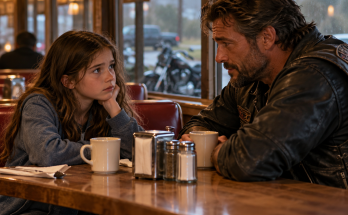
Then Ava came into the diner.
Eleven years old.
My daughter.
A child I hadn't even known existed.
That alone should have taught me never to mistake an assumption for the truth.
Yet here I was, fighting the same habit.
Trying to decide what must have happened because not knowing was unbearable.
When we paused between assigned areas, I thought about the paternity report.
Greater than 99.99 percent.
It was almost absurd how clearly that document had answered one of the biggest questions of my life.
A few pages.
An official result.
One number.
Then everything changed.
I had gone from being Stone, the man who fixed motorcycles and kept his past private, to being somebody's father.
Not somebody's possible father.
Not a man who might have a child somewhere.
Ava's father.
I still didn't know what to do with the feeling that came over me whenever I thought about it.
Pride was part of it.
So was grief.
And there was a kind of tenderness I had never learned how to handle.
I thought about Ava's arms going around me after she read the result.
I hadn't expected her to hug me.
I certainly hadn't expected it to mean so much.
Doc had turned away and pretended he was searching for a socket.
I smiled at the memory.
Then I felt guilty for smiling.
That was happening less often, but it still happened.
I had to remind myself that finding something good in my life wasn't a betrayal of Mara.
Ava needed happiness.
She needed laughter.
She needed ordinary afternoons where her mother's disappearance wasn't the only thing anybody could think about.
I needed those moments, too.
I just hadn't fully accepted it yet.
The search continued.
We traveled the roads assigned to us and looked carefully at the places Doc had identified.
I could see the effort the men were making.
They weren't treating this like a weekend ride.
They understood we were looking for a missing person.
They understood a small detail might matter.
And they understood that anything suspicious had to be left alone and reported.
I was proud of them.
That was another feeling I hadn't expected.
I had known these men for years.
We'd ridden together.
Worked on motorcycles.
Helped each other with problems that seemed important at the time.
But seeing them search quietly for Mara made me understand what their loyalty really meant.
They weren't there because I could order them around.
They were there because somebody needed help.
They had chosen to come.
I watched one pair prepare to continue along their assigned route.
Another pair checked the map.
Nobody was making speeches.
Nobody needed to prove how tough he was.
The work mattered more than the appearance.
That was exactly what I wanted.
A few years earlier, I might have felt differently.
I might have wanted a show of strength.
Motorcycles filling a parking lot.
Men standing shoulder to shoulder.
Somebody demanding answers.
Now I could see how useless that would be.
Dale Rusk wasn't going to become more truthful because I stood in front of him looking angry.
The Cedar House records weren't going to explain themselves because a group of riders showed up at a warehouse.
The investigation needed evidence.
Mara needed to be found.
And Ava needed me to remain someone she could depend on.
That was enough.
Later, I returned to the shop.
I was tired in a way I couldn't remember feeling before.
My body wasn't the problem.
I'd worked longer days.
I'd ridden farther.
I'd spent hours fighting stubborn mechanical problems.
This tiredness came from not knowing.
I washed my hands at the sink and watched the water carry away the dirt.
For a moment, I stood there longer than necessary.
There was something almost insulting about how easily the grime disappeared.
Soap.
Water.
A towel.
A problem solved.
I wished everything worked that way.
Doc came into the work area.
He glanced at me.
"You should eat something."
"I will."
He waited.
I knew he didn't believe me.
I probably wouldn't have believed myself either.
I dried my hands.
Then I looked at the red training bike.
Ava had asked me to teach her about it someday.
I had told her I'd like that.
The word someday had seemed comforting then.
Now I understood how important it was not to keep putting life off until every problem was solved.
Mara's disappearance had reminded me how quickly an ordinary afternoon could become something else.
I couldn't know what tomorrow would bring.
But I could keep the promises I was capable of keeping today.
That meant showing up for Ava.
It meant respecting Mrs. Hanley's responsibility for her care.
It meant cooperating with Elena and the detective.
And it meant continuing the search without pretending I knew more than I did.
I was getting better at saying those things.
Living them still took effort.
That evening, I thought about calling Mara.
The impulse came so suddenly that I almost reached for my phone.
For a second, I forgot the reality of what was happening.
I wanted to ask her why she had never told me about Ava.
I wanted to ask whether the Cedar House records were worth the risk she'd taken.
I wanted to hear her say something that made sense of the last eleven years.
Then I remembered.
She was missing.
Nobody knew where she was.
I sat quietly with that thought.
There was nothing useful I could do with it at that moment.
I couldn't turn it into anger.
I couldn't turn it into a repair.
I simply had to feel it.
That was new for me.
I'd spent a long time believing that feelings were problems to be solved as quickly as possible.
If I was angry, I'd find something to work on.
If I was sad, I'd go riding.
If I was confused, I'd keep busy until I was too tired to think.
Those habits had helped me through some difficult years.
But they hadn't made me especially good at understanding myself.
Now I had Ava.
And Ava was going to need more from me than a man who disappeared into the shop whenever something hurt.
She was going to need honest answers.
Patience.
And the ability to stay in the room when a conversation became uncomfortable.
I thought about how she'd asked whether Mara had done something wrong.
The question had frightened me.
I had wanted to tell her that everything was simple.
That adults always had good reasons for their choices.
That nobody she loved had ever made a serious mistake.
But children eventually learn that isn't true.
Ava already knew.
So I'd told her what I could.
That I didn't know why Mara had kept the truth from me.
That I would ask her when we found her.
And that none of those answers would change Ava's right to be loved.
I still believed every word.
The difficult part was waiting for the chance to prove it.
I looked at the county fair photograph again.
Mara's smile was familiar.
The past in that photograph wasn't.
It belonged to two people who hadn't known what was coming.
I wondered what I would tell the younger man standing beside her.
Maybe I'd tell him to ask more questions.
Maybe I'd tell him not to let pride make decisions for him.
Or maybe I'd simply tell him to appreciate the afternoon he was having.
I didn't know.
What I did know was that the search had changed me.
Not because we'd found an answer.
We hadn't.
But because I was learning to work with other people instead of making my fear the center of everything.
I thought about Doc keeping the riders organized.
About Elena bringing the evidence to the detective.
About Mrs. Hanley giving Ava a safe place while everything remained uncertain.
Those people were doing work I couldn't do.
And the world hadn't fallen apart because I let them.
That was an important lesson for a man who had spent years insisting he could manage on his own.
Before I left the shop, I checked the work area.
I put a few tools away.
I looked once more at the old motorcycle with the red tank.
I thought about teaching Ava the difference between building something and repairing it.
I thought about her question.
Whether fixing a machine meant knowing why it had broken.
I'd told her that sometimes you had to find the damage first.
I understood now why the question had stayed with me.
I knew plenty about the damage in my own life.
I knew about the missing years.
The anger.
The silence between Mara and me.
But I didn't yet know what had caused all of it.
And I wasn't going to pretend the paternity report answered everything.
The search had to continue.
The police still needed to verify Rusk's account.
And we still had no confirmed explanation for Mara's whereabouts.
I went home knowing none of those things had changed.
But something in me had.
I was no longer trying to find Mara entirely by force of will.
I was learning to help carefully.
And for the first time, I understood that patience wasn't the same as surrender.
Click here to continue reading: PART 10: Ava Needed More Than News About the Investigation, and I Began to Understand What Being Her Father Would Ask of Me
I Had Spent Years Trying to Forget Mara, Until Her Eleven-Year-Old Daughter Walked Into My Life and Made That Impossible
Part 9 of 12