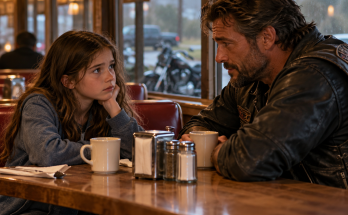
I wasn't always a man who stopped to help.
That is difficult to admit now.
People who knew me through the Iron Saints sometimes assumed I had always been the way I was at forty-seven.
They saw me keeping the riders together.
They saw the volunteer work.
They saw the men who trusted me.
They thought I had earned that trust by being a good man for a long time.
I hadn't.
There were years when I wasn't much good to anybody.
Not even myself.
Especially not myself.
I had been a mechanic.
Then a soldier.
Those were parts of my life I could talk about without much difficulty.
I understood engines.
I understood tools.
I understood doing the job in front of me.
Military service had taught me other things.
Discipline.
Loss.
How quickly a person's life could change.
But understanding those things didn't mean I knew how to live with them.
That came much later.
And I made a lot of mistakes before I got there.
I had been a husband.
A bad one.
I had been a father.
And I had failed in ways I still struggled to put into words.
I drank.
Too much.
Too often.
I used alcohol to avoid dealing with the things that frightened me.
I told myself I needed it.
That I deserved a break.
That I would stop when life became easier.
Those excuses sound familiar to me even now.
I can remember how believable they seemed when I said them.
I can also remember the damage they caused.
The promises that lasted until the next difficult day.
The apologies.
The disappointment.
The look on my daughter's face.
That's the part that stays.
Not the drinking itself.
Not the mornings afterward.
Her face.
Lily was eight.
She should have spent those years knowing her father would keep his word.
Instead, there were times when she had to wonder which version of me would come home.
I hate writing that.
I hate remembering it.
But leaving it out would make me sound better than I was.
And I don't want to do that.
There is no useful lesson in pretending I was a good father every day.
I wasn't.
I loved my daughter.
I loved her more than I knew how to express.
But love didn't automatically make my behavior safe or kind.
I had to learn that.
And I learned it too late to give Lily what she deserved.
I eventually chose sobriety.
Not because somebody gave me a speech that solved everything.
Not because I woke up one morning and suddenly became a different person.
I had to make a choice I should have made much earlier.
I couldn't keep hurting the people I loved and then expect an apology to erase it.
I couldn't keep using pain to excuse the pain I caused.
And I couldn't keep telling myself tomorrow would be different while doing nothing today.
So I began trying to change.
That word matters.
Trying.
I didn't become perfect.
I didn't stop carrying anger.
I didn't suddenly know how to handle grief.
I still had days when my thoughts felt impossible to manage.
But I stopped pretending that being hurt gave me permission to hurt other people.
That was a beginning.
Lily wasn't there to see it.
She had died before she could know the man I was working to become.
There are sentences a father never wants to say.
That is one of mine.
I don't like turning her into a lesson.
She was a little girl.
She had a life.
She deserved more than being remembered as the reason her father finally changed.
But her memory was part of every decision I made afterward.
I couldn't separate those things.
I didn't want to.
There were days when I thought about the time I had wasted.
The mornings I could have spent being present.
The conversations I could have listened to instead of dismissing.
The ordinary chances to be a father.
Those memories weren't dramatic.
That made them worse.
Because ordinary things are what you lose first without noticing.
I had learned to keep moving.
Not to outrun the loss.
I knew I couldn't.
But to keep from letting it decide every choice I made afterward.
Motorcycles helped.
So did working with my hands.
So did the men who eventually became my brothers in the Iron Saints.
We were a strange group if you only looked at us from the outside.
Tattoos.
Leather.
Old injuries.
Faces that had been weathered by years on the road.
Some of the men had scars they could explain.
Others didn't want to.
I never pushed.
I knew what it felt like to have strangers decide they were entitled to your worst memories.
The club had a rough appearance.
I wasn't blind to that.
Our patch was designed to be noticed.
A skull with wings.
The name IRON SAINTS across the back.
Some people looked at it and saw trouble.
I understood why.
There had been a time when a frightening reputation meant something to me.
When I thought being intimidating gave a man power.
I had been wrong.
Fear might make somebody step aside.
It doesn't make them trust you.
It doesn't make them believe you'll help when there is nothing to gain.
And it doesn't make you decent.
Those lessons took years.
The men riding with me had learned some of them the hard way too.
There were veterans among us.
Men who had seen things they couldn't forget.
There were men who had survived overdoses.
Men who had lost people.
Men trying to repair damage they had helped cause.
We didn't sit around pretending all of that made us noble.
It didn't.
It made us responsible for what we chose to do next.
That was something we could control.
Some of the men volunteered at veterans' shelters.
They gave time.
Worked without expecting an audience.
Helped people who needed something practical.
I respected that more than any tough talk.
A man could tell you he would fight for his brothers.
That was easy to say.
It was harder to spend a day helping somebody who couldn't offer anything back.
Harder to show up when nobody was watching.
Harder to be patient with someone whose life had become difficult.
Those were the things I wanted our club to stand for.
Not the skull.
Not the noise.
Not the way strangers looked at us.
The work.
The choices.
The promises we kept.
I knew people didn't see that when we rode into a parking lot.
They saw the motorcycles first.
Then the leather.
Then the tattoos.
They noticed my scar.
A mark running along my left cheek.
People sometimes stared at it when they thought I wasn't looking.
I could always tell.
Their eyes would move toward it.
Then away.
I usually pretended not to notice.
There wasn't much point making them uncomfortable about it.
My hair had begun turning silver at the temples.
My beard was short.
I had blue eyes that people once described as friendly.
I didn't hear that much anymore.
Life had changed my face.
I could see it in photographs.
The man looking back at me seemed harder than the one I remembered from years earlier.
Prison had played a part in that.
So had grief.
I had made choices that led me places I never wanted my daughter to associate with her father.
I could not erase those years.
I could only stop repeating them.
That was the thing about a past like mine.
It didn't disappear when you began behaving better.
People remembered.
Records remained.
Relationships didn't automatically heal.
And the people you hurt were not required to forgive you simply because you changed.
I had to accept that.
It wasn't always easy.
But it was true.
Sometimes the people who knew me before wanted nothing to do with the person I had become.
I couldn't blame them.
They had known the old version.
The one whose promises meant little.
The one who drank.
The one who believed saying sorry was the same as making things right.
I had no right to ask them to forget.
That was part of accountability too.
The men in the club knew enough about my past to understand I wasn't interested in pretending.
They didn't need every detail.
They had their own stories.
Some days we talked.
Some days we didn't.
Sometimes riding together was enough.
I liked that about them.
There was no requirement to explain yourself every morning.
You showed up.
You did your part.
You watched the road.
You paid attention to the man ahead and the man behind.
Trust grew from that.
Not from speeches.
Seven of us were riding together that afternoon.
I was leading.
Mason, one of the younger riders, was with us.
The others kept their places.
We moved along the eastern Texas highway with the engines steady beneath us.
Anybody watching from a car would have seen exactly what they expected.
A group of bikers.
Black leather.
A skull patch.
Seven motorcycles.
Maybe they would have moved aside.
Maybe they would have locked their doors.
I didn't know.
I had stopped guessing what strangers thought.
But I sometimes wondered how Lily would have seen us.
Would she have liked the motorcycles?
Would she have laughed at the sound?
Would she have asked questions about the patch?
Those were things I would never know.
I hated how often my mind reached for answers to questions that no longer had them.
When Lily was alive, I had been too busy making excuses.
After she was gone, I had nothing but time to think about the things I should have done.
It didn't seem fair.
But fairness had nothing to do with it.
I learned to carry the feeling without letting it decide everything.
Some days I managed.
Some days I didn't.
On that Texas highway, I was managing.
The wind was steady.
The road was clear.
My hands were relaxed.
The engine beneath me sounded right.
Nothing in my thoughts suggested that a little girl was waiting a short distance ahead.
Nothing told me I was about to meet someone whose age would bring Lily back into my mind in a way I couldn't ignore.
Ava was eight.
Lily had been eight.
I didn't know that coincidence yet.
But once I learned it, I never forgot.
I have wondered whether knowing about Ava sooner would have made me ride differently.
Maybe I would have hurried.
Maybe I would have been afraid of what she wanted.
Maybe I would have thought about Lily so much that I couldn't see Ava clearly.
I don't know.
And there is no point pretending I do.
At the time, Ava was simply a child I had never met.
She was waiting with seven dollars and forty-three cents.
She had a bruised cheek.
She was looking for someone who frightened other people.
And I was a man whose appearance frightened other people.
That was the cruel little connection between us.
She had been warned about men who looked like me.
I had spent years trying to become someone a child wouldn't need to fear.
Neither of us knew the other was nearby.
Not yet.
I looked ahead.
The highway was hot.
Mason pointed toward the diner.
And I began slowing down.
I wasn't thinking about saving anyone.
I wasn't thinking about my past.
I was thinking about coffee.
That's what makes the memory so difficult.
A child's desperate plan was waiting beside the road.
And the man she hoped to find had no idea she existed.
Click here to continue reading: PART 3: SEVEN IRON SAINTS LEFT THE TEXAS HIGHWAY FOR COFFEE, WHILE AN EIGHT-YEAR-OLD GIRL WAITED WITH HER ENTIRE SAVINGS IN ONE HAND
I DIDN’T KNOW A LITTLE GIRL WAS WAITING FOR ME WITH SEVEN DOLLARS, AND I ALMOST RODE PAST THE DINER
Part 2 of 20