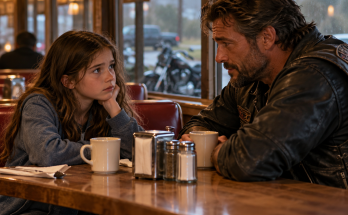
I used to believe an answer would bring peace.
Find the missing fact.
Understand the problem.
Put everything back where it belonged.
That was how I approached motorcycles.
It was how I approached most of my life.
Then Ava came into the diner.
And I discovered that some answers changed your world without making it any easier to understand.
The paternity test had answered one question completely.
I was her father.
There was no doubt about that anymore.
The report had stated the probability plainly.
Greater than 99.99 percent.
I remembered how I'd stared at those numbers.
At first, they seemed almost impossible to believe.
Then Ava asked whether she could call me Dad.
That was the moment the result became real.
Not when I read the laboratory's conclusion.
Not when Elena brought the document into my shop.
When an eleven-year-old girl looked at me and asked whether she was allowed to use a word she'd never used for me before.
I had lowered myself so we were looking at each other.
I told her she could choose.
Today.
Later.
Whenever she was ready.
I hadn't wanted to take that decision away from her.
And I still didn't.
I had spent enough of my life worrying about what other people hadn't given me.
Now I wanted to make sure Ava didn't feel that way with me.
She deserved room to make her own choices.
She deserved honest answers.
And she deserved to know that none of the problems between adults changed her value.
Those things had become clearer as the days passed.
I thought about how little I had known when we first met.
I hadn't known she hated raisins.
I hadn't known she loved cinnamon toast.
I hadn't known she had bought a telescope at a yard sale.
I hadn't known she wanted to study astronomy.
I hadn't known she could sit at a table and ask questions until I admitted I didn't know the answer.
Now I knew all those things.
They weren't the kind of facts anyone would put in an official report.
But to me, they mattered as much as the number on the paternity test.
Maybe more.
The report told me our biological relationship.
Those small details were teaching me who my daughter was.
I had been given an opportunity I never expected.
I wasn't going to treat it lightly.
But finding Ava hadn't solved the reason she came looking for me.
Mara was still missing.
That remained the truth.
The police had uncovered important information.
The county archive camera confirmed Mara left at 4:18 on the afternoon she disappeared.
A black pickup followed about thirty seconds later.
Its metal toolbox was dented.
A faded marking on its rear window connected it to Hartwell Protective Services.
Warren had recognized that marking.
The company worked as a security contractor at Voss warehouses.
That connection led investigators to Dale Rusk.
He was a Hartwell supervisor.
At first, he described his assignment as surveillance connected to an old civil dispute.
He denied knowing where Mara had gone.
When the detective wanted to question him again, he packed a bag and drove toward the state line.
The highway patrol stopped him before midnight.
Then he admitted more.
A manager at Voss had paid him to determine whether Mara had obtained original Cedar House records.
Rusk said he followed her from the archive to a gas station.
He confronted her there.
He demanded the documents.
And according to his statement, Mara drove away before he could search her vehicle.
Those details were significant.
They explained why someone had been following her.
They established a connection between the surveillance and the records she had been seeking.
But they did not establish where Mara went after the gas station.
That was the answer we still needed.
I had spent days trying to turn Rusk's statement into something more certain than it was.
Sometimes I wanted to believe he'd told the whole truth.
Sometimes I was convinced he was hiding something.
Neither feeling was evidence.
I had learned to admit that.
It was painful.
But it was necessary.
The detective had explained that Rusk's statement required independent verification.
The investigation was expanding.
I understood why.
There were too many questions left unanswered to accept one man's account as the final explanation.
I still wanted to know what the original Cedar House records contained.
I wanted to know why the Voss manager was so interested in them.
I wanted to know whether Mara had kept those documents after leaving the gas station.
And I wanted to know what had happened to her afterward.
None of those questions had been settled by the information we'd received.
I couldn't pretend otherwise.
For a long time, I had believed that admitting uncertainty made me weak.
Now I understood that it was part of being responsible.
Ava needed the truth.
Not a story I told her because I couldn't bear to say I didn't know.
I thought about that whenever I visited her.
Mrs. Hanley's kitchen had become familiar to me.
The table where we worked on homework.
The view toward the garden.
The quiet way Mrs. Hanley watched over her without making her feel constantly observed.
I appreciated all of it.
At first, I'd been uncomfortable having other people make decisions about my time with Ava.
I understood the need for those arrangements, but part of me resented how little control I had.
Now I saw them differently.
They were there to protect her.
That had to come first.
Biology didn't erase the need for trust.
And trust couldn't be demanded simply because a laboratory had confirmed who I was.
I had to earn it through my behavior.
I was trying.
Every scheduled visit mattered.
Every ordinary conversation mattered.
If I said I would be there, I needed to be there.
If I didn't know an answer, I needed to say so.
If Ava needed quiet, I had to let her have it.
Those weren't dramatic responsibilities.
Nobody was going to applaud me for remembering that she didn't like raisins.
But they were part of being her father.
And I was beginning to care about them deeply.
I thought back to the afternoon she'd visited my motorcycle shop.
Mrs. Hanley and the caseworker had brought her.
I had been so nervous that I'd straightened tools that were already in the right places.
Ava hadn't seemed concerned with my nerves.
She wanted to see everything.
The parts counter.
The lift.
The old motorcycle with the red fuel tank.
She'd asked whether I'd built every machine in the building.
I'd told her I repaired them.
Then she'd asked whether repairing something meant understanding why it had broken.
I remembered standing there, trying to answer.
At the time, the question seemed like a clever observation from a curious child.
Now I understood how closely it applied to my life.
I had wanted to repair my past with Mara before I understood it.
I had wanted the missing years explained in a way that made me feel less hurt.
I had wanted someone to tell me who was wrong.
Who was right.
Who deserved forgiveness.
But I didn't know enough.
And some of those questions couldn't be answered while Mara was missing.
She deserved the opportunity to speak for herself.
Ava deserved to hear her mother's explanation.
And I deserved the chance to understand what had happened without having to invent the missing parts.
I still felt angry sometimes.
I would remember that Mara had raised our daughter without telling me.
Eleven years.
The number could still hurt.
I couldn't pretend it didn't.
But anger no longer felt like the only reasonable response.
There was fear, too.
And concern.
And love that had survived longer than I wanted to admit.
Those feelings existed together.
I was learning not to let one cancel out the others.
I had once thought of Mara only as the woman who'd left my life.
Now I thought of her as Ava's mother.
A woman who had raised a thoughtful, stubborn, curious child.
A woman who could repair a bicycle chain with a wrench and a few words that weren't suitable for repeating.
A woman who'd gone to the county archive looking for original records.
And a woman who'd apparently drawn the attention of somebody connected to Voss.
I didn't know how all those parts of her life fit together.
But I knew she was more than the hurt she'd caused me.
I wished I'd understood that sooner.
Doc helped me more than he probably realized.
He'd organized the Hollow Creek Riders when I asked them to assist with the search.
Pairs.
Maps.
Clear assignments.
No disturbing suspicious evidence.
No confronting anyone.
He'd made sure we approached the work seriously.
And the riders had followed those instructions.
I had watched them search roads and abandoned driveways with more care than I'd expected.
Their motorcycles were loud.
Their work wasn't.
There were no speeches.
No unnecessary confrontations.
Just men giving their time because somebody needed help.
I was grateful for that.
The search hadn't provided us with a confirmed location for Mara.
But the volunteers had contributed to a careful effort rather than making the investigation harder.
That distinction mattered.
I had wanted action for so long that I nearly forgot action had to be useful.
Doc reminded me.
Elena reminded me.
The detective reminded me, even when I didn't want to listen.
And Ava reminded me without trying.
Every time I thought about doing something reckless, I remembered her arms around my shoulders.
I remembered the trust in that hug.
I remembered the way she'd asked whether she could call me Dad.
It made me stop.
I didn't want my first lesson to her to be that love gave a man permission to behave irresponsibly.
I wanted her to see something different.
That caring about somebody meant doing difficult things carefully.
That being frightened didn't excuse hurting other people.
That anger didn't turn a guess into a fact.
I hadn't always understood those lessons myself.
I was learning them late.
But I was learning.
One afternoon at the shop, I stood beside the red training motorcycle again.
I ran my eyes over its familiar parts.
The fuel tank.
The engine.
The pieces I'd worked with so many times.
There was comfort in knowing how they fitted together.
I thought about Ava standing there.
Her questions.
Her excitement.
The way she listened when I explained something.
I wanted more afternoons like that.
I wanted to teach her how things worked.
Not because I expected her to become interested in motorcycles the way I was.
She might decide astronomy mattered more.
I would be proud of her either way.
I simply wanted to share something of my life with her.
And I wanted to learn about hers.
There was so much I still didn't know.
The books she loved best.
What she hoped to do when she was older.
Which school subjects frustrated her.
What made her feel brave when she was frightened.
Those were things I could discover over time.
I didn't need to rush.
There was no way to replace eleven years in a few weeks.
I had finally accepted that.
The past was gone.
I couldn't get it back by being angry.
I couldn't get it back by blaming Mara before hearing her explanation.
And I couldn't get it back by trying to become a perfect father overnight.
All I could do was be present now.
That was a smaller promise than the ones I once wanted to make.
It was also one I had a chance of keeping.
I thought about the county fair photograph again.
For years, it had represented a time I believed was finished.
Now it meant something else.
It was proof that Mara and I had once shared happiness.
It was something Ava had been able to see with her own eyes.
And it reminded me that the people in photographs didn't know everything that would happen afterward.
I hadn't known about Ava.
Mara had not yet explained why.
Neither of us, in that old picture, could have imagined the conversations still waiting for us.
I wanted those conversations to happen.
I wanted them to be difficult if they needed to be.
I wanted the truth more than I wanted comfort.
But before any of that, we had to find Mara.
I couldn't settle the central question simply by wanting it badly enough.
The information available to us stopped with Rusk's statement that Mara had driven away from the gas station.
Her location after that remained unconfirmed.
The Cedar House records remained central to the investigation.
The Voss manager's role in arranging surveillance had been described by Rusk, but the full circumstances still required investigation.
And the riders' search had not supplied the answer Ava needed.
I hated leaving things there.
I still do.
Because this wasn't a story about a missing motorcycle that I'd eventually repaired.
It was a story about real people living with consequences they didn't fully understand.
An eleven-year-old girl had come looking for help.
She'd found the man who turned out to be her father.
And that man had discovered that loving somebody didn't mean he could guarantee a happy ending.
I wished I could tell Ava more.
I wished I could tell her where her mother was.
I wished I could give her a date when she'd see Mara again.
But I had no such information.
So I stayed with what I knew.
I was her father.
I cared about her.
The investigation was continuing.
And I wasn't going to abandon her because the answers were difficult.
That was what I could promise.
I thought about how she'd once told me that stars were easier to trust than adults.
I hoped, someday, she'd find that at least a few adults could be dependable, too.
Not because they always knew what to say.
Not because they never made mistakes.
But because they told the truth when they could.
Admitted uncertainty when they couldn't.
And stayed.
I wanted to be one of those adults.
I had spent years hiding behind the name Stone.
The man who could repair anything.
The rider who never showed fear.
The person who didn't need much from anybody.
Then Ava walked into my life and changed what those things meant.
I still worked on motorcycles.
I still rode with the Hollow Creek Riders.
I still had friends who knew me as Stone.
But I was also a father.
And fatherhood was teaching me that sometimes the most important thing a man could do wasn't solve a problem.
It was remain present while the problem remained unsolved.
I looked once more at the old red motorcycle.
I thought about Mara.
About Ava.
About all the unanswered questions that still lay between us.
I couldn't repair everything.
I couldn't explain everything.
And I couldn't claim a resolution the evidence hadn't given us.
But I could keep my promise to my daughter.
I would stay.
I would listen.
And I would keep helping the people trying to find her mother.
The End
Read more original stories on Feel Every Story.
I Had Spent Years Trying to Forget Mara, Until Her Eleven-Year-Old Daughter Walked Into My Life and Made That Impossible
Part 12 of 12