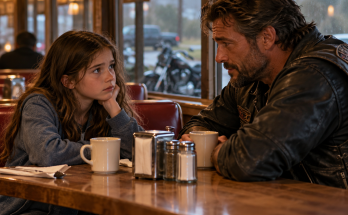
The hardest part of becoming Ava's father wasn't the paternity test.
It was everything that came afterward.
The report had given us certainty.
It hadn't given us eleven years of shared memories.
It hadn't taught me what she liked for breakfast or what frightened her at night.
It hadn't made me good at helping with homework.
And it certainly hadn't prepared me for what to say when she asked about Mara.
I had wanted fatherhood to feel like something I could understand immediately.
Instead, I was discovering it one ordinary conversation at a time.
Mrs. Hanley's kitchen table had become an important place in my life.
I hadn't expected that.
The first time I'd sat there with Ava's schoolwork spread between us, I'd felt like a visitor trying not to do anything wrong.
Now I was beginning to feel less awkward.
I still respected the arrangements.
The visits happened at the agreed times.
Mrs. Hanley knew when I was coming.
The caseworker remained involved.
Nobody pretended that biology alone settled every question about Ava's care.
I appreciated that more than I had at first.
There had been a part of me that wanted everything to change the moment the test confirmed I was her father.
I wanted the years we'd lost to count for something.
I wanted somebody to say I could finally take my rightful place.
But Ava wasn't an object that could be handed over when ownership was established.
She was a child.
She had routines.
People she trusted.
A life that had been shaken badly enough already.
I needed to become part of that life without making it harder.
I thought about those things as I arrived for another visit.
Mrs. Hanley greeted me in her usual careful way.
She wasn't suspicious of everything I did anymore.
But she still paid attention.
I was glad.
Ava needed adults who took their responsibilities seriously.
I followed her into the kitchen.
There were schoolbooks on the table.
I recognized that look immediately.
Homework.
She glanced at me.
"You remember this stuff?"
I looked at the page.
"Some of it."
She gave me a doubtful expression.
I laughed.
"All right. Maybe less than I should."
She smiled.
Then she pushed the work toward me.
I sat down.
We went through it together.
Slowly.
She asked questions.
I answered the ones I could.
When I wasn't sure, I said so.
At first, admitting that had embarrassed me.
I was used to being the person people came to for answers.
At the motorcycle shop, customers expected me to know what was wrong.
The men I worked with relied on my experience.
I liked being useful.
But Ava didn't seem disappointed when I admitted I had forgotten something from school.
She simply wanted to figure it out.
That made the task easier.
We weren't competing.
We were learning together.
I thought about how Mara would have handled the same problem.
I knew she'd probably have been more patient with certain things.
Less patient with others.
I smiled when I remembered Ava's story about the bicycle chain.
Her mother with a wrench.
An uncooperative chain.
Words Mrs. Hanley wouldn't approve of.
It was one of the few memories that could still make me laugh without immediately hurting.
Ava noticed.
"What?"
"Nothing."
She narrowed her eyes.
I knew that expression.
I'd seen Mara give me the same look.
I decided there was no point hiding the reason.
"I was thinking about your mom fixing that bicycle."
Ava smiled.
"She got it working."
"I believe it."
"She always said you shouldn't give up just because something was annoying."
I looked down at the homework.
"Sounds like good advice."
Ava nodded.
Then she went back to work.
I watched her concentrate.
For a moment, I felt the familiar ache of missing everything that had come before this.
I hadn't been there when she learned to read.
I hadn't helped her with her first school assignment.
I hadn't heard her early questions about stars or watched her discover the telescope.
Mara had done those things.
And I knew I couldn't simply insert myself into the memories.
I had to make new ones.
That sounded easy.
It wasn't.
I was still thinking about every decision too much.
Should I ask another question?
Should I let her concentrate?
Was I talking too much?
Not enough?
I had never been so uncertain about something that seemed so ordinary.
Eventually, I noticed how relaxed Ava looked when I stopped trying to do everything perfectly.
She didn't need a performance.
She needed me to sit there.
So I did.
I listened.
We finished what we could.
And I tried not to turn the afternoon into some grand moment.
Later, the subject of food came up.
I remembered the raisins.
I would probably remember them for the rest of my life.
There were very few things Ava disliked as strongly.
I still found it funny.
She didn't.
To her, raisins were a serious matter.
Cinnamon toast was another story.
That was something she could speak about with real enthusiasm.
I had begun to think of those two details as part of learning how to care for her.
They weren't important to the investigation.
They wouldn't help us identify the black pickup.
They had nothing to do with the Cedar House records.
But they mattered to Ava.
And that made them important to me.
I was starting to understand something I'd never learned from working on engines.
Big responsibilities were often built from small acts of attention.
Remembering what someone liked.
Noticing when they were tired.
Listening when they wanted to talk.
Leaving them alone when they needed quiet.
I had known how to do some of those things as a friend.
Doing them as a father felt different.
There was more at stake.
Ava wasn't going to judge me by the strength of my promises.
She was going to learn whether she could trust me by what happened over time.
That thought made me careful.
I knew trust could be damaged by things adults considered small.
Being late.
Forgetting a commitment.
Making a promise because it sounded comforting and then failing to keep it.
I didn't want to become another person Ava learned to question.
She'd already told me why she liked studying the stars.
They didn't change what they were.
I couldn't be as predictable as the sky.
But I could make an effort to be honest.
When the conversation turned toward Mara, I felt that responsibility again.
Ava had questions.
Of course she did.
Her mother was missing.
And now she knew I was her father.
Two enormous changes had entered her life almost together.
I sometimes wondered how she managed to keep talking about ordinary things at all.
Then I realized that children needed those ordinary things.
School.
Books.
Food.
Something interesting to look forward to.
They couldn't spend every moment carrying adult fears.
And they shouldn't have to.
I was learning to answer her questions without making them bigger than they needed to be.
If she asked whether the police were still looking, I could tell her they were.
If she asked whether there was new information, I could explain only what was appropriate and confirmed.
But if she asked whether Mara would definitely be home soon, I couldn't give her certainty.
That hurt.
I wanted to.
More than anything.
I wanted to be the man who could tell her everything would be all right.
Instead, I had to be the man who stayed beside her when I couldn't make that promise.
I thought about the detective's explanation of Rusk's statement.
The gas station.
The demand for the records.
Mara driving away before he could search the car.
The statement had given us something important.
It had also made the remaining uncertainty sharper.
If Mara escaped Rusk, where had she gone?
Was someone else involved?
Had she been frightened enough to take a different route?
We had no verified answers to those questions.
I couldn't treat my guesses as facts.
Especially not when speaking to Ava.
I remembered what Elena had done when I grew angry during the detective's explanation.
She'd touched my sleeve.
Such a small gesture.
But it had kept me from making the conversation worse.
I was beginning to see that responsible adults sometimes helped each other remain responsible.
Elena wasn't stopping me from caring about Mara.
She was helping me turn that care into something useful.
Mrs. Hanley was doing something similar for Ava.
Doc was doing it for the search.
I wasn't alone.
I had resisted that truth for years.
Now I depended on it.
When I returned to the shop after the visit, I found myself looking at the training motorcycle again.
The red tank had become part of how I thought about Ava.
She'd stood beside it and asked questions that seemed simple until I tried to answer them.
Had I built the motorcycles?
Did repairing them mean understanding why they broke?
Could I teach her about the machine someday?
I had said yes to that last question.
I intended to keep the promise.
But I didn't want to rush her into anything just to make myself feel useful.
I knew she'd have plenty of time to learn about tools if she wanted.
For now, she needed stability more than lessons about engines.
I understood that.
Still, I found myself imagining a day when she might stand beside me in the shop without the weight of Mara's disappearance hanging over everything.
Just an ordinary afternoon.
A motorcycle.
A question.
Maybe a little laughter.
I wanted that future.
I also wanted Mara in it.
I was no longer pretending those desires were in conflict.
Finding my daughter hadn't reduced my concern for her mother.
It had made it greater.
I knew what Mara meant to Ava.
I had seen it in her questions.
In the stories she told.
In the way she'd looked at the county fair photograph.
Ava loved her mother.
That was obvious.
And if I loved Ava, I had to respect that love.
I couldn't let my hurt over the missing years make Mara smaller in her daughter's eyes.
I couldn't turn our complicated past into something Ava felt responsible for resolving.
That was a lesson I had to keep learning.
Every time I thought about the eleven years I hadn't known about, some old resentment stirred.
I would wonder why Mara hadn't told me.
Whether she'd believed I would disappoint her.
Whether she'd thought Ava was better off without me.
Those questions were painful.
But I didn't have the answers.
And until Mara could speak for herself, I had no right to present my fears as her reasons.
I tried to remember that whenever Ava mentioned her.
Her mother was not a mystery for me to solve in front of her.
She was a person Ava loved.
A person we were trying to find.
And a person who deserved the chance to explain her own choices.
One evening, I spoke with Doc about how much had changed.
He was working nearby.
I mentioned that I was getting more comfortable helping Ava with schoolwork.
He seemed amused.
"Never thought I'd hear you talking so much about homework."
"Neither did I."
He smiled.
I told him about the telescope again.
About her interest in astronomy.
About the way she asked questions until an answer made sense.
Doc listened.
Then he said something that stayed with me.
"Sounds like you're getting to know her."
I looked at him.
He was right.
Not learning about her.
Getting to know her.
There was a difference.
Facts could be collected quickly.
Relationships took time.
I had been treating the missing years as a debt I needed to repay immediately.
But Ava wasn't keeping a ledger.
She was deciding whether she could trust me.
One afternoon at a time.
I could do that.
I could keep arriving when I said I would.
I could remember the little things.
I could listen when she talked about books.
And I could admit when I didn't know the answer.
The investigation remained unresolved.
The riders' careful search had not given us a confirmed location for Mara.
The police were still examining Rusk's account and the connection to Voss.
Nothing about that had become simple.
But something in my relationship with Ava was becoming clearer.
I didn't need to prove I deserved the word Dad by doing something dramatic.
I needed to behave like someone who meant it.
I had spent years measuring myself by what I could fix.
Now I was learning to measure myself by what I could give.
Time.
Attention.
Honesty.
And the willingness to stay.
Click here to continue reading: PART 11: The Evidence Pointed Back Toward Voss and the Cedar House Records, but I Refused to Turn Suspicion Into an Answer
I Had Spent Years Trying to Forget Mara, Until Her Eleven-Year-Old Daughter Walked Into My Life and Made That Impossible
Part 10 of 12