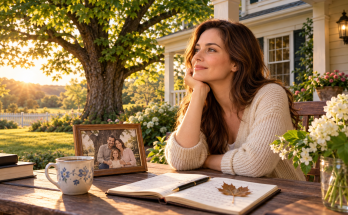
By the following year, Emily had become comfortable with silence.
She no longer interpreted every unexpected sound as danger.
A knock on the door was simply a knock.
An unknown number was simply an unknown number.
A letter was simply a letter.
Most of the time.
One morning, a package arrived from the court archive.
Emily opened it at the kitchen table.
Inside was a copy of the final historical record relating to the Wilson trust.
She almost put it away unopened.
Then she noticed the accompanying note.
The archive is complete. No further records are expected.
Emily smiled.
No further records.
It was a strangely beautiful sentence.
She read the document.
It contained the entire chronology.
The original trust.
The fraudulent transfers.
The hidden companies.
The false identities.
The investigations.
The testimony.
The restitution.
The court-supervised dissolution.
The foundation.
The final closure.
At the end was a simple statement.
The assets and records associated with the former trust have been fully resolved.
Emily closed the folder.
She expected to feel something dramatic.
She didn't.
Instead, she felt tired.
Not emotionally exhausted.
Finished.
There was a difference.
She placed the document in the archive box.
Then she walked outside.
Rebecca was gardening.
“You look serious.”
“I got the final archive record.”
Rebecca stopped.
“Is that it?”
“Yes.”
She smiled.
“Then you're free.”
Emily laughed.
“I think I have been for a while.”
“Maybe.”
Rebecca returned to the flowers.
After a moment, she said, “Do you remember when you were little?”
“Some things.”
“You used to hide under the kitchen table.”
Emily laughed.
“Why?”
“You said the table was the only place nobody could find you.”
Emily looked at her.
“I don't remember that.”
“I do.”
Rebecca smiled.
“You would crawl underneath and bring a book.”
“What kind of book?”
“Anything.”
Emily shook her head.
“Apparently I was strange.”
“You were quiet.”
“Still am.”
“No.”
Rebecca looked at her.
“You're not quiet anymore.”
Emily smiled.
“I guess I'm not.”
They worked in the garden.
Later that afternoon, Clara arrived.
She had returned from another trip and brought photographs.
“This is Portugal.”
Emily looked through them.
“You went alone?”
“Yes.”
“Did you like it?”
“I loved it.”
“Would you go again?”
“Probably.”
Clara looked at her.
“You should come next time.”
Emily hesitated.
Then smiled.
“I might.”
The invitation mattered because there was no obligation behind it.
No hidden expectation.
Just an open door.
That evening, Marcus called.
“I have news.”
Emily laughed.
“Again?”
“I got the position.”
“The oversight group?”
“Yes.”
“Congratulations.”
“They want me to start next month.”
“That’s excellent.”
“I'll be traveling.”
“I know.”
“You're not disappointed?”
Emily smiled.
“No.”
Marcus was quiet.
“I thought maybe—”
“You don't belong to me.”
The words came out gently.
He laughed.
“I know.”
“Do you?”
“Yes.”
“Good.”
They spoke for another twenty minutes.
After the call, Emily realized she had said something she once could not imagine saying.
You don't belong to me.
It was not cold.
It was loving.
That was the lesson she had spent years learning.
Love was not possession.
The next morning, Emily visited Willow Crest House.
A new group of residents had arrived.
She did not introduce herself as the founder.
She simply sat in the kitchen.
One of the residents recognized her.
“You're Emily.”
“Yes.”
“I read your story.”
Emily smiled.
“Then you know more about me than I know about you.”
The woman laughed.
“I don't know what to say.”
“You don't have to say anything.”
They drank coffee.
After a while, the woman began telling Emily about her situation.
Emily listened.
She did not interrupt.
She did not offer solutions immediately.
She asked questions.
“What do you want?”
The woman looked surprised.
“I don't know.”
“That’s okay.”
“Everyone keeps asking what I should do.”
Emily nodded.
“They may have good intentions.”
“They do.”
“But what do you want?”
The woman thought.
“I want my own apartment.”
“Okay.”
“I want my own bank account.”
“Okay.”
“I want to stop explaining myself.”
Emily smiled.
“Those are good goals.”
The woman looked at her.
“Can I do it?”
Emily answered honestly.
“I don't know.”
The woman looked disappointed.
Emily continued.
“But I know you can start.”
That was enough.
Later, Emily walked through the house.
She stopped outside the old study.
The door was open.
Inside, a staff member was helping a resident fill out paperwork.
Emily smiled.
The room no longer belonged to Thomas.
It no longer belonged to her.
It belonged to whoever needed it.
That was freedom.
Not taking ownership.
Letting go of it.
In the afternoon, Emily drove to the cemetery.
She had avoided it for a long time.
Thomas's grave was quiet.
There were no flowers except the ones already fading from another visit.
Emily stood there.
“I don't know if you're listening,” she said.
The wind moved through the trees.
“I don't forgive everything.”
She paused.
“But I don't hate you anymore.”
That was the truth.
She did not owe Thomas hatred.
She did not owe him forgiveness either.
She owed herself honesty.
“You made terrible choices,” she continued.
“And some of them hurt people for generations.”
She looked down.
“But I don't want to spend my life fighting you.”
Emily placed a small stone beside the grave.
“I think I'm done.”
She walked away.
There was no thunder.
No sign.
No revelation.
Only the sound of her footsteps.
She felt lighter.
Not because she had forgiven Thomas.
Because she had stopped needing anything from him.
That night, Emily called Rebecca.
“Where are you?”
“At home.”
“Can I come over?”
“Of course.”
Emily drove there.
They ate leftovers at the kitchen counter.
Rebecca looked at her.
“You seem different.”
“I went to Thomas's grave.”
Rebecca was quiet.
“How was it?”
“Quiet.”
“Did you say anything?”
“Yes.”
Rebecca waited.
“I told him I was done.”
Rebecca nodded.
“I think that's good.”
Emily looked at her.
“Do you ever want to go?”
“To his grave?”
“Yes.”
Rebecca thought.
“Maybe.”
“You don't have to.”
“I know.”
Emily smiled.
Rebecca reached across the counter.
“That's the difference now.”
“What?”
“I know I can say no.”
Emily squeezed her hand.
“Yes.”
They sat together.
No explanations.
No secrets.
No obligation.
Just two people who had lost years and were finally learning how to use the years they still had.
Before leaving, Emily noticed a photograph on Rebecca's shelf.
It showed Emily as a child.
She had never seen it.
“You had this?”
Rebecca nodded.
“You were six.”
Emily looked closer.
She was sitting under a tree holding a book.
Rebecca laughed.
“You were always reading.”
Emily smiled.
“Some things don't change.”
“No.”
Emily looked at the photograph.
She realized the child in it was not waiting to become someone important.
She was simply reading.
Existing.
Being herself.
Emily wanted to remember that.
Before leaving, she asked Rebecca for the photograph.
“Can I have it?”
Rebecca smiled.
“Of course.”
Emily carried it home.
She placed it beside the photograph of herself as a baby.
Then beside the family photograph.
Three moments.
Three versions of herself.
None erased the others.
She opened her notebook.
Things I choose.
She added:
To remember without returning.
Then she closed it.
The room was quiet.
Emily looked around.
Her life no longer felt like something she had escaped into.
It felt like something she had built.
Not perfectly.
Not permanently.
But honestly.
She turned off the light.
Tomorrow would bring something unexpected.
It always did.
For the first time, Emily welcomed that possibility.
Click here to continue reading: PART 32: The Life We Choose
By the Time the Wedding Toasts Ended, I Discovered My Savings Had Vanished and My Family Already Knew Why
Part 31 of 35