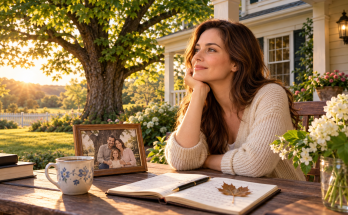
Years later, I still lived in the same house.
The maple tree had grown enormous.
Its branches stretched over the backyard.
Children from the neighborhood sometimes played beneath it.
They didn't know its history.
They didn't know about the metal container.
They didn't know about the letters.
They didn't know how many secrets had once been buried beneath its roots.
And I was glad.
To them, it was just a tree.
That was how it should be.
Mom had grown older.
Her hair was almost completely gray.
She moved more slowly.
But she still complained about the kettle.
Some things were permanent.
One morning, she asked me to sit with her.
She held a small envelope.
“I found this in the attic.”
I smiled.
“Another secret?”
“No.”
“How do you know?”
“Because I looked.”
She handed it to me.
Inside was a photograph.
It showed my father standing beneath the maple tree.
He was holding my hand.
I was young.
Mom stood beside us.
We were smiling.
On the back was a date.
The day the tree had been planted.
I looked at Mom.
“I thought this was gone.”
“So did I.”
She smiled.
“Keep it.”
I placed the photograph on the table.
“I will.”
Then she surprised me.
“I want you to promise me something.”
“What?”
“If I ever become afraid, don't let me make your choices for you.”
My throat tightened.
“Mom.”
“I mean it.”
“You already know I won't.”
“I know.”
She smiled.
“But promise anyway.”
“I promise.”
She nodded.
“And if you become afraid?”
I laughed softly.
“What about me?”
“Same rule.”
I looked at her.
She was right.
Fear didn't disappear simply because you had survived it once.
It returned in different forms.
A new relationship.
A new business.
A new responsibility.
A new loss.
The lesson wasn't to become fearless.
It was to refuse to let fear become the person making your decisions.
“I promise,” I said.
She squeezed my hand.
Years earlier, I would have called that conversation sad.
Now I called it honest.
That afternoon, I walked beneath the maple tree.
The trunk was wider than ever.
I put both hands against it.
I remembered the first time I had stood there after discovering the container.
I had been terrified.
I remembered the photograph.
The note.
The ledger.
The people who had watched me.
The secrets that seemed endless.
Now there was nothing buried beneath the roots.
The ground had been restored.
The house was quiet.
The tree was simply alive.
I sat beneath it.
The foundation was no longer mine.
It had a new executive director.
Nora had retired from daily operations but remained an adviser.
Daniel was now one of the leading investigators in the field.
The university center had trained hundreds of students.
The witness program had become independent.
The scholarship had continued.
Everything I had once feared would collapse without me had survived.
That was perhaps my proudest achievement.
I had learned to let go.
Edward came home the following summer.
He arrived without warning.
I was in the kitchen when I heard a knock.
Mom called from the living room.
“Clare, someone is here.”
I opened the door.
Edward stood on the porch.
Older.
Thinner.
Gray-haired.
Smiling.
For several seconds, neither of us moved.
Then he said, “You got taller.”
I laughed.
“You're terrible at greetings.”
He opened his arms.
I hugged him.
It was the first time in decades that I had held my uncle without wondering whether someone was watching.
Mom came to the doorway.
She stopped.
Edward looked at her.
“Hello.”
She began crying.
He smiled.
“I was hoping you'd still make bad coffee.”
She laughed through her tears.
“You're still rude.”
“Good.”
He came inside.
We spent the afternoon talking.
Not about the network.
Not about Bell.
Not about hidden accounts.
Not about why he had disappeared.
We talked about his travels.
He had lived in several places.
He had learned to fish.
He had failed at gardening.
He had become fond of mountains.
He had made friends who knew nothing about the Hail family.
I loved that most.
He had finally built a life where his identity wasn't determined by what happened decades earlier.
Before dinner, he walked outside.
He stopped beneath the maple tree.
“This got big.”
“It did.”
“Your father would be proud.”
I smiled.
“Maybe.”
Edward looked at me.
“You don't have to say maybe anymore.”
I understood.
He wasn't talking about Dad.
He was talking about me.
That night, the three of us sat at the kitchen table.
Mom burned the bread.
Edward blamed me.
I blamed him.
Mom laughed.
For a moment, we were simply family.
Not survivors.
Not witnesses.
Not names in an archive.
Family.
And it felt peaceful.
Later, Edward and I stood outside.
“I owe you an apology,” he said.
“For what?”
“For disappearing.”
“You were surviving.”
“I still should have told you more.”
I shook my head.
“You protected yourself.”
“Yes.”
“And I understand now.”
He looked at the house.
“Your father would have wanted me to stay.”
“Probably.”
“Would you have?”
“No.”
He smiled.
“Good.”
We stood beneath the stars.
“You know,” he said, “Walter always believed the family story would continue.”
“It did.”
“How?”
I looked toward the house.
“Not the way he expected.”
Edward nodded.
“That may be better.”
“It is.”
He stayed for three weeks.
Then he left again.
This time, he gave us an address.
Not because he needed protection.
Because he wanted us to visit.
That small decision meant more than any hidden document he had ever given me.
He was no longer disappearing.
He was choosing distance.
There was a difference.
Mom eventually went to sleep.
I remained outside.
The maple tree moved in the warm night air.
I thought about everything that had happened.
The letter.
The trust.
The forged signature.
The hospital.
The recordings.
The ledger.
The warehouse.
The safe-deposit box.
My mother.
Edward.
Jonathan.
Mark.
William.
Thomas Reed.
The archive.
Northbridge.
The silver key.
The final letter.
So many doors.
So many rooms.
So many years spent believing there was always something else waiting behind them.
But there wasn't.
Not anymore.
The story had ended.
Not because every mystery in the world had been solved.
Because I had stopped needing my past to keep giving me instructions.
I went inside.
On the table was the photograph of my parents.
Beside it was my childhood note.
I want to be happy.
I smiled.
I finally understood that the little girl who wrote those words hadn't been asking for wealth.
She hadn't wanted an empire.
She hadn't wanted control.
She hadn't even understood what money was worth.
She wanted something much simpler.
A life that felt safe enough to belong to her.
It had taken years.
It had cost more than I would have chosen.
But I had built it.
Not alone.
Never alone.
My mother had returned.
Edward had survived.
Nora had stood beside me.
Samuel had finally told the truth.
Countless people had helped dismantle what needed to be dismantled.
And I had learned to trust people without surrendering myself.
That was the balance my family had never found.
The next morning, I opened the study window.
Fresh air filled the room.
The old desk was gone.
The hidden compartments were empty.
The shelves held books I had chosen.
The walls held photographs I loved.
There was no safe.
No false panel.
No secret ledger.
No emergency envelope.
Just a room.
My room.
I sat at the desk and opened my notebook.
On the final page, I wrote one last entry.
I used to think inheritance was what remained after someone died.
Now I know it is also what remains after you decide what will not continue.
I closed the notebook.
Outside, Mom called me for breakfast.
I stood.
The house was full of sunlight.
I walked downstairs.
There was coffee.
Toast.
Laughter.
Nothing hidden.
Nothing waiting.
Nothing owed.
I looked through the kitchen window at the maple tree.
It stood exactly where it had always stood.
Roots deep.
Branches wide.
Still growing.
So was I.
My father had left me money.
Mark had tried to take it.
Bell had tried to take the empire behind it.
Others had tried to use fear, secrecy, loyalty, and family to decide what my life should become.
They had all failed for the same reason.
In the end, the one thing they could never own was my choice.
I could not change what my family had done.
I could not erase the years of fear.
I could not bring back the people who had been lost.
I could not make every wrong right.
But I could decide what came next.
I could turn secrets into records.
Fear into questions.
Money into opportunity.
Pain into understanding.
Inheritance into responsibility.
And responsibility into freedom.
I looked at Mom.
She smiled.
“You're thinking too much.”
I laughed.
“Probably.”
“Breakfast.”
“I'm coming.”
I left the study door open behind me.
That mattered.
Once, closed doors had meant secrets.
Now an open door meant choice.
I walked into the kitchen.
Mom handed me a cup of coffee.
Outside, the maple leaves moved in the morning breeze.
For the first time, I didn't think about what was buried beneath them.
I thought about what was growing above them.
A life.
My life.
And I finally understood the truth my father had spent his entire life trying to reach, but had never quite managed to live.
You cannot protect someone by taking away their freedom.
You cannot love someone by owning their future.
You cannot inherit another person's choices.
You can only make your own.
And I did.
I chose myself.
That was the inheritance no one had been able to steal.
The End
Read more original stories on Feel Every Story.
Three Days After Dad’s Funeral, My Husband Made a Decision That Revealed How Long He Had Been Waiting for My Father to Die
Part 35 of 35