The book took three years to finish.
I didn't realize it was a book until the last page.
For a long time, I thought I was simply writing memories.
Then Nora read the manuscript.
She came to my house carrying printed pages covered in notes.
“You wrote a book.”
“I wrote too much.”
“No.”
“I don't even know what to call it.”
“That comes later.”
I looked at the pages.
“Is it accurate?”
“Yes.”
“Completely?”
“No book is completely accurate.”
I frowned.
She smiled.
“You remember things differently from other people.”
“I know.”
“That's not dishonesty.”
“What is it?”
“Being human.”
That helped.
The manuscript wasn't a legal record.
The archive was the legal record.
The book was my perspective.
I wrote that clearly.
I didn't claim to know what everyone thought.
I didn't pretend to understand every decision.
I wrote what I remembered.
What I learned.
What I misunderstood.
What I later discovered.
And what remained unanswered.
The publisher wanted a dramatic title.
I refused.
They suggested using my father's name.
I refused.
They suggested focusing on the inheritance.
I refused again.
Finally, they asked what the story was really about.
I thought for a long time.
“Choice.”
They nodded.
“That works.”
The book was published quietly.
I expected controversy.
There wasn't much.
Most people who read it seemed more interested in the lessons than the scandal.
Some readers wrote letters.
One man said the book convinced him to ask his brother for independent legal advice.
A woman wrote that she had finally checked the ownership documents for her family's property.
Another said she had realized her husband had been using her name on financial applications without permission.
She sought help.
She left.
She rebuilt her life.
That letter made me cry.
Not because my story had saved her.
Because she had saved herself.
That distinction mattered.
The book became useful in the foundation's workshops.
We never told people to copy my decisions.
We told them to understand their own.
One chapter became especially controversial.
It was about my father.
Some readers wanted me to condemn him.
Others wanted me to defend him.
I did neither.
I wrote that he had been both loving and controlling.
Brave and afraid.
Generous and secretive.
A protector who sometimes needed protecting from his own fear.
Some people disliked that.
They wanted simple heroes.
Simple villains.
I couldn't give them that.
Real life had never given me those.
One evening, I received a letter from someone claiming to be related to Bell.
The letter accused me of destroying the family legacy.
I read it once.
Then I threw it away.
Mom watched me.
“You didn't answer.”
“No.”
“Why?”
“Because I don't owe every angry person a conversation.”
She smiled.
“That took you a while to learn.”
“Yes.”
The foundation continued expanding.
The new research center produced studies.
The scholarship program became national.
The witness-support program helped hundreds of people.
And the archive became one of the most respected resources for studying financial fraud involving family businesses.
Sometimes journalists asked me whether I regretted giving up the remaining family wealth.
I always gave the same answer.
“No.”
They would ask why.
I would tell them the truth.
“Because I didn't give up my life. I chose it.”
One reporter asked whether I thought my father would have made the same choice.
I smiled.
“No.”
“Why not?”
“Because he spent his life believing he had to hold everything together.”
“And you don't?”
“I learned that some things become stronger when you let them go.”
The quote appeared in newspapers.
Mom clipped one article.
She framed it.
I made fun of her.
“You're turning me into a motivational speaker.”
She smiled.
“Better than turning you into your father.”
I laughed.
One summer, we traveled together.
Just Mom and me.
No lawyers.
No investigators.
No foundation meetings.
We stayed in a small coastal town.
We ate at restaurants.
Walked along the water.
Bought unnecessary souvenirs.
Mom complained about the hotel.
I complained about the weather.
We laughed.
One evening, we watched the sunset from a pier.
Mom looked at me.
“I never thought we'd get this.”
“What?”
“Normal.”
I nodded.
“Neither did I.”
She held my hand.
“I was afraid for so long.”
“I know.”
“I thought if I kept you away from the truth, you'd be safe.”
I looked at her.
“You were trying to protect me.”
“Yes.”
“You were also deciding for me.”
She closed her eyes.
“I know.”
I squeezed her hand.
“I forgive you.”
She began crying.
“I don't need you to.”
“I know.”
“But I want to.”
That was the difference.
Forgiveness wasn't surrender.
It wasn't forgetting.
It was choosing not to let the past dictate every future conversation.
We watched the sun disappear.
Neither of us said anything else.
When we returned home, I noticed something strange.
The house felt smaller.
Not because it had changed.
Because I had.
The rooms no longer seemed filled with history.
They were simply rooms.
The kitchen was where Mom made coffee.
The living room was where we watched television.
The study was where I wrote.
The porch was where we sat.
The backyard was where the maple tree grew.
Home.
Nothing more.
Nothing less.
A few months later, I received a package from Edward.
Inside was a small wooden box.
There was a note.
For the things that deserve keeping.
I opened it.
Inside was the dried leaf from a maple tree.
I laughed.
Mom looked over.
“What is it?”
“Edward.”
She smiled.
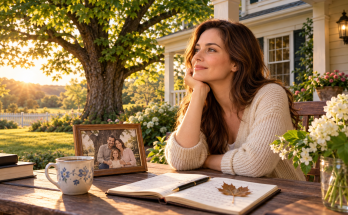
I placed the leaf inside my book.
Not the manuscript.
The notebook.
The first notebook.
The one where I had written what I wanted my life to become.
It felt right.
A leaf belonged with beginnings.
One evening, I called Edward.
He answered.
“You sent me a leaf.”
“Yes.”
“Why?”
“Because you like trees.”
“I do.”
“Then I thought you should have one.”
“I have one.”
“You sent it to me.”
“Then we're even.”
I laughed.
“Are you coming home?”
He paused.
“Maybe next year.”
I smiled.
“I'll make coffee.”
“I'll bring breakfast.”
“Don't burn it.”
“I make no promises.”
We laughed.
After we ended the call, I realized something.
I was no longer waiting for Edward to return.
I was simply happy that he might.
That was another form of freedom.
The book eventually reached its final page.
I wrote the last sentence slowly.
Then I stopped.
I didn't use the line I had used before.
I wanted something new.
I wrote:
A life is not measured by what we inherit, but by what we are brave enough to choose after we have learned the truth.
I stared at it.
Then I closed the notebook.
I didn't know what the future would bring.
That was okay.
The future had finally become mine.
Click here to continue reading: PART 35: THE INHERITANCE:
Three Days After Dad’s Funeral, My Husband Made a Decision That Revealed How Long He Had Been Waiting for My Father to Die
Part 34 of 35