I had imagined seeing Brian again many times.
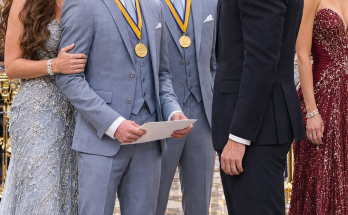
In none of those imagined meetings had one of our sons been standing in front of him with a gold medal around his neck.
And in none of them had my son been holding an envelope.
Yet there we were.
Brian stood facing the boy he hadn't recognized that morning.
My son held the envelope between them.
And I was several feet away, trying to understand what was happening without taking the moment away from him.
I could still hear the words he'd spoken.
"Dad, we've wanted to hand you this for thirteen years."
Thirteen years.
He had said it calmly.
Not loudly.
Not with the anger I might have expected.
That made the words harder to hear.
I looked toward my other son.
He had also earned a gold medal that afternoon.
He had also grown up without Brian.
And from the way his brother had spoken, I understood that the envelope concerned both of them.
I hadn't known about it.
That surprised me more than I wanted to admit.
For most of their lives, I'd been the person who knew almost everything happening around them.
I knew their school schedules.
I knew when they were worried about assignments.
I knew when one was disappointed and pretending he wasn't.
I knew their favorite subjects and the different ways they approached difficult problems.
But they were seventeen now.
They had thoughts they didn't always share with me.
They had feelings they needed to understand for themselves.
And apparently, they had something they wanted to give their father.
I watched Brian look at the envelope.
For the first time that day, he wasn't speaking.
That morning, he'd had plenty to say.
He'd demanded to know why I was there.
He'd acted offended that my children and I had arrived at the same statewide academic competition.
He'd stood beside Carla and their son as though the event belonged to them.
Now he was standing in front of a young man whose face resembled his own.
The same eyes.
The same jawline.
The same familiar expression.
I wondered whether he could see what I saw.
Not just the resemblance.
The years he'd missed.
The baby from that old christening photograph had become a seventeen-year-old boy who could stand in front of his father and speak for himself.
No explanation from me could have made that more obvious.
I thought about the morning again.
Brian had looked directly at the twins.
He hadn't recognized either one.
I'd known there was a chance that would happen.
The last photograph he'd seen was taken when they were babies.
Faces changed.
Children grew.
Thirteen years was a long time.
But watching it happen had hurt me in a way I hadn't expected.
I hadn't wanted Brian back.
I hadn't spent those years hoping he'd return and make everything right.
Eventually, I'd stopped thinking about that possibility.
But I had wanted him to remember our sons existed.
I wanted him to wonder who they were becoming.
I wanted him to care enough to know something about them.
Instead, he'd stood a few feet away and treated them like strangers.
Now one of those strangers was offering him an envelope.
I looked at my son's gold medal.
It rested against his jacket.
Only a short time earlier, he had stood on the stage while the announcer recognized him for physical sciences.
Then came the announcement about his raw score.
The highest in the entire state competition.
I had barely been able to believe it.
His brother had already received gold in applied mathematics.
Two sons.
Two separate achievements.
Two medals.
I had watched them work for years.
I knew those results hadn't appeared out of nowhere.
They had come from curiosity.
Discipline.
Patience.
And the willingness to keep trying when a problem wasn't easy.
There had been evenings when homework covered the table.
Evenings when one boy wanted to talk about mathematics while the other explained something from science.
I didn't always understand every detail.
Sometimes their questions went beyond what I could answer.
But I listened.
I asked them to explain.
I encouraged them to keep learning.
And when they became frustrated, I reminded them that difficult work wasn't the same as impossible work.
Those evenings had become such an ordinary part of our lives that I rarely stopped to consider what they meant.
Now I understood.
They were the years behind the medals.
They were also the years Brian hadn't been there.
I wondered if he knew anything about those evenings.
He couldn't.
He hadn't been there to see them.
He didn't know which son preferred applied mathematics.
He didn't know which one had developed a talent for physical sciences.
He didn't know how they behaved when they were disappointed.
He didn't know how they celebrated small victories.
He didn't know the different ways they smiled when something finally made sense.
And the painful truth was that those things mattered far more to me than the medals themselves.
The awards were wonderful.
I would remember that afternoon for the rest of my life.
But the boys had been worth knowing long before anybody called their names from a stage.
I wanted Brian to understand that.
I wanted to tell him that he hadn't missed two gold medals.
He'd missed two childhoods.
But it wasn't my moment to speak.
My son was standing in front of him.
And I had to let him finish what he'd chosen to do.
I looked at Brian's face.
The anger from the registration counter had disappeared.
I couldn't tell what had replaced it.
Surprise, perhaps.
Embarrassment.
Maybe regret.
I didn't know.
I had spent too many years imagining what Brian might be thinking.
I wasn't going to begin guessing again simply because he had finally recognized our sons.
What I knew was what he'd done.
He'd left thirteen years earlier.
He hadn't been part of the boys' upbringing.
He hadn't recognized them that morning.
And now he'd heard their surname announced twice.
Campbell.
The same surname I had spoken and written thousands of times while raising them.
The name on school paperwork.
The name teachers called.
The name attached to homework, performances, science fairs, and now two statewide gold medals.
He'd heard it.
He'd seen the boys stand together.
And he'd watched one of them look toward me from the stage.
That had been enough.
The truth was no longer something I needed to explain.
I thought about the woman sitting near us who had looked at the program.
She'd identified the Campbell twins.
Then she'd mentioned that their mother had raised them alone.
I hadn't expected anyone to say that.
And when she added that I deserved recognition too, I'd nearly cried.
It was strange to hear a stranger acknowledge something I'd done without thinking of it as an achievement.
Raising my sons hadn't been a competition.
There had been no medal waiting for me.
No ceremony after the difficult years.
No announcement when I made it through another week of responsibilities.
There had simply been another morning.
Another school day.
Another meal.
Another problem to solve.
And another reason to keep going.
I hadn't done those things because I expected praise.
I'd done them because my children needed me.
But hearing that woman's words had meant more than I expected.
Someone had noticed.
Someone understood that two boys didn't reach seventeen without years of care behind them.
I looked at my sons again.
For so long, I'd worried that I wasn't giving them enough.
I worried about the absence of a father.
I worried about the questions I couldn't answer.
I worried about the moments when other children had two parents attending their school events.
I couldn't change those circumstances.
I could only be present.
And I had tried to be.
I remembered birthdays when both boys wanted something different.
Medical appointments when one needed more attention than the other.
School performances when I searched the room for the best place to watch.
The late homework sessions.
The family dinners.
The ordinary conversations that happened when nobody expected anything important.
Those were the moments that built our family.
Not one dramatic event.
Not one perfect decision.
Thousands of small ones.
I had made mistakes.
I had lost patience sometimes.
I had worried too much.
There were occasions when I was tired enough to answer a question more sharply than I should have.
I wasn't going to pretend I'd been a perfect mother.
My sons knew better.
But I had never stopped being their mother.
That was the promise I'd kept.
And now they were old enough to decide what kind of relationship, if any, they wanted with Brian.
That realization frightened me.
I had spent so many years trying to protect them from pain that the instinct hadn't disappeared simply because they were nearly adults.
I wanted to step between them and anything that might hurt.
I wanted to shield them from another rejection.
Another careless remark.
Another moment when Brian treated their feelings as inconvenient.
But I couldn't protect them by preventing them from speaking.
They weren't little boys anymore.
They had earned the right to tell their own story.
I thought about the question one of them had asked after registration.
"Mom, was that really our father?"
I'd answered yes.
Then both boys had become quiet.
I had assumed they were struggling with the shock.
That may have been part of it.
But standing there now, I realized I'd been wrong to believe I understood everything about their silence.
Perhaps they'd been thinking about what they wanted to say.
Perhaps they'd been remembering the envelope.
Perhaps they'd simply needed a moment to accept that Brian was finally standing close enough to hear them.
I couldn't know.
I hadn't asked.
And whatever they had decided, they'd made that decision themselves.
I watched the envelope in my son's hand.
I didn't know what it contained.
There were no words visible for me to read.
No explanation I could safely give myself.
I wasn't going to pretend I knew its purpose simply because I was their mother.
For once, I was the one who had to wait.
And I understood something about how difficult that could be.
I had spent years giving the boys answers.
Now I needed to respect the fact that they had something to say which hadn't come through me first.
I felt proud of that.
And a little sad.
Not because they'd kept something from me.
Because it reminded me how close they were to adulthood.
They wouldn't always need me to stand beside them.
They would make decisions.
They would face people who disappointed them.
They would have conversations I couldn't manage.
And I would have to trust the values I'd tried to teach them.
I had always wanted them to be thoughtful.
I wanted them to understand that success didn't make them better than other people.
That disappointment didn't give them permission to be cruel.
That they could be firm without humiliating someone.
And that their worth didn't depend on another person's approval.
Now one of them stood in front of the father who had failed to give them the attention they deserved.
I watched him carefully.
He wasn't shouting.
He wasn't trying to turn the awards ceremony into a spectacle.
He was holding an envelope.
And he'd addressed Brian as his father.
The simplicity of it hurt.
Dad.
Such a small word.
I'd heard other children say it countless times.
At schools.
At performances.
In ordinary conversations.
Sometimes I'd heard it from across a room and felt a brief ache before reminding myself to concentrate on my own children.
For my sons, that word carried thirteen years of absence.
I didn't know how often they'd wanted to say it directly to Brian.
I didn't know whether they'd imagined this moment.
But I knew they'd lived without the everyday relationship that should have given the word its meaning.
Now my son had spoken it.
And Brian had heard him.
That was a fact no one could take away.
I looked toward Carla.
She was still part of the scene I'd never expected to encounter that morning.
Her son had come to compete.
I didn't know how he felt about what was happening.
I hoped nobody would make him responsible for his father's choices.
He hadn't abandoned my children.
He hadn't created the past thirteen years.
He was another student at an important event.
He deserved to have his own efforts respected.
I didn't want my sons' achievements to become a way of humiliating him.
Their success belonged to them.
It didn't need somebody else's failure to make it meaningful.
I wondered whether Brian understood that distinction.
He'd arrived to support one son.
Now he was face-to-face with another.
And the brother of the young man holding the envelope had also received gold.
All three boys had been part of the same competition.
But only two had spent their childhood without Brian.
That wasn't the fault of any child in the auditorium.
It was the result of decisions Brian had made as an adult.
And those decisions had consequences that no award ceremony could erase.
I looked at my son's face again.
I remembered the first time I saw that resemblance to Brian growing stronger.
It had unsettled me.
The eyes.
The jaw.
Sometimes even the expression.
There were moments when I looked at him and remembered the man who'd left us.
I had to remind myself that resemblance wasn't character.
My son wasn't responsible for his father's behavior.
He deserved to be loved as himself.
Not judged through my memories of Brian.
Over time, that became easier.
I stopped seeing Brian first.
I saw my boy.
His humor.
His patience.
His growing interest in science.
His determination to understand difficult things.
Now I wondered whether Brian was experiencing the opposite.
Seeing a stranger and suddenly recognizing his own face.
Recognizing a son he'd never known.
I couldn't tell whether that realization would change him.
The medals might impress him.
The resemblance might disturb him.
The envelope might make him confront something he'd avoided.
But none of those things guaranteed he would become a different person.
I had learned that lesson over thirteen years.
A moment of surprise wasn't the same as responsibility.
A father's recognition wasn't the same as fatherhood.
And regret, if he felt it, couldn't replace the years he'd missed.
I wasn't going to build new hopes around his expression.
My sons deserved steadier things than that.
They deserved to be valued whether or not Brian finally understood them.
I looked toward the stage.
Only a short time earlier, it had been the center of everything.
Names had been announced.
Medals had been awarded.
The highest raw score in the state had been recognized.
Now the important moment for me was happening away from the stage.
No announcer was explaining it.
No medal was being presented.
A young man was standing before his father.
And a mother was trying to let him speak.
I realized that this was another kind of achievement.
Not something measured by test results.
Not something that came with a certificate.
It was the ability to face a painful part of his life without needing me to handle it for him.
I was proud of that.
Perhaps more proud than I could have explained.
For thirteen years, my sons had grown in a home where Brian wasn't present.
His absence had shaped some parts of their lives.
I couldn't deny that.
But it hadn't prevented them from becoming thoughtful, capable young men.
They had built interests.
Learned difficult subjects.
Formed their own opinions.
And developed the courage to face a man who hadn't been there for them.
I wished Brian could understand that the courage mattered more than the medals.
The medals showed what they'd accomplished academically.
The moment with the envelope showed that they were prepared to speak for themselves.
I looked down at my hands.
They were trembling slightly.
I hadn't realized it.
I wanted to tell myself to calm down.
But I decided not to.
There was nothing shameful about being emotional.
My sons had just received statewide honors.
I'd seen my ex-husband for the first time in thirteen years.
And one of my boys was now addressing him directly.
I was allowed to feel overwhelmed.
I thought again about our family dinners.
The three of us sitting together.
Sometimes discussing school.
Sometimes laughing about something unimportant.
Sometimes eating quietly because everyone was tired.
I had once worried that those dinners looked incomplete from the outside.
Only three people.
No father at the table.
I used to imagine what other families might think.
Now I realized how little that mattered.
Those dinners had been complete in the ways that counted.
There was attention.
There was conversation.
There was care.
We knew one another.
Brian had missed that.
Not simply the meals, but the familiarity that grew from sharing them.
He didn't know how the boys spoke when they were relaxed.
He didn't know how they teased one another.
He didn't know which subjects made them excited.
He hadn't been there long enough to learn those details.
And those were the things that couldn't be handed over in an envelope.
I looked at the paper my son held.
Whatever was inside, it couldn't contain thirteen years of childhood.
Not all of it.
There were too many memories.
Too many ordinary moments.
Too much of life that had already happened.
The envelope could carry something the boys had chosen to give Brian.
But it couldn't give him the years themselves.
Those were gone.
I had to accept that too.
I couldn't return to the beginning and make different decisions for him.
I couldn't give the twins the father I'd once hoped they'd have.
And I couldn't change the way Brian treated us at registration.
I could only stand beside the young men I'd raised and respect how they chose to handle the present.
I looked toward my eldest son.
His medal was another reminder that this day belonged equally to both brothers.
One had won applied mathematics.
The other had won physical sciences and the highest overall raw score.
They were separate achievements.
Neither diminished the other.
I had always tried to teach them that.
Being twins didn't mean they had to compete against each other.
They could support one another while pursuing their own strengths.
And watching them receive their medals had shown me how far they'd come.
I wished their father had known that long before today.
But I wouldn't allow his ignorance to become the center of their success.
They had earned those honors with their own work.
I was there because I was their mother.
Brian's presence was an accident of the event.
It didn't change what they'd accomplished.
I remembered how harshly he'd questioned my right to attend.
How strange that seemed now.
I hadn't needed his permission.
The boys had qualified.
I had accompanied them.
That was the entire explanation.
Yet he'd reacted as though seeing me threatened something.
Now I was the one standing quietly while he faced the consequences of recognizing his sons.
I didn't feel a need to answer his earlier anger.
The afternoon had already answered it.
We belonged there because the boys had earned their place.
And I belonged there because I'd come to support them.
No argument could have made that clearer.
I watched Brian remain in front of my son.
The envelope was still between them.
I didn't know what he would say next.
For years, I'd imagined that hearing Brian apologize might heal something inside me.
But standing there, I understood that my life no longer depended on his words.
Whatever he said couldn't change the years behind us.
It couldn't take away the boys' accomplishments.
And it couldn't erase the love that had held our small family together.
That love had existed without his approval.
It would continue without it.
I felt something loosen inside me.
Not forgiveness.
I wasn't ready to call it that.
Not satisfaction either.
There was too much sadness in the situation.
It was simply the recognition that I had stopped needing Brian to understand my worth as a mother.
I knew what I'd done.
My sons knew I'd been there.
And their lives had become evidence of years we shared together.
I didn't need him to congratulate me.
I didn't need him to admit he'd been wrong.
I didn't need him to explain why he'd left.
Those questions might still matter to the boys.
If they wanted answers, they had every right to ask.
But I no longer needed Brian's response to decide whether our family had been enough.
We had lived thirteen years.
We had celebrated birthdays.
Managed illness.
Completed homework.
Attended performances.
Shared dinners.
And reached this extraordinary afternoon.
Three Campbells.
That was how we'd arrived.
And whatever happened with the envelope, that was still who we were.
I looked at my son's gold medal once more.
It caught the light when he moved.
I remembered the announcer saying his name.
I remembered hearing the highest raw score announced.
I remembered the pride on his face when he looked toward me.
That was the memory I wanted to keep closest.
Not Brian's anger.
Not Carla's smile.
Not the awkward confrontation.
The moment my son searched the auditorium for me and knew I was watching.
For thirteen years, that had been my promise.
I would be there.
When things were difficult.
When things were ordinary.
And when something wonderful happened.
I had kept it.
I looked back at Brian and my son.
The conversation belonged to them now.
I didn't know the envelope's contents.
I couldn't predict whether Brian would accept what it represented.
And I couldn't decide what the boys should feel afterward.
Those were answers that would have to come from them.
But I did know that neither son had anything left to prove in that room.
They hadn't needed the medals to deserve recognition from their father.
They hadn't needed the highest score in the state to deserve his presence.
They hadn't needed to carry an envelope for thirteen years to earn the right to speak.
They'd deserved those things simply because they were his children.
If Brian finally understood that, it would be something he had learned far too late.
If he didn't, the boys would still have their lives ahead of them.
Their achievements.
Their interests.
Their possibilities.
And the family we'd made together.
I watched my son stand steady before him.
Seventeen years old.
A gold medal around his neck.
An envelope in his hand.
The boy Brian had failed to recognize that morning.
The young man he could no longer ignore.
I didn't move to interrupt.
I didn't try to explain the past.
I didn't speak for either of my sons.
I simply stayed where they could see me.
Because after thirteen years, I finally understood that the most important thing I could give them wasn't another explanation for why their father had left.
It was the certainty that I hadn't.
And whatever was inside that envelope, whatever Brian eventually said, and whatever my sons chose to do with their relationship with him, that certainty would remain.
They had grown up loved.
They had grown up knowing somebody would show up.
And that afternoon, when their names were called before an auditorium full of people, I had been there to hear them.
Both names.
Both medals.
Every word.
I looked at my boys and felt the same thing I'd felt when they were little enough to hold against my chest.
They were my sons.
I was proud of them.
And nothing Brian said could change that.
The End
Read more original stories on Feel Every Story.
I Brought My Twin Sons to the Most Important Competition of Their Lives, Never Expecting to Find the Father Who Had Forgotten Them
Part 5 of 5