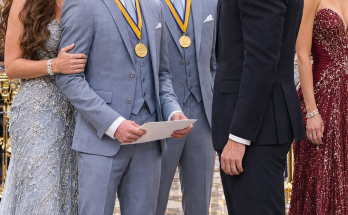
I thought the awards would be the most emotional part of the day.
I was wrong.
By the time both boys had received their gold medals, I was struggling to keep myself composed.
My eldest had won applied mathematics.
His brother had won physical sciences.
And the second award had come with another distinction.
The highest raw score of any student in the entire state.
I had heard all three announcements.
I had seen my sons recognized.
And I had watched Brian discover that the boys he'd ignored at registration were his own children.
That should have been enough for one afternoon.
I wanted to enjoy the moment.
I wanted to congratulate the boys.
I wanted to take in what they'd accomplished before ordinary life began moving again.
But something else was happening in the auditorium.
People were noticing the two names.
The same surname.
Campbell.
Two boys.
Two gold medals.
I could hear the interest around me.
It was understandable.
A pair of brothers winning separate statewide categories was remarkable.
I knew that.
But I had spent so many years thinking of them simply as my sons that hearing strangers discuss their achievements felt strange.
They weren't babies anymore.
They weren't little boys sitting at our table with schoolwork.
They were young men whose effort had brought them public recognition.
I looked toward them again.
Both seemed composed.
I wondered whether they were aware of everything happening around them.
Whether they had noticed Brian's reaction.
Whether they understood what he was discovering.
I thought back to the morning.
His voice at the registration counter.
The anger in his expression.
The way he'd demanded to know why I was there.
He had behaved as though I was intruding on something that belonged to him.
Then he'd looked at my sons without recognizing either one.
I hadn't forgotten that.
I doubted I ever would.
But I hadn't expected the truth to reach him so publicly.
He'd come with Carla and their son.
He'd wanted to support the boy they were raising together.
That boy had every right to be there.
Every right to compete.
Every right to feel proud of his own effort.
I didn't want him embarrassed because of his father's history.
And I didn't want my twins' achievements turned into a contest between families.
That wasn't why we'd come.
But the contrast was impossible to ignore.
Brian had been present for one son's academic event.
He had abandoned the other two thirteen years earlier.
And now those two boys were receiving gold medals in front of him.
The same man who hadn't recognized them that morning was watching them stand among the best students in the state.
I turned slightly in my seat.
Brian was several rows behind me.
He was still watching.
His expression had lost the anger I'd seen earlier.
There was something unsettled about him now.
I couldn't know exactly what he felt.
I didn't want to pretend I could read his mind.
But I could see that he was no longer treating our presence as a minor inconvenience.
He understood that the boys were connected to him.
He understood that their surname wasn't a coincidence.
And he had seen the face of our second son.
That resemblance was impossible for me to overlook.
The same eyes Brian had.
The same jawline.
The same expression.
I remembered noticing those features when my son was younger.
Sometimes the resemblance hurt.
It brought back memories I'd tried not to dwell on.
Other times, I barely thought about it.
My son was his own person.
He might look like his father, but he wasn't Brian.
He had grown up making his own choices.
He had developed his own interests.
He had worked for his achievements.
And he had learned to treat people with a consideration his father hadn't shown us.
I wanted Brian to understand that.
Not because he deserved to share in their success.
But because the boys deserved to be seen for who they were.
They were more than a reminder of the family he'd left.
More than two familiar faces.
More than the surname being announced from the stage.
They were people.
People he'd never bothered to know.
I looked back toward the front.
My second son had smiled at me while receiving his recognition.
I would remember that expression for the rest of my life.
There was pride in it.
And warmth.
The kind of look a child gives a parent when something important has happened and he wants to share it.
I smiled back.
I wanted him to know I had seen everything.
Every award.
Every moment.
Every bit of work that had brought him to that stage.
I didn't need him to explain why it mattered.
I'd been there for the years behind it.
Then I heard a man speaking nearby.
He was asking his wife about the two boys.
I didn't turn immediately.
I was still looking toward the stage.
But I could hear the conversation.
The woman checked the printed program.
She identified them as the Campbell twins.
Then she mentioned that their mother had raised them alone.
I felt my face grow warm.
I hadn't expected a stranger to know that.
Perhaps it was something she understood from information available to her.
I didn't know.
But hearing it spoken aloud in that room affected me.
For thirteen years, I'd lived that truth.
I hadn't treated it as a special achievement.
It was simply what needed doing.
My children needed me.
So I stayed.
There had been times when I was overwhelmed.
Times when I worried about whether I was making the right decisions.
Times when I wished I had somebody to share the responsibility.
But the years moved forward.
And so did we.
Now a stranger was describing our family in a sentence.
Their mother raised them alone.
It sounded simple.
It hadn't been simple.
It had meant attending medical appointments without another parent beside me.
It had meant helping with homework when I was tired.
It had meant remembering school schedules.
It had meant showing up for performances.
It had meant making family dinners feel ordinary even when I was worried about something.
It had meant answering difficult questions about Brian.
And it had meant learning when to step back so the boys could become independent.
I hadn't done every part perfectly.
I knew that.
But I had remained present.
The woman continued speaking.
She said their mother deserved recognition too.
Her voice was loud enough for people nearby to hear.
I looked down.
I wasn't accustomed to being praised like that.
I had spent years trying to make certain the boys didn't feel the absence of a second parent more than necessary.
I hadn't expected anyone to notice the work behind it.
And I certainly hadn't expected that work to be acknowledged at a statewide awards ceremony.
I felt tears again.
Not because I wanted a medal.
I didn't.
The boys had earned theirs.
But hearing somebody recognize the years I'd spent raising them touched something I hadn't realized was still so tender.
I thought about all the times I'd wondered whether I was enough.
Whether one parent could give two boys the support they deserved.
Whether they'd grow up feeling something essential had been missing.
I couldn't erase Brian's absence.
I never could.
But I had tried to make sure they knew they were loved.
Now they were seventeen.
They had become thoughtful, capable young men.
And a stranger had noticed that someone had been there for them.
I couldn't explain why that mattered so much.
It simply did.
I glanced toward Brian.
He had heard the remark.
I could see it in his reaction.
He was sitting close enough that the woman's words reached him.
The description was unmistakable.
The Campbell twins.
Their mother.
Raised alone.
It was a public statement of the life he'd left behind.
I wondered whether he'd ever thought about the practical details.
Not the dramatic moments.
The ordinary ones.
Had he ever considered who took the boys to the doctor?
Who helped when schoolwork became difficult?
Who attended their birthdays?
Who listened when they were disappointed?
Who stood beside them when they achieved something important?
Perhaps he had.
Perhaps he hadn't.
I couldn't know.
But he was hearing the answer now.
I had.
For thirteen years.
That wasn't something I wanted to use as a weapon.
It was simply true.
And the truth had reached him without me having to explain it.
I looked at the boys again.
I wanted to keep the focus on them.
Their medals weren't proof that I'd defeated Brian.
They were recognition of their own work.
I knew how much the distinction mattered.
For years, I had worried that their father's absence might make them believe they were somehow less important.
I never wanted that.
I wanted them to understand that Brian's choices were his responsibility.
Not theirs.
They hadn't caused him to leave.
They hadn't failed to earn his attention.
They hadn't needed to become exceptional students to deserve his love.
They had deserved it all along.
That was the part I wished he'd understood before this afternoon.
My eldest was worthy of his father's care long before anyone awarded him a gold medal.
His brother was worthy of it long before he achieved the highest raw score in the state.
They were worthy when they were babies.
When they were learning.
When they were frightened.
When they needed ordinary help.
And when they were doing nothing more impressive than sitting at our dinner table.
The medals hadn't changed that.
They had only made it impossible for Brian to keep overlooking the people his sons had become.
I watched as my second son stepped down from the stage.
His medal hung around his neck.
I expected him to come toward me.
That was what usually happened after an important moment.
He would find me.
We would exchange a smile.
Perhaps he'd say something understated, as though winning gold weren't such a big deal.
I was already preparing to congratulate him.
But he didn't move in my direction.
He turned.
At first, I thought he was simply finding another way through the auditorium.
Then I saw where he was looking.
Brian.
My son's father.
The man he'd recognized near registration that morning.
I felt my heart begin to beat faster.
I wasn't prepared for this.
I had assumed the boys wanted time to process seeing Brian.
Their silence after the encounter had seemed natural.
I thought they might want to discuss it privately later.
I hadn't expected either of them to approach him in front of the other families.
I watched my son's face.
He didn't appear uncertain about where he was going.
He moved directly toward Brian.
For a moment, I wanted to call him back.
Not because he'd done anything wrong.
Because I knew how painful the conversation could become.
Brian had already behaved cruelly that morning.
He'd spoken to me with anger.
He'd treated our presence as an intrusion.
I didn't want my son to stand in front of him and receive the same treatment.
I wanted to protect him.
The old instinct rose immediately.
I had protected the boys for thirteen years.
I had tried to shield them from unnecessary hurt.
And now one of them was walking toward the person who had caused some of the deepest hurt in our family.
I started to move.
Then I stopped.
My son was seventeen.
He wasn't a small child asking me to solve a problem.
He was a young man.
He had just stood on a statewide stage and accepted recognition for his work.
He knew who Brian was.
He knew the history.
And he was choosing to approach him.
I couldn't make every difficult decision for him.
I had spent years teaching the boys to think for themselves.
To speak honestly.
To take responsibility for their choices.
Now I had to trust what I'd taught them.
Even when it frightened me.
Brian saw him approaching.
He began to rise.
I watched the movement carefully.
The man who had stood so confidently at registration seemed different now.
He no longer had the advantage of not recognizing the boys.
He knew.
He had heard the names.
He had seen the medals.
He had seen the face that resembled his own.
And he'd heard another parent acknowledge that their mother had raised them alone.
There was nothing left to misunderstand about who was standing in front of him.
My son stopped.
For a moment, neither moved.
I wanted to hear what they might say.
I also wanted to look away.
Thirteen years were standing between them.
Thirteen years of missed birthdays.
Missed appointments.
Missed performances.
Missed ordinary moments.
I wondered whether Brian understood how much that meant.
I wondered whether my son had rehearsed something.
Whether he had questions.
Whether he wanted an explanation.
I didn't know.
The auditorium seemed quieter to me.
Perhaps it wasn't.
Perhaps people were still speaking and moving around.
But my attention had narrowed to those two figures.
Brian.
And our son.
One wearing a gold medal.
The other seeing him properly for the first time in thirteen years.
I thought about the last photograph Brian had seen of the twins.
Their christening.
That picture had always troubled me.
It represented the point where his knowledge of their lives had effectively stopped.
He hadn't watched them grow.
He hadn't learned their personalities.
He hadn't been there to see them discover the subjects they loved.
Now one of those babies was standing in front of him as a young man.
And he had something to say.
I looked at my son's expression.
I couldn't tell whether he was angry.
He seemed composed.
That didn't mean he wasn't hurting.
I knew how carefully he could hold his feelings when something mattered.
I wanted to walk over and stand beside him.
I wanted to make certain he knew he wasn't alone.
Then I remembered something.
He already knew.
I'd spent thirteen years showing him.
I didn't need to interrupt the moment to prove it again.
So I stayed where I was.
I let him stand in front of his father.
Brian was on his feet now.
His attention remained fixed on the boy.
I wondered what he saw.
The familiar eyes?
The jawline?
The gold medal?
Or the thirteen years that had passed without him?
I couldn't answer that.
Only Brian knew what he was thinking.
But I could see that he recognized his son.
That recognition had come too late to change the past.
It couldn't restore birthdays.
It couldn't return childhood moments.
It couldn't give the twins the father they'd needed when they were younger.
And no medal could make those years disappear.
But it was happening now.
The truth was standing in front of him.
I thought about the other boy.
My eldest.
He had also won gold.
He had also grown up without Brian.
Whatever happened in this conversation belonged to both of them.
That mattered.
Their experiences weren't identical in every detail.
They were different people.
But they shared the same absence.
The same father.
The same thirteen years.
And the same mother who had tried to keep life moving.
I watched my son reach toward his jacket.
The movement surprised me.
I hadn't expected him to take anything out.
His gold medal still hung around his neck.
For one brief moment, I thought he might be adjusting it.
But his hand moved inside the jacket.
Then he brought out an envelope.
I stared.
I hadn't known he was carrying it.
I didn't know what was inside.
I didn't know whether his brother had helped prepare it.
But the way he held it made me understand that this moment wasn't an accident.
He had brought something for Brian.
Something he intended to give him if the opportunity came.
I thought back to the quiet walk away from registration.
One of my sons had asked whether the man was their father.
I'd said yes.
Then both boys had fallen silent.
I'd assumed they were overwhelmed.
I'd assumed they needed time.
Perhaps I'd been too quick to decide what that silence meant.
They were seventeen.
They had their own thoughts.
Their own memories.
Their own feelings about the man who had left us.
I knew a great deal about their lives.
But I couldn't know everything inside them.
And I shouldn't have expected to.
My son held the envelope in front of him.
Brian looked at it.
I could feel my own hands tightening.
I wanted to know what was written inside.
I wanted to know why he'd carried it.
I wanted to know whether this encounter would help him or hurt him.
But those questions had to wait.
For once, the conversation wasn't mine to manage.
It belonged to my sons.
I had spent thirteen years answering questions Brian should have been there to answer.
Now one of the boys was standing directly in front of him.
He no longer needed me to speak on his behalf.
I felt proud.
And frightened.
Both at once.
I thought about the morning again.
Brian's anger.
Carla beside him.
Their son in his private-school blazer.
The way Brian had demanded to know why I was attending the competition.
He had believed the day belonged to his new family.
He had no idea that the two young men standing behind me were his own children.
Now those young men had won two gold medals.
One had achieved the highest raw score in the state.
And the father who hadn't recognized them was standing face-to-face with one of them.
I couldn't have arranged a more painful demonstration of what Brian had missed.
But I hadn't arranged any of it.
The boys had earned their awards.
They had attended the competition because of their work.
They had asked the truth about Brian that morning.
And now one of them had chosen to approach him.
I had done nothing except bring them to the event and stand beside them.
That was enough.
For thirteen years, I'd worried about whether being the only parent at home was enough.
I'd wondered whether there were things my sons needed that I couldn't provide.
I'd carried guilt over circumstances I hadn't created.
But looking at my son with his medal and envelope, I understood something important.
I hadn't raised children who needed their father's approval to believe they mattered.
I had raised young men capable of facing difficult truths.
They could be hurt.
They could be disappointed.
They could have questions.
But they were not helpless.
And they were not invisible.
I looked at Brian.
He had spent thirteen years living without knowing these sons.
Now he could no longer pretend they were distant memories.
They were standing in the same room.
They had names.
Faces.
Achievements.
And feelings that didn't disappear simply because he'd chosen another life.
My son looked directly at him.
Then he spoke.
"Dad."
I felt the word settle inside me.
It was so ordinary.
A word millions of children used every day.
But hearing it directed at Brian after thirteen years was almost unbearable.
My son continued quietly.
He told Brian that he and his brother had been waiting thirteen years to give him the envelope.
Then he held it out.
I stayed where I was.
The medals had already been awarded.
The crowd had already heard the Campbell name.
Brian had already recognized the faces of the boys he'd abandoned.
Now he was being offered something I knew nothing about.
I couldn't tell what the envelope contained.
I couldn't decide what it meant for my sons.
I couldn't predict how Brian would respond.
And I wasn't going to invent an explanation simply because I wanted the moment to end neatly.
I watched my son.
He was still standing straight.
The gold medal rested against his chest.
The envelope remained in his hand.
I thought about the boy who had once needed help with his homework.
The child who had asked difficult questions about his father.
The teenager who had worked hard enough to stand among the best students in the state.
He had become someone I admired.
Not because he had won.
Not because Brian was finally paying attention.
Because he was facing something painful with a calmness I wasn't sure I could have managed at his age.
I looked toward my other son.
He was part of this moment too.
Whatever was in the envelope, his brother had spoken for both of them.
I knew there would be things we'd need to discuss afterward.
Questions I would have.
Feelings they might want to share.
But I didn't need to interrupt.
They deserved the opportunity to speak for themselves.
Brian had missed thirteen years of their lives.
He couldn't recover those years by accepting an envelope.
He couldn't erase his absence by looking surprised.
And he couldn't claim their achievements simply because he was their father.
But he could no longer say he didn't know who they were.
That much had changed.
I thought about the woman who had looked at the program and praised me for raising the twins alone.
Her words had touched me.
But standing there, watching my son, I realized I didn't need a stranger's approval to understand what those years had meant.
I knew.
I had lived them.
Every birthday.
Every appointment.
Every late homework session.
Every ordinary dinner.
Every moment when I chose to stay present.
Those years had shaped our family.
Brian's absence had been part of our story.
But it hadn't been the whole story.
The boys had grown.
They had learned.
They had worked.
They had become people with futures beyond the circumstances of their childhood.
And now they were standing in front of the man who hadn't been there to watch it happen.
I didn't know what would come next.
I only knew that the person holding the envelope wasn't the baby Brian remembered from a christening photograph.
He was my son.
Seventeen years old.
A statewide gold medalist.
A young man with his own voice.
And he was finally using that voice to address the father who had missed almost everything.
I watched him hold out the envelope.
For the first time that day, I wasn't thinking about what Brian might say to me.
I was thinking about what my sons had chosen to say to him.
And I understood that the moment belonged to them.
Click here to continue reading: PART 5: My Son Held Out an Envelope to the Father Who Abandoned Him, and I Finally Understood What Thirteen Years Had Taught My Boys
I Brought My Twin Sons to the Most Important Competition of Their Lives, Never Expecting to Find the Father Who Had Forgotten Them
Part 4 of 5