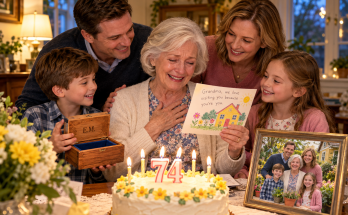
The first thing I noticed was the laughter. Not the warm, affectionate laughter that fills a room when a family shares a happy memory, but the thin, careless kind that leaves one person standing outside the joke. My daughter-in-law, Paige, had just handed me a birthday card with a lottery ticket tucked inside. My son, Graham, was already smiling before I opened it. Across the dining table, my grandchildren watched their parents, waiting to discover what was so amusing about their grandmother receiving a present.
"Go ahead, Evelyn," Paige urged, sliding a quarter toward me. "Maybe this will finally make you rich enough to afford your own transportation." She glanced at Graham, inviting him to appreciate her cleverness. He obliged with a laugh. I looked at the scratch ticket, then at the little card it had come in. The price sticker was still attached. Two dollars for the ticket, another dollar or so for the card. I was seventy-three years old, and this was the only birthday gift my son and his wife had chosen for me.
I thanked Paige anyway. That was a habit I had developed over many years: acknowledge the gesture, even when the intention behind it was difficult to understand. Beside me sat the birthday cake I had prepared that morning, a simple vanilla sponge with buttercream frosting. Paige had complained that bakery cakes were expensive, so I had offered to make one. She had accepted without hesitation. Now she was cutting generous slices for everyone else while I scratched the silver coating from the ticket.
At first, I wasn't paying much attention. The quarter left metallic dust along the edge of my thumb, and one of the children was asking for a larger piece of cake. I uncovered the first row of symbols, then the second. Something about the pattern made me stop. I brought the ticket closer to the overhead light and examined the instructions printed in tiny letters near the bottom. My pulse began to quicken. I checked the symbols again, moving my fingertip across each one to make certain I hadn't misunderstood what I was seeing.
The advertised prize was eleven million dollars.
For several seconds, the kitchen seemed to withdraw from me. I could still hear plates touching the table and Graham opening another bottle of wine, but the sounds appeared to come from another room. I read the ticket's instructions a third time. Nothing changed. The symbols remained exactly where they had been. I had spent most of my adult life watching grocery prices, comparing electricity bills, and putting aside small amounts for emergencies. Now I was holding a piece of cardboard that might be worth more money than I could easily imagine.
"Well?" Graham asked from the counter. "Did Paige make you a millionaire?"
I looked up. He was smiling, his attention already returning to the wineglass in his hand. Paige stood beside the cake, scraping excess frosting from the knife. Neither of them seemed particularly interested in my answer. They expected another joke, another opportunity to laugh at the old woman who still checked supermarket advertisements and saved rubber bands in a kitchen drawer.
I folded the ticket carefully, keeping the printed surface from rubbing against itself. "I don't believe I'll be buying any bus tickets with it," I replied.
Paige laughed. "That's about what I expected."
I slipped the ticket into the pocket of my gray cardigan. My hands were steady by then, although I could feel my heartbeat against the fabric of my blouse. Graham carried the wine into the living room. Paige asked me to bring the remaining cake after everyone had finished eating. I nodded and began collecting the plates. Nobody asked to see the ticket. Nobody noticed that I had stopped eating my own slice.
My name is Evelyn Mercer. I had been living in my son's rented house for almost four years, ever since my husband, Thomas, died. When Graham first suggested that I move in with his family, I believed it was an expression of love. He had been worried about me living alone, particularly during the difficult months after the funeral. I was still learning how to sleep in a bed that felt too large, how to shop for one person, and how to make decisions without turning to Thomas for his opinion.
"You'll have company," Graham had told me. "And the children will get to spend more time with you."
He sounded so much like the boy I had raised that I agreed before thinking through what sharing a household would mean. Graham had always been affectionate as a child. He used to follow Thomas into the garage, asking questions about tools and fishing equipment, then return to the kitchen to tell me everything he had learned. I could still picture him at eight years old, standing beside the refrigerator with muddy shoes and an enormous grin. I wanted to believe that the man he had become possessed the same generous heart.
For the first few months, living together seemed to work. I helped with dinner when Paige was delayed at the office. I watched Owen and Chloe when their parents had appointments. I drove to the supermarket and occasionally collected prescriptions. Those were ordinary things a grandmother might do for a family she loved. I enjoyed hearing the children come home from school, and I liked having people to talk to at breakfast. After the silence of my own house, their busy household initially felt comforting.
Then the requests became expectations. Paige stopped asking whether I could cook and began leaving ingredients on the counter. Graham assumed I would collect the children whenever his workday ran late. Laundry appeared outside my bedroom door, sometimes without anyone mentioning it. I discovered that if I didn't clean the kitchen after dinner, the dishes would remain there until morning. Nobody announced that I was responsible for these tasks. They simply waited for me to do them.
I told myself that families made adjustments. I was grateful to have somewhere to live, and I didn't want Graham to think I had forgotten his kindness. Still, there were moments when I felt less like his mother and more like an employee who received room and board instead of wages. If I sat down with a book while Paige was preparing dinner, she would remark that there was plenty to do. If I mentioned visiting a friend, Graham sometimes asked who would stay with the children.
The most painful incident happened several weeks before my birthday. I had been carrying clean towels along the upstairs hallway when I heard Paige speaking in the kitchen below. Her voice was sharp with frustration. She complained that I was becoming difficult to accommodate, that the house was crowded, and that she wanted more privacy. Then she said something I couldn't dismiss as ordinary irritation.
"Your mother is becoming a burden, Graham."
I stopped with the towels pressed against my chest. There was a pause, followed by the familiar sound of my son sighing. I waited for him to defend me, perhaps to remind Paige how much I contributed to their household. Instead, he asked what she expected him to do. After all, I was his mother. He spoke as though that relationship were an unfortunate circumstance neither of them could change.
I returned to my bedroom without delivering the towels. I sat on the edge of the bed, staring at Thomas's photograph on the dresser. He was standing beside a fishing boat, squinting into the sun, one hand raised to shield his eyes. Thomas had never been a wealthy man, but he understood the difference between needing someone and valuing them. When Graham was young, Thomas would sometimes tell him that gratitude was something a person demonstrated through behavior, not merely through words.
I wondered what Thomas would have thought of our son now. The question hurt because I already knew part of the answer. Graham wasn't cruel in the obvious ways people recognized immediately. He didn't shout at me or threaten me. He simply allowed my life to become smaller because that arrangement made his own life easier. Perhaps that was why I had tolerated it for so long. There was no single dramatic event I could point to, only hundreds of small moments that had gradually changed the way I saw myself.
On the evening of my birthday, after everyone had gone upstairs, I returned to the kitchen and washed the remaining dishes. Paige had left frosting on the counter. Graham's wineglass stood beside the sink. I cleaned everything, wiped down the table, and switched off the overhead light. Then I went into my bedroom, closed the door, and took the lottery ticket from my cardigan.
Under the yellow glow of my bedside lamp, I examined it again. I read the instructions slowly, checking each symbol against the printed prize information. I didn't allow myself to celebrate. A mistake seemed far more likely than a miracle. I knew there were rules governing large prizes, deadlines for claiming them, and procedures I didn't understand. Before telling anyone, I needed to know whether the ticket was genuine and what it actually meant.
I found an envelope among my stationery and placed the ticket inside. Then I put the envelope in a small wooden box where I kept Thomas's letters and several important documents. The box had belonged to his father, and its brass clasp had grown loose with age. I closed it carefully and pushed it toward the back of my dresser drawer. For a moment, I stood there with my hand resting on the polished wood.
I could have walked into Graham's bedroom and shown him the ticket. I could have watched his expression change, heard Paige suddenly speak to me with excitement, and allowed the entire household to celebrate. But the thought troubled me. I wanted to know whether their affection would change because I had money. More importantly, I wanted time to understand what I might be able to do with it before anyone began making plans on my behalf.
That night, I lay awake listening to the house settle. A pipe clicked somewhere behind the wall. Owen's bedroom door opened and closed. Outside, rain tapped against the window above the flower bed. I thought about Thomas, the years we had spent working, and the retirement we had imagined before illness took him away. We had planned to travel more, perhaps find a little cottage near my sister Ruth. Those plans had disappeared beneath hospital appointments and funeral arrangements.
For the first time in years, I allowed myself to picture a future that wasn't organized around someone else's needs. I imagined waking up without wondering what Paige expected me to accomplish before lunch. I imagined choosing when to visit my grandchildren rather than waiting to be assigned responsibility for them. The possibilities frightened me almost as much as they excited me. At seventy-three, I had become accustomed to asking permission without realizing I was doing it.
By morning, I had made one decision. Whatever the ticket was worth, I would not discuss it with Graham or Paige until I understood my position. I prepared breakfast as usual, packed Chloe's lunch, and reminded Owen to take his sports bag. When Graham asked whether I had slept well, I told him I had. It was an ordinary conversation, the kind we had every weekday morning. Yet something fundamental had changed.
After the house emptied, I took out my address book and searched for the name of an attorney Thomas had once recommended. I had never needed his services, but I remembered that he handled estates and financial matters. His name was Martin Hale. I wrote down his telephone number, placed the lottery ticket in my handbag, and called his office.
The receptionist offered me an appointment for the following Monday. I accepted, then stood by the kitchen window for a long time, watching a delivery truck pull away from the neighbor's driveway. I had no idea how complicated the coming weeks might become. I only knew that the ticket had introduced a possibility I hadn't possessed the day before: the ability to make decisions without depending on my son's approval.
Before leaving the kitchen, I opened my handbag one last time to check that the envelope was still there. It was. I fastened the clasp and put the bag in my bedroom, beyond the reach of curious hands. Then I returned to the household chores, keeping my thoughts to myself. For the moment, Graham and Paige believed nothing had changed. I intended to let them continue believing that.
Click here to continue reading: PART 2: The Attorney Asked One Question About My Family, and I Realized Why My Unexpected Fortune Needed Protection Before Celebration
On My Seventy-Third Birthday, a Two-Dollar Gift Revealed a Secret That Would Change Everything I Believed About My Family
Part 1 of 35