One year after the birthday that changed everything, I returned to the same bakery where I had bought Thomas's favorite bread.
The owner recognized me.
“Still yellow walls?”
I smiled.
“Still.”
She handed me the loaf.
“Your husband used to come in every Thursday.”
“I know.”
“He always bought two.”
“He only ate one.”
She laughed.
“He said the second was for you.”
I smiled.
“He was lying.”
We both laughed.
Outside, the morning was warm.
People moved along the sidewalk carrying coffee.
Cars passed.
A dog barked at a delivery truck.
The world had continued.
That was one of the strangest things about grief.
You could lose someone and still have to buy groceries.
Still answer emails.
Still wash dishes.
Still wake up.
Still live.
For a long time, I had thought surviving meant returning to the person I had been before Thomas died.
I finally understood that wasn't possible.
I had become someone else.
Someone who knew her own value.
Someone who could love people without surrendering herself.
Someone who could have money without apologizing for it.
Someone who could forgive without pretending nothing happened.
When I reached home, Graham was waiting.
He carried a toolbox.
“What are you doing here?”
“Your porch.”
“My porch is fine.”
“It isn't.”
I looked at the loose railing.
“All right.”
He smiled.
“I'll fix it.”
He worked for an hour.
I watched from the kitchen.
When he finished, he tested the railing twice.
“There.”
“Thank you.”
He wiped his hands.
“Lunch?”
“You're making it.”
He groaned.
“You still remember.”
“I remember everything.”
We cooked together.
It was ordinary.
And that was precious.
Later, Paige arrived with the children.
The house filled with noise.
The grandchildren ran outside.
Ruth brought dessert.
Daniel came by with foundation papers.
For the first time, all the people who mattered were in one place.
Not because they needed money.
Not because they needed something from me.
Because they wanted to be together.
That was the outcome Thomas had never been able to guarantee.
It had to be chosen.
Graham sat beside me on the porch.
“Mom.”
“Yes?”
“Do you regret the ticket?”
I laughed.
“No.”
“Not even everything that followed?”
I thought about it.
“I regret some things.”
“Like what?”
“I regret that I spent so many years believing I had to earn my place in my own family.”
He looked down.
“I regret that too.”
“But I don't regret leaving.”
He nodded.
“I don't either.”
He was quiet.
Then he asked, “Would you do anything differently?”
“Yes.”
“What?”
“I would have said no sooner.”
He smiled.
“I would have listened sooner.”
I looked at him.
“That would have helped.”
We laughed.
Inside the house, the children shouted.
Ruth called from the kitchen.
“Who wants pie?”
Everyone answered.
I stood.
Then stopped.
On the porch table sat the original scratch ticket.
The one Paige had given me.
I had kept it.
Not because it was valuable.
Because it reminded me of the moment everything changed.
The ticket itself had long since expired as a financial instrument.
The winning claim had been processed.
The money had been invested.
The number no longer mattered.
But I still remembered scratching those silver squares.
I remembered thinking I had won millions.
I hadn't understood what I had really won.
Choice.
I placed the ticket into a small frame.
Then I hung it beside Thomas's photograph.
The two things belonged together.
The ticket represented the life I chose.
The photograph represented the person who had believed I could choose it.
That evening, after everyone left, I sat alone in the kitchen.
The yellow walls glowed beneath the lights.
Rain began tapping against the window.
I opened the final letter from Thomas one more time.
There was something I hadn't noticed before.
At the bottom, beneath his signature, he had written one final sentence.
Not an instruction.
Not a warning.
Just a confession.
I was never afraid you would lose everything, Evelyn.
I was afraid you would spend your life believing you had nothing.
I read it until the words blurred.
Then I understood why he had chosen me.
Not because I knew business.
I didn't.
Not because I understood trusts.
I hadn't.
Not because I was fearless.
I wasn't.
He had chosen me because I had spent my entire life believing love meant giving.
He wanted me to learn that love could also mean receiving.
Receiving help.
Receiving money.
Receiving respect.
Receiving an apology.
Receiving the right to say no.
And perhaps most importantly, receiving my own life without feeling guilty for wanting it.
I folded the letter.
The house was quiet.
For once, quiet did not frighten me.
I made tea.
I sat beside the window.
Outside, rain fell across the garden Thomas had never seen.
The roses moved gently in the wind.
The cottage was small.
The fortune was enormous.
But the money no longer felt like the center of my life.
It was simply a tool.
A way to help people.
A way to create opportunities.
A way to protect the future.
But my life belonged to me.
That was the lesson Thomas had tried to leave behind.
Not how to become rich.
Not how to win.
How to choose.
Months later, the final legal proceedings ended.
Charles was convicted.
Martin was convicted.
Richard accepted responsibility for his role in the financial scheme.
Paige completed her sentence and continued rebuilding her life.
Daniel remained with the foundation.
Graham's business grew slowly.
The old house became a safe residence for families who needed somewhere to start again.
Ruth traveled more.
She refused to let the kidnapping become the story of her life.
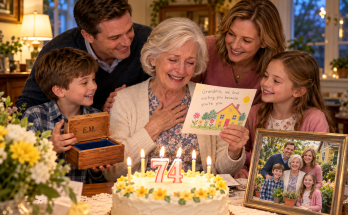
And I turned seventy-four.
This time, Paige did not give me a scratch ticket.
She brought flowers.
Graham brought a cake.
The grandchildren made a card.
Ruth cooked too much food.
Daniel brought a bottle of sparkling cider.
We ate on the porch.
At some point, Graham stood.
“I want to say something.”
Everyone became quiet.
He looked at me.
“Mom, I spent years believing you were strong because you could handle anything.”
I smiled.
“I wasn't.”
“I know.”
He continued.
“You were strong because you kept loving us even when we made it difficult.”
I looked down.
“But I learned something.”
“What?”
“Being strong doesn't mean letting people hurt you.”
He smiled.
“It means knowing when to walk away.”
The porch became quiet.
Then I raised my glass.
“To walking away when we need to.”
Everyone lifted theirs.
“To choosing.”
The word stayed with me.
Choosing.
That was the beginning.
That was the ending.
The scratch ticket had been worth millions.
But the greatest prize had been much smaller.
A yellow kitchen.
A quiet morning.
A son who finally understood.
A sister who survived.
A daughter-in-law who learned to tell the truth.
A husband whose final gift had been the courage to choose myself.
I had once believed that winning millions would change my life.
It did.
But not because money made me powerful.
Money simply removed the fear that had kept me from using the power I already possessed.
The power to say no.
The power to leave.
The power to forgive.
The power to stay.
The power to choose.
And when I finally understood that, I realized Thomas had been preparing me for that moment long before I ever scratched the first silver square.
I looked at his photograph on the wall.
“Thank you,” I whispered.
Then I turned off the kitchen light.
For the first time in my life, I walked into the darkness without being afraid of what waited there.
Click here to continue reading: PART 21: The Photograph Evelyn Thought She Had Finally Buried Returned With One Last Name, Forcing Her to Question What Thomas Had Left Unfinished
The Birthday Joke That Left Me Silent While Everyone Else Laughed at the Woman They Thought They Knew
Part 20 of 21