On the first morning of the new year, I woke to sunlight falling across the bedroom floor. The air was cold, and a thin layer of frost covered the garden. I lay quietly for several minutes, listening to the faint sounds of birds outside the window.
It had been thirteen months since I moved into the cottage.
Thirteen months since the courier delivered the legal notice to Graham and Paige.
Thirteen months since I left the house where I had spent nearly four years cooking, cleaning, and caring for my grandchildren.
And almost exactly a year since the January first date they had chosen for my move into Pine Harbor Senior Living.
I sat up slowly.
The anniversary felt important, though not in the way I might once have expected.
There was no anger rising in my chest.
No desire to revisit every argument.
Only a quiet awareness of how much had changed.
I dressed warmly and went downstairs.
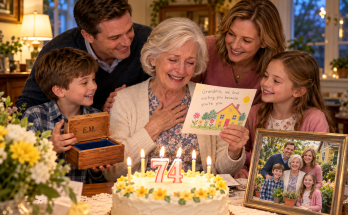
The cottage was still decorated for Christmas. The little tree stood beside the fireplace, and the framed photograph from my birthday rested on the mantel near Thomas's picture.
I made coffee and carried it to the reading chair.
Outside, the garden was resting beneath winter's cold.
The roses had been pruned.
The herbs were protected.
Owen's repaired planter stood beside the path, and Chloe's yellow birdhouse hung beneath the porch roof.
I smiled at the sight.
The garden had become a collection of memories.
Not because anyone had designed it that way.
But because people I loved had contributed small pieces of themselves to it.
I opened Ruth's notebook.
The first page contained the plans I had written after my birthday.
Continue volunteering.
Improve the garden.
Travel with Ruth.
Spend time with family without losing my independence.
I read the list carefully.
Then I turned to a fresh page.
At the top, I wrote:
What I have learned.
I sat for a while, considering the words.
The previous year had taught me more than I expected.
I had learned that financial security could provide choices, but it couldn't make those choices for me.
I had learned that love and obligation were not the same thing.
I had learned that people could change, but only when they were willing to acknowledge what they had done and behave differently.
And I had learned that forgiveness was not a single decision.
It was something built through repeated moments of honesty, respect, and care.
I wrote slowly.
Then I closed the notebook and went into the kitchen.
Later that morning, Ruth arrived carrying a small bag of pastries.
"Happy New Year."
"Happy New Year."
She hugged me.
We settled at the dining table with coffee.
Ruth looked around the cottage.
"Well, Evelyn. Another year."
"Yes."
"Any regrets?"
I considered the question.
"About leaving Graham's house?"
"About any of it."
I looked toward the window.
"I regret that things became so painful."
Ruth nodded.
"But I don't regret leaving."
She smiled.
"I didn't think you would."
We ate our pastries and talked about the coming spring.
Our coastal trip was beginning to take shape. We had chosen a small hotel near the water and planned to spend several days walking, reading, and visiting local shops.
Ruth was already making lists.
I laughed.
"You're becoming more organized than I am."
"Someone has to keep us sensible."
We spoke about the historical society, the winter lectures, and the possibility of volunteering for another exhibition later in the year.
I felt pleased by the prospect.
My life had become full of things I wanted to do.
Not things I had been assigned.
Not duties I had accepted because I was afraid to disappoint someone.
But activities that interested me.
After Ruth left, I walked through the garden.
The cold air made my cheeks sting.
I stopped beside the bench and looked toward the cottage.
The yellow walls were bright against the winter sky.
I remembered the first morning I arrived here.
Ruth had brought bread, jam, and chrysanthemums.
The rooms had been quiet and unfamiliar.
I had felt relieved, frightened, and uncertain all at once.
I had wondered whether Graham would forgive me for leaving.
Whether Paige would continue fighting over the lottery.
Whether the children would still want to visit.
Whether I had made a terrible mistake.
Now I knew the answer.
Leaving had not destroyed my family.
It had forced us to confront the way we had been living.
The process had been painful.
But it had given us the chance to build something healthier.
That afternoon, Graham telephoned.
"Happy New Year, Mom."
"Happy New Year, sweetheart."
He sounded cheerful.
The children were playing in the background, and I could hear Paige asking someone to put away a game.
I smiled.
"Sounds busy."
He laughed.
"Very."
We spoke about Christmas and the coming weeks.
Then Graham hesitated.
"Mom, I've been thinking about something."
"What is it?"
"About this time last year."
I sat down.
"So have I."
He was quiet for a moment.
"I remember how angry I was when I found out you owned the house."
"I know."
"I thought you'd been hiding something from us."
I listened.
He continued.
"I didn't understand that we'd made you feel you couldn't tell us what you wanted."
I looked toward the garden.
"It wasn't easy."
"I know."
He took a breath.
"I think about that morning sometimes. The letter, the notice, the taxi."
I remembered it too.
The suitcase beside the front door.
The children's confused faces.
Paige's anger.
Graham standing in the hallway, unable to understand why I was leaving.
"I was frightened," I admitted.
He sounded surprised.
"You were?"
"Very."
"I didn't know."
"I was afraid you'd stop speaking to me."
He was silent.
Then he said, "Mom, I'm sorry."
"I know."
He took a breath.
"I wish I'd made you feel safe enough to tell me."
I felt tears rise.
"Thank you."
We sat in silence for a moment, connected by the telephone and the memories we had finally learned to discuss honestly.
Then Graham said, "I hope you know you can tell me things now."
I smiled.
"I'm learning that."
He laughed softly.
"So am I."
We spoke for a while longer.
He told me that the family had made further progress with their repayment plan. They were still working carefully with their financial counselor, and Paige's new position was helping them build savings.
They hadn't become wealthy.
Their problems hadn't vanished.
But they were managing their responsibilities.
I was proud of them.
Before ending the call, Graham asked whether I would join them for dinner the following weekend.
I checked my calendar.
Saturday was free.
"I'd love to."
He sounded pleased.
"Great."
After we ended the call, I sat quietly for a while.
I thought about the lottery ticket.
The little square of cardboard Paige had given me on my seventy-third birthday.
At the time, I had been hurt by the joke.
I had felt that my dependence had become something the family could laugh about.
Then I scratched the ticket and discovered the prize.
The advertised eleven million dollars had seemed almost impossible to comprehend.
But even then, I hadn't understood what the money would mean.
At first, I thought it would simply provide security.
Then I realized it could give me choices.
The choice to buy the cottage.
The choice to protect my grandchildren's education.
The choice to manage my finances independently.
The choice to refuse demands that would have left me feeling used.
And, perhaps most importantly, the choice to remain connected to my family without depending on them for a place to live.
I looked toward Thomas's photograph.
He had worked hard throughout his life.
We had built a business, raised a son, and managed our money carefully.
We had known difficult years.
We had also known happiness.
When he died, I had felt that much of my purpose disappeared with him.
I had moved into Graham's house believing I was being cared for.
And in some ways, I was.
But gradually, my role had changed.
I became the person who cooked, cleaned, drove, organized, and solved problems.
My own wishes faded into the background.
The lottery didn't create that imbalance.
It simply gave me the means to step away from it.
I stood and walked toward the mantel.
Thomas's notebook lay beside my chair.
I opened it to the familiar page.
Find somewhere Evelyn can sit in the sun and read without anyone needing her for a while.
I ran my fingers over the words.
He had written them months before his diagnosis.
At the time, we had been discussing the possibility of moving to a smaller home after retirement.
We had imagined a garden, a quiet room, and more time together.
Life had not allowed us to complete those plans.
But I had found the place he wanted for me.
I looked around the cottage.
The blue sofa.
The oak table.
The reading chair beside the window.
The shelves filled with books.
The photographs.
The garden.
It was not a grand house.
It was not the kind of property people might expect someone with my financial resources to purchase.
But it was exactly what I wanted.
A home where I could live comfortably and peacefully.
A home where my family could visit.
A home where I could close the door when I needed quiet.
I smiled.
Later that afternoon, Chloe telephoned.
"Grandma, Happy New Year!"
"Happy New Year, sweetheart."
She sounded excited.
"Mommy says we might visit you next weekend."
"Yes. We're arranging something."
"Can we make biscuits?"
I laughed.
"Of course."
"And can Owen help with the garden?"
"If there's something that needs doing."
She paused.
"Grandma?"
"Yes?"
"Do you like living in your cottage?"
I looked toward the window.
"Very much."
"More than living with us?"
I considered the question carefully.
"I loved being with you and Owen," I said. "But I also love having a home of my own."
She was quiet.
"Does that mean you don't want to live with us again?"
"No, sweetheart. It means I can love you very much and still enjoy living here."
She seemed to think about that.
Then she said, "I like having my own room too."
I smiled.
"I know."
"And sometimes I don't want Owen coming in."
I laughed.
"Exactly."
She giggled.
Then she said, "Okay. I love you, Grandma."
"I love you too."
After we ended the call, I sat for a while smiling.
Children often understood things more simply than adults.
Chloe didn't need a complicated explanation of independence.
She understood that people could love one another and still want space of their own.
I wished the adults in our family had understood that sooner.
But we were learning.
That evening, I prepared a simple dinner and ate at the oak table.
The house was quiet.
Afterward, I washed the dishes, made tea, and settled into my reading chair.
Outside, the winter sky darkened.
The garden disappeared into shadow.
The cottage lamps cast a warm light across the room.
I thought about the year ahead.
There would be volunteer meetings, family dinners, school events, and visits from the children.
There would be a trip to the coast with Ruth.
There would be books to read, flowers to plant, and new things to learn.
There might be disagreements.
There might be difficult decisions.
Life would continue to change.
But I no longer felt that those changes had to be decided by someone else.
I had learned to trust my own judgment.
I had learned to ask for help without surrendering control.
I had learned to say no without apologizing for having needs.
And I had learned to accept love without turning it into a debt I had to repay through endless service.
I looked toward the framed family photograph on the mantel.
Graham.
Paige.
Owen.
Chloe.
And me.
We were standing together in the garden, smiling beneath the summer sun.
The photograph didn't show the arguments we had survived.
It didn't show the letters, the legal notices, or the painful conversations.
But I knew those things were part of our history.
I didn't need to erase them.
They had taught us something.
I picked up Ruth's notebook and turned to the page I had begun that morning.
Beneath What I have learned, I wrote one final sentence.
My life belongs to me, and that makes the love I give freely more meaningful.
I read it slowly.
Then I closed the notebook.
The room was peaceful.
Thomas's photograph stood beside the family picture.
Owen's wooden box rested on the shelf.
Chloe's drawing was still attached to the refrigerator.
And the little yellow birdhouse waited outside for spring.
I smiled.
A year earlier, I had been expected to move into a senior community chosen by my family.
Instead, I had chosen a cottage.
I had chosen independence.
I had chosen to protect my future.
And, eventually, I had chosen to rebuild my relationship with the people I loved.
The lottery ticket had been worth millions.
But the life I had created was worth something I couldn't measure.
I turned off the lamp and went upstairs.
Tomorrow would be another ordinary day.
There would be coffee in the morning, perhaps a walk if the weather was pleasant, and a few hours of reading before I worked on my notes for the historical society.
Nothing dramatic.
Nothing extraordinary.
Just a day that belonged to me.
And that was enough.
The End
Read more original stories on Feel Every Story.
On My Seventy-Third Birthday, a Two-Dollar Gift Revealed a Secret That Would Change Everything I Believed About My Family
Part 35 of 35