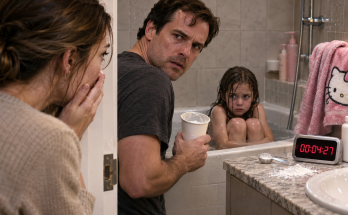
Several weeks had passed when the detective contacted me again.
I was sorting Ivy's clothes into a small dresser Natalie had cleared for us.
He asked whether I had time to speak privately.
I closed the bedroom door.
Then I sat on the edge of the bed.
He explained that investigators had obtained additional relevant records concerning Graham's management of Ivy's supposed health problems.
Those records included notes he had made about her routines.
Some entries corresponded with occasions Ivy had described during her interview.
Others required further examination.
I listened without interrupting.
The detective said the information supported concerns that Graham's actions hadn't been limited to the afternoon I discovered him.
There was a pattern.
I looked toward the blue quilt.
I had suspected that already.
Hearing it from someone examining the evidence was different.
The detective explained that Graham's notes appeared to emphasize compliance.
Whether Ivy remained in the bathroom.
Whether she cooperated.
Whether the routine had been completed.
The language disturbed me.
Ivy was a child.
She wasn't an accounting problem.
She wasn't a set of figures that needed to balance.
She was allowed to be uncomfortable.
She was allowed to ask questions.
She was allowed to say she wanted to stop.
I asked whether the records established his intentions.
The detective explained that intentions were a separate question.
Investigators could establish actions and circumstances.
They couldn't simply assume what a person had been thinking.
I appreciated his caution.
I wanted the truth.
Not a version exaggerated by my anger.
He also explained that the findings would be reviewed alongside the medical evidence and professional assessments.
When the call ended, I remained sitting on the bed.
I thought about Graham's personality.
His preference for order.
His impatience when plans changed.
His tendency to treat disagreement as something requiring correction.
Those qualities weren't proof of wrongdoing by themselves.
But what he had done with them mattered.
He had applied them to a little girl who depended entirely on him.
He had ignored her discomfort.
Then he had asked her to hide it from me.
I walked downstairs.
Natalie was washing dishes.
I told her about the call.
She dried her hands.
“Are you okay?”
“I don't know.”
She nodded.
We stood in the kitchen together.
The rainbow was still on the wall.
Its corners had begun curling.
I found another piece of tape and secured them.
That was something I could fix.
A few days later, Ivy had another appointment with her counselor.
She had started becoming familiar with the office.
There were colored cushions, books, and a collection of small toys.
She liked choosing where to sit.
While she spent time with the counselor, I waited in the adjoining area.
I brought a book.
I read the same page several times.
Afterward, the counselor spoke with me about Ivy's progress.
She explained that children could experience mixed emotions about a parent who had frightened them.
They might miss that parent.
They might remember happy moments.
They might feel worried about seeing them again.
Those feelings could exist together.
I understood immediately.
I had been experiencing a grown-up version of the same confusion.
The counselor encouraged me to let Ivy express her feelings without correcting them.
I agreed.
That evening, while we were putting away her school things, Ivy asked about Graham.
“Does Daddy miss me?”
I sat beside her.
“I think he does.”
“Can he be sad?”
“Yes.”
She considered that.
“Is it my fault?”
“No.”
I said it gently.
“Grown-ups are responsible for their own choices.”
She looked at Bunny.
“Daddy used to read me books.”
“I remember.”
“He did funny voices.”
“Yes, he did.”
She smiled at the memory.
Then her expression changed.
“I don't want to do the bathroom thing.”
“You don't have to.”
She seemed relieved.
I realized she had been trying to understand whether missing her father meant accepting everything he had done.
I wanted her to know that it didn't.
Love wasn't permission.
Missing someone wasn't an obligation to be frightened by them.
She didn't need those ideas expressed in complicated words.
She needed to experience them through the decisions I made.
The following week, Graham's mother requested contact with Ivy.
My attorney advised me about the appropriate arrangements.
I had no desire to punish Ivy's grandmother simply because she was Graham's mother.
But I needed to know that any contact would respect the boundaries established for Ivy's protection.
We communicated through the appropriate channels.
Graham's mother insisted she would never deliberately upset her granddaughter.
I hoped that was true.
Then she suggested telling Ivy that Daddy was sorry for the misunderstanding.
I refused.
I wasn't going to let anyone explain away Ivy's experience before the investigation was complete.
Her grandmother became angry.
She accused me of controlling the family.
I didn't respond to the accusation.
The boundaries remained.
That afternoon, I took Ivy shopping for new shoes.
She chose a pair with little silver stars.
They were slightly more expensive than the plain ones.
I checked my budget.
Then I bought them.
She wore them out of the store.
Every few steps, she looked down at her feet.
“Do you see them shining?”
“I do.”
She was delighted.
We stopped for groceries afterward.
I let her choose apples.
She examined each one seriously before putting it into the bag.
Watching her made me realize how often I used to hurry her.
Graham liked finishing errands efficiently.
Everything had a preferred order.
I had gradually adopted his impatience.
Now I waited while Ivy selected six apples.
Nothing terrible happened because we took longer.
Back at Natalie's house, I started looking at apartment listings.
My sister had never suggested that we needed to leave.
But I wanted to establish a home of our own.
Somewhere Ivy could choose the decorations for her bedroom.
Somewhere I could make ordinary decisions without considering Graham's opinion.
I found several modest apartments within a reasonable distance of her school.
One had two bedrooms and a small balcony.
The kitchen was narrow.
The living room received plenty of sunlight.
I arranged a viewing.
Natalie came with us.
Ivy explored the empty rooms.
She was particularly interested in the smaller bedroom.
“Could Bunny sleep here?”
“Of course.”
She looked at the window.
“Can I have yellow curtains?”
I smiled.
“We'll find some.”
The apartment wasn't impressive.
There were no expensive appliances.
The floors had a few scratches.
But I could afford it if I was careful.
I completed the application.
While waiting for the decision, I continued managing the legal paperwork.
The investigation had reached another stage.
The detective explained that the evidence would be reviewed by the appropriate authorities to determine further legal action.
I asked what I should expect.
He explained that the process could take time.
There were still matters that needed to be assessed.
I understood.
I didn't need an immediate promise.
I needed the process to be thorough.
Graham requested another opportunity to explain himself through the approved channels.
This time, his message was shorter.
He admitted that he should have discussed his decisions with me.
He admitted that he had asked Ivy not to mention the bathroom routine.
But he maintained that he had done so because he believed I would overreact.
I read that sentence slowly.
There it was again.
He had made a decision.
Our daughter had become frightened.
He had concealed the decision.
And somehow, my reaction was still his explanation.
I wondered what an apology would have sounded like if he had genuinely understood the damage.
Perhaps he would have asked how Ivy was doing.
Perhaps he would have acknowledged her fear without arguing about whether she should have experienced it.
Perhaps he would have accepted responsibility without immediately introducing my supposed faults.
His message contained none of those things.
I forwarded it to my attorney.
Then I went back to making dinner.
A few days later, the apartment application was approved.
I showed Natalie the email.
She hugged me.
Ivy wanted to know whether we were celebrating something.
I told her we had found a new place to live.
She asked whether Natalie could visit.
“Whenever we arrange it.”
“Can she bring pancakes?”
Natalie laughed.
“Absolutely.”
That evening, we made a list of things we would need.
Bedsheets.
Plates.
Towels.
Curtains.
Ivy insisted that Bunny needed a special pillow.
I added it to the list.
The next weekend, Natalie helped me begin packing.
We gathered our clothes and books.
I removed Ivy's pictures from the kitchen wall.
The rainbow came away carefully.
The drawing of the yellow sun followed.
Then her spelling worksheet.
Natalie found a large envelope to protect them.
Ivy held it against her chest.
“These go in our new house.”
“Yes.”
She smiled.
I thought about how those pictures had appeared one by one throughout our stay.
Each represented an ordinary afternoon.
A moment when Ivy had felt safe enough to create something.
I wanted more moments like that.
I didn't need our new home to be perfect.
I needed it to be a place where she could speak without worrying about what happened afterward.
That night, I made one final entry in the notebook I had started when we arrived at Natalie's house.
I listed the apartment deposit.
The first month's rent.
Estimated grocery expenses.
The cost of the yellow curtains.
I added everything carefully.
The numbers were manageable.
There wouldn't be much left over.
But there would be enough.
I closed the notebook.
For years, Graham had used financial uncertainty to make difficult decisions seem impossible.
Now I was beginning to see the difference between something being difficult and something being impossible.
I could manage difficult.
I had already managed worse.
Upstairs, Ivy called for me.
I found her sitting beneath the blue quilt.
She was holding Bunny.
“Mommy, are you happy?”
I sat beside her.
“I'm happy we're together.”
“Me too.”
She leaned against me.
Then she asked whether I would leave the bathroom door open in our new apartment.
“Whenever you want.”
She nodded.
That was apparently all she needed to know.
I kissed her forehead.
When she fell asleep, I looked around Natalie's spare bedroom.
The room had held us during the worst weeks of our lives.
Soon, we would leave it.
Not because everything was finished.
Not because all our questions had been answered.
Because we were ready to begin living somewhere that belonged to us.
Click here to continue reading: PART 8: We Moved Into a Small Apartment With Yellow Curtains, and Graham Finally Faced Consequences That His Explanations Could Not Prevent
I Thought I Knew the Man I Married Until a Quiet Voice Behind Our Bathroom Door Made Me Question Everything
Part 7 of 10