The next morning, I woke before Ivy.
For several seconds, I didn't recognize the bedroom.
Then I saw the blue quilt.
Everything came back.
Ivy was sleeping beside me with one hand resting against my arm.
I stayed still until she woke.
She asked for cereal.
Natalie had three different kinds in her cupboard.
We let Ivy choose.
It felt important to give her a choice, even about something that small.
She picked the cereal with little marshmallows.
She ate slowly.
I made two phone calls while Natalie sat with her.
The first was to the detective assigned to our case.
The second was to Ivy's pediatrician.
I explained why I needed to speak with her.
The office arranged an appointment that afternoon.
Graham's statement kept repeating in my head.
The doctor recommended it.
I needed to know whether that was true.
At the clinic, Ivy recognized the receptionist.
She waved.
The waiting room had the same colorful posters it had always had.
Ordinary things had begun to feel strangely comforting.
When the pediatrician entered, she greeted Ivy first.
Then she turned to me.
“I understand there was an incident yesterday.”
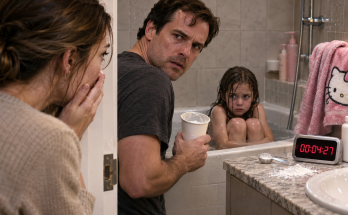
I described the bathroom.
I told her about the powder, timer, and Graham's explanation.
She opened Ivy's medical record on her computer.
For several minutes, she reviewed the information.
I watched her face.
Finally, she turned away from the screen.
“We discussed her constipation at her last visit.”
I nodded.
“We recommended dietary adjustments, hydration, and a treatment plan appropriate for her age.”
“Did you tell Graham to use a powder during her bath?”
“No.”
“Did you recommend timing her baths?”
“No.”
I stared at the floor.
She continued gently.
“There is nothing in her treatment plan resembling what you've described.”
I wanted to ask her whether she was absolutely certain.
But she had the records in front of her.
Graham had used her professional authority to justify something she hadn't recommended.
That much was now clear.
I took a breath.
“Could there be another explanation?”
“There could be information we don't have. The substance needs to be identified, and the circumstances need to be investigated.”
She wasn't accusing him of anything beyond what she knew.
Neither would I.
But his explanation had fallen apart.
The doctor agreed to cooperate with the investigators.
Before we left, she checked Ivy again and discussed her follow-up care with me.
I thanked her.
Outside the clinic, Ivy asked whether we could get a small ice cream.
We did.
She chose vanilla.
She ate it in the back seat while I sat in the driver's seat staring at my steering wheel.
I had trusted Graham's explanation because it sounded medically responsible.
He had known exactly which words would make me hesitate.
That was difficult to admit.
My phone displayed another message from his mother.
She insisted that Graham was a wonderful father.
She reminded me how often he attended Ivy's school events.
I didn't dispute those things.
I had attended the same events.
I knew how charming he could be around other parents.
But good attendance at school functions couldn't answer the questions about that bathroom.
I called the detective.
I told him what the pediatrician had said.
He requested the medical documentation through the appropriate process.
Then he asked whether Graham had contacted me.
I described our conversation the previous evening.
He told me to preserve the messages.
I agreed.
That afternoon, I received information about temporary protective arrangements.
Graham wasn't permitted to have unsupervised contact with Ivy while the situation was being assessed.
I read the notice twice.
Then a third time.
For the first time since the previous afternoon, there was something concrete between my daughter and the situation that had frightened her.
It wasn't a final answer.
It was protection while people looked for answers.
Back at Natalie's house, Ivy was coloring at the kitchen table.
I recognized the picture she was working on.
A house.
A tree.
Three people.
She colored one figure blue and another purple.
I didn't ask her to explain it.
I sat nearby and folded laundry.
After a while, she put her pencil down.
“Mommy?”
“Yes?”
“Am I in trouble?”
I stopped folding.
“No, honey.”
“Daddy said I wasn't supposed to tell.”
I placed the shirt beside me.
“You can always tell me when something worries you.”
“Even if somebody says not to?”
“Yes.”
She thought about that.
Then she returned to her picture.
I didn't question her further.
I wrote down her exact words afterward, along with the date and circumstances.
I passed that information to the professional handling her case.
That evening, Graham emailed me.
His message was longer than his previous ones.
He described himself as a devoted father.
He accused me of escalating a misunderstanding.
He suggested that my emotional state had influenced Ivy's behavior.
At the bottom, he asked me to consider the financial consequences of a prolonged investigation.
I read that sentence several times.
There was something extraordinarily familiar about it.
Graham had always been good with money.
He understood numbers, contracts, and consequences.
When we disagreed, he often explained what my decisions would cost.
Now he was treating our daughter's safety as another calculation.
I forwarded the message to my attorney and the investigator.
I didn't answer him.
Natalie found me sitting at her kitchen table.
“Have you eaten?”
I shook my head.
She put a plate of food in front of me.
I took a few bites.
Then I began crying again.
Not because I missed Graham.
Because I remembered how much I had believed in him.
I remembered holding Ivy for the first time and watching him stand beside the hospital bed.
I had imagined our future together.
Birthdays.
School graduations.
Family vacations.
Growing old.
I couldn't simply erase those memories because of what I had discovered.
But I couldn't use them to erase what was happening now either.
Natalie sat beside me.
Neither of us spoke for a while.
Upstairs, Ivy was getting ready for bed.
She called for me.
I wiped my face and went to her.
She was standing outside the bathroom.
“Can you come in with me?”
“Absolutely.”
I left the door open.
There was no timer on the counter.
No unexplained container.
No one asking her to keep anything from me.
Later, as I tucked her beneath the quilt, she asked whether we could stay another night.
I told her we could.
She smiled.
It was a small smile.
But it was the first one I had seen at bedtime since everything happened.
I turned off the lamp.
Then I sat beside her until she fell asleep.
Click here to continue reading: PART 4: While Graham Insisted That Everyone Had Misunderstood Him, the Evidence From Our Bathroom Began Telling a Very Different Story
I Thought I Knew the Man I Married Until a Quiet Voice Behind Our Bathroom Door Made Me Question Everything
Part 3 of 10