The divorce papers were prepared the following week.
I read them at Natalie's kitchen table.
Ivy was at school.
The house was unusually quiet.
My name appeared beside Graham's.
Seeing the two names together brought back memories I hadn't invited.
Our wedding invitations.
The documents we signed when we bought our house.
Ivy's birth certificate.
For years, our names had represented a shared future.
Now they appeared on papers explaining why that future needed to end.
I signed where my attorney had instructed me.
Then I put the pen down.
There was no dramatic feeling of freedom.
I was ending a marriage that had once meant everything to me.
That hurt.
I allowed myself to admit it.
Later that afternoon, my attorney confirmed that the paperwork would proceed through the proper channels.
I thanked her.
Then I collected Ivy from school.
She wanted to stop at the park.
We spent nearly an hour there.
She climbed the little steps leading to the slide.
She waved every time she reached the top.
I waved back.
It was strange how motherhood continued through everything.
Children still needed snacks.
They still lost hair clips.
They still asked questions about clouds.
I was grateful for those ordinary demands.
They kept me connected to the present.
Two days later, Graham learned about the divorce filing.
His message arrived that evening.
He asked whether I had considered what this would do to Ivy.
I stared at the screen.
It was the same argument he had made in the bathroom.
The circumstances had changed.
His reasoning hadn't.
He said children needed both parents.
He reminded me that Ivy had always loved him.
He suggested that separating her from him could cause more damage than anything that had happened during her baths.
I felt anger rising inside me.
Then I remembered that I didn't need to answer every accusation.
I saved the message.
My attorney would handle the matters requiring a response.
I turned my phone off.
The next morning, Graham's mother called Natalie.
My sister told her that she wouldn't discuss the investigation or the divorce.
Graham's mother became upset.
Natalie ended the conversation politely.
When she told me what had happened, I apologized.
She shook her head.
“You don't need to apologize for somebody else's behavior.”
I was still learning that.
A few days later, the detective asked whether I remembered when Graham first began managing Ivy's bathroom routine.
I sat down with my notebook.
I tried to separate clear memories from guesses.
I remembered several evenings when he had insisted on helping her.
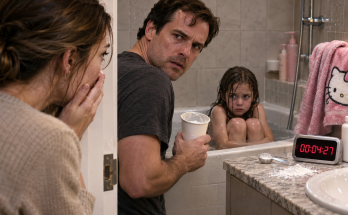
I remembered that the timer had appeared among our household items months earlier.
I couldn't remember when it had first been used in the bathroom.
I explained that honestly.
The detective asked whether Graham kept records of Ivy's health.
He had occasionally mentioned tracking her symptoms.
I had assumed that was part of his organized personality.
He liked spreadsheets.
He liked schedules.
He liked having information arranged where he could review it.
I told the detective what I remembered.
Afterward, I wondered whether Graham's organization had hidden something I should have questioned.
I didn't know.
I was becoming careful about those three words.
I didn't know.
They were more honest than the explanations I used to invent for him.
The detective explained that investigators were reviewing relevant records obtained through lawful processes.
He didn't ask me to conduct an investigation myself.
That was a relief.
I wanted to spend my time caring for Ivy.
I didn't want every evening to become another examination of Graham's behavior.
That afternoon, Ivy came home with a small spelling worksheet.
We sat together at the kitchen table.
She practiced writing the word cat.
Then dog.
Then mom.
She drew a heart beside the last word.
I kissed the top of her head.
“That's lovely.”
“It's for you.”
I placed the worksheet beside the other pictures.
The wall was becoming crowded.
Natalie said we might need another wall soon.
Ivy laughed.
That weekend, my attorney arranged another opportunity to retrieve belongings from our house.
I made a list.
Winter clothes.
Shoes.
Personal documents.
A few things from Ivy's bedroom.
I didn't want to spend longer there than necessary.
When I entered the house, I noticed the absence of ordinary family noise.
There was no television.
No child asking for something.
No Graham opening his laptop at the dining table.
I went directly upstairs.
Ivy's bedroom still smelled faintly of her shampoo.
Several picture books were stacked beside her bed.
I packed them.
Her little pink slippers were beneath the chair.
I put those in the bag too.
Then I found a drawing taped to the side of her bookshelf.
It showed three people holding hands.
I recognized Graham's figure.
He was taller than everyone else.
I folded the drawing carefully and placed it inside a book.
I wasn't going to destroy Ivy's memories because of my own feelings.
She had a complicated relationship with her father.
She deserved help understanding it without being told what to feel.
In our bedroom, I opened the drawer containing my jewelry.
My wedding ring felt heavy on my finger.
I looked at it for a moment.
Then I removed it.
I placed it inside its original box.
I didn't throw it away.
I wasn't ready to make that decision.
But I didn't want to wear it anymore.
Downstairs, I collected a few photographs.
I left the wedding portrait on the dresser.
As I walked toward the front door, I noticed the indentation in the living room couch where I had sat holding Ivy that afternoon.
Perhaps it had always been there.
I couldn't tell.
I remembered the paramedic looking at my shaking hands.
I remembered Graham describing me as anxious.
I wondered whether he had genuinely believed that explanation would work.
Probably.
It had worked often enough before.
I left the house carrying two bags.
Outside, the sunlight was bright.
I stood beside my car and looked back.
I had imagined raising Ivy there.
I had imagined measuring her height against a doorway every birthday.
I had imagined watching her walk out that front door on her first date.
Those memories hadn't happened.
I was grieving things that had never existed.
That was one of the strangest parts of leaving.
Back at Natalie's house, Ivy was delighted to see her picture books.
She selected the one about a rabbit who couldn't find his way home.
I read it to her before dinner.
She corrected me when I accidentally skipped a page.
We laughed.
Later that evening, my attorney informed me that Graham was challenging aspects of the temporary custody arrangements.
He wanted expanded contact with Ivy.
He maintained that the restrictions were unnecessary.
I asked what would happen.
She explained the legal process and reminded me that decisions would be based on the available evidence and Ivy's welfare.
I listened.
Then I asked whether the pediatrician's statement had been included.
She confirmed that it had.
The medical records.
The laboratory findings.
The officers' observations.
The relevant professional assessments.
All of those things mattered.
I felt grateful that the situation wasn't simply a disagreement between Graham and me.
For years, disagreements with him had ended when I became too tired to continue.
This time, other people were examining the facts.
The hearing took place several days later.
I wore a plain navy blouse.
Natalie stayed with Ivy.
My attorney met me outside the courtroom.
I saw Graham before we entered.
He looked almost exactly as he had on ordinary workdays.
Clean shirt.
Neatly arranged hair.
Polished shoes.
He looked at me.
I looked back.
For the first time, I noticed how little his appearance told me about him.
Inside, the attorneys presented their arguments.
Graham's attorney described him as a responsible parent whose intentions had been misunderstood.
My attorney focused on the established concerns and the need to protect Ivy while the investigation continued.
When Graham spoke, his voice was steady.
He acknowledged making an independent decision concerning Ivy's treatment.
He insisted he had been trying to help.
He said the secrecy had been misunderstood.
He claimed he had only wanted to avoid unnecessary disagreement between us.
That sentence stayed with me.
Avoid disagreement.
He had involved our five-year-old daughter in his effort to keep information from me.
Even by his own account, he had placed her in the middle of something that belonged entirely to adults.
The court maintained protective restrictions.
Additional decisions would depend on further information and assessment.
My attorney explained the outcome as we walked outside.
I felt relieved.
I also felt exhausted.
Graham approached from the other end of the corridor.
His attorney was beside him.
He stopped a short distance away.
“You didn't have to do this.”
My attorney indicated that communication should go through the proper channels.
I didn't respond.
Graham looked disappointed.
Not frightened.
Not ashamed.
Disappointed that I hadn't returned to the role he expected me to play.
I walked away.
In the parking lot, I called Natalie.
She put Ivy on the telephone.
“Mommy, we're making pancakes!”
I smiled.
“For lunch?”
“Yes!”
I heard Natalie laughing in the background.
I told Ivy I would be home soon.
On the drive back, I thought about the word home.
For years, I had used it to describe the house I shared with Graham.
Now it meant a blue quilt.
A kitchen wall covered with drawings.
My sister making pancakes at an unreasonable hour.
And a little girl who no longer had to wait for permission to leave the bathtub.
When I arrived, Ivy ran toward me wearing a flour-covered apron.
She showed me the pancake she had made.
It was shaped like something between a circle and a triangle.
I ate it anyway.
She watched me carefully.
“Do you like it?”
“I love it.”
She grinned.
I noticed a little flour on her nose.
A few weeks earlier, the sight of white powder had made her stop beside Natalie's kitchen counter.
That afternoon, she was laughing while helping make pancakes.
I didn't interpret that as proof that everything was healed.
But I was happy to see her enjoying herself.
Healing was allowed to happen quietly.
That night, Graham sent another lengthy message.
He reminded me of birthdays, holidays, vacations, and the years we had spent together.
He asked whether none of those memories mattered anymore.
I read the message once.
They mattered.
Of course they mattered.
But good memories couldn't cancel dangerous behavior.
They couldn't make Ivy's fear imaginary.
They couldn't turn secrecy into responsible parenting.
I put the phone down.
Upstairs, Ivy was waiting for her bedtime story.
She had selected the rabbit book again.
I climbed beside her beneath the blue quilt.
When the rabbit finally found his home, Ivy smiled.
“Read it again tomorrow?”
“Absolutely.”
She closed her eyes.
I sat beside her until her breathing became slow and even.
Then I looked at my empty ring finger.
I had loved Graham.
That was true.
I was leaving him.
That was true too.
For the first time, I understood that both truths could exist together without requiring me to abandon either one.
Click here to continue reading: PART 7: The Investigation Uncovered a Pattern Graham Could No Longer Explain Away, and I Began Understanding What Ivy Had Been Carrying Alone
I Thought I Knew the Man I Married Until a Quiet Voice Behind Our Bathroom Door Made Me Question Everything
Part 6 of 10