
The rainbow stayed beside Natalie's kitchen doorway.
Every morning, Ivy stopped to look at it before breakfast.
Sometimes she touched the purple stripe with one finger.
She was particularly proud of that part because she had drawn it herself.
I was glad she had something to be proud of.
There had been too many days when she seemed afraid of making even the smallest mistake.
On Monday morning, I received a telephone call from the detective.
I stepped into the backyard.
Natalie remained inside with Ivy.
The detective explained that the laboratory had completed additional testing on the substance recovered from our bathroom.
The results supported the preliminary findings.
The container held a laxative product that hadn't been prescribed to Ivy.
There was no evidence that her pediatrician had approved Graham's use of it.
I pressed my hand against the wooden fence.
“Does Graham know?”
“He's been informed about the findings.”
“What did he say?”
The detective explained that Graham maintained he had been trying to help his daughter.
He denied intending to harm her.
He also denied deliberately frightening her.
I looked through the kitchen window.
Ivy was sitting at the table with a piece of toast.
Natalie was pouring her some milk.
I wondered how many mornings Graham had watched that same little girl eat breakfast after doing something she was afraid to tell me about.
The detective continued.
The interview with Ivy had raised concerns about repeated incidents involving the bathroom.
Repeated.
I asked him to explain.
He told me that Ivy had described more than one occasion when her father made her remain in the bathroom despite her asking to leave.
She had also described being instructed not to discuss those occasions with me.
I closed my eyes.
“How many times?”
“We're still working to establish that.”
I thanked him.
Then I ended the call.
I remained beside the fence for several minutes.
I could hear a lawn mower somewhere down the street.
A bird landed on the fence and flew away.
Everything around me continued normally.
Inside my head, I was remembering things.
Little things.
Things I had dismissed because children sometimes complained about ordinary routines.
One evening, Ivy had followed me into the laundry room carrying her pajamas.
She had asked whether I could give her a bath instead of Graham.
I had been folding towels.
“Daddy can help you tonight, sweetheart.”
She hadn't moved.
“Please, Mommy.”
I remembered telling her that Daddy loved spending time with her.
I had actually said that.
I sat down on Natalie's back steps.
My hands felt cold.
There was another evening when Ivy had complained that she didn't like the bathroom anymore.
I had assumed she was going through a phase.
Children developed fears.
That was what I had told myself.
I hadn't asked enough questions.
Natalie came outside.
She sat beside me without saying anything.
After a moment, I told her what the detective had explained.
She listened.
When I finished, she placed her hand on my shoulder.
“I should have noticed.”
She didn't argue with me.
She didn't try to make the memories disappear.
Instead, she asked what I could do for Ivy now.
That was a much harder question.
It was also the question that mattered.
I called Ivy's care team later that morning.
We arranged another appointment.
I wanted to understand how to respond when Ivy shared something frightening.
I didn't want my own reaction to make her feel responsible for my sadness.
The specialist explained that children sometimes worried more about upsetting their parents than about describing what had happened to them.
I thought about the question Ivy had asked in front of the officers.
Would Daddy be angry?
She hadn't asked whether what happened was wrong.
She had asked whether telling someone would have consequences.
That distinction stayed with me.
That afternoon, I helped Ivy pack her school bag.
We were preparing for her return to school under the new safety arrangements.
She put her favorite purple pencil inside the front pocket.
Then she asked whether Graham would collect her afterward.
“No. I'll be there.”
“Promise?”
“I promise.”
She nodded.
We finished packing.
The next morning, I walked her into school.
Her teacher greeted us at the classroom door.
The school administration had received the necessary information about authorized pickup arrangements.
I appreciated their discretion.
Nobody discussed the situation in front of the other children.
Ivy hugged my leg.
Then she disappeared into the classroom.
I stood in the corridor longer than necessary.
Through the little window in the door, I could see her hanging up her backpack.
She looked like any other five-year-old.
I wanted her life to feel that ordinary again.
When I returned to Natalie's house, my attorney had sent several documents.
There were forms concerning temporary custody and protective arrangements.
There were financial matters that needed attention.
There were decisions about our house.
I read everything carefully.
Graham had handled most of our household finances throughout our marriage.
Not because I couldn't understand them.
Because he was an accountant, and it had seemed convenient.
Convenience had gradually become dependence.
I hadn't noticed the difference.
My attorney asked whether I had access to sufficient funds for Ivy's immediate needs.
I checked.
Fortunately, I still had access to an account in my own name.
We discussed practical expenses.
School supplies.
Medical appointments.
Food.
A possible apartment.
The ordinary costs of starting over looked enormous when they were written down together.
I began making a list in a notebook.
Natalie looked over my shoulder.
“You don't need to figure everything out today.”
“I know.”
But I needed somewhere to begin.
That evening, Graham sent another message through the approved communication channel.
He wanted me to understand that Ivy had a sensitive stomach.
He said I was interpreting her fear incorrectly.
He described her as a difficult child during certain routines.
I read that sentence twice.
A difficult child.
She was five.
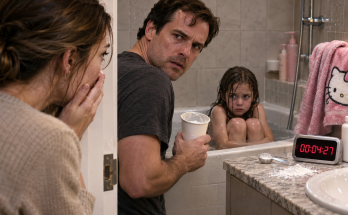
She had been sitting in a bathtub, frightened and waiting for a timer to finish.
And he was describing her as the problem.
I forwarded the message to my attorney.
Then I put my phone away.
When Ivy returned from school, she had a drawing in her backpack.
It showed a yellow sun above a little house.
She had written her name at the bottom.
Some of the letters were backward.
I told her it was beautiful.
She asked whether we could put it beside the rainbow.
We did.
Natalie brought the tape.
Ivy stood back and admired both pictures.
“This is our picture wall.”
“Yes, it is.”
She smiled.
At dinner, she told us about a classmate who had brought a dinosaur to school.
She laughed while describing its tiny arms.
I laughed too.
The sound surprised me.
I had forgotten that ordinary happiness could arrive in the middle of something terrible.
Later, I helped her get ready for bed.
She chose her pajamas.
She brushed her teeth.
When it was time to wash, she asked whether we could leave the bathroom light on afterward.
I agreed.
She held Bunny while I prepared everything.
There was no hurry.
There was no schedule she had to satisfy.
I let her tell me when she was ready.
When she finished, she wrapped herself in the Hello Kitty towel.
She had become particularly attached to it.
I dried her hair gently.
Then she looked at me through the mirror.
“Mommy?”
“Yes?”
“Daddy didn't like it when I wanted to get out.”
I stopped moving the towel.
I remembered what the specialist had told me.
Stay calm.
Listen.
Let her speak in her own words.
“What would you like me to know about that?”
She looked down.
“He said I had to wait.”
I nodded.
She touched the edge of her towel.
“I wanted you.”
My throat tightened.
“Thank you for telling me.”
She looked up.
“Are you sad?”
“A little.”
“Because of me?”
“No, sweetheart. Never because you told me.”
She leaned against my stomach.
I held her.
I didn't ask her to explain anything else.
After she fell asleep, I recorded what she had said and shared it with the appropriate professionals.
Then I went downstairs.
Natalie was sitting on the couch.
I sat beside her.
For a while, we watched television without paying attention.
Eventually, I told her something I hadn't said aloud before.
“I think I was afraid of upsetting him, too.”
She turned toward me.
I tried to explain.
Graham had rarely shouted.
He didn't need to.
He could make a simple disagreement last for hours.
He could turn my concerns into examples of my supposed lack of judgment.
He could make me apologize for raising questions that deserved answers.
Eventually, I had learned to choose silence because silence was easier.
I had thought I was keeping the peace.
Now I wondered whose peace I had actually been protecting.
Natalie reached for my hand.
I remembered Ivy sitting in that bathtub.
I remembered the way she had watched her father before speaking.
The similarities made me uncomfortable.
I didn't want her learning the habits I had developed throughout my marriage.
I didn't want her growing up believing that someone else's anger mattered more than her own safety.
The next day, I met with my attorney.
We discussed the possibility of filing for divorce.
She asked whether I was ready.
I looked down at the notebook containing my expenses.
There were pages of figures.
Some were estimates.
Some were amounts I couldn't yet afford.
For years, those numbers would have frightened me into reconsidering.
That morning, they looked like problems I could solve.
I thought about the things that couldn't be solved with money.
Ivy's fear.
Her lost trust.
The moments when she had wanted me and I hadn't understood.
“I want to proceed.”
My attorney explained the next steps.
I listened.
I asked questions.
When I left her office, I didn't feel victorious.
I felt tired.
But underneath the exhaustion was something I hadn't experienced in a long time.
The certainty that I had made my own decision.
That afternoon, Ivy ran toward me when I arrived at her school.
Her backpack bounced against her shoulders.
She took my hand.
“Did you remember?”
“Remember what?”
“You promised to get me.”
I squeezed her hand gently.
“Of course I remembered.”
She smiled.
We walked toward the car.
I understood then that rebuilding her trust wouldn't happen through one enormous promise.
It would happen through hundreds of small ones.
And I intended to keep every promise I could.
Click here to continue reading: PART 6: Graham Asked Me to Remember the Good Years of Our Marriage, but His Own Words Made It Impossible to Turn Back
I Thought I Knew the Man I Married Until a Quiet Voice Behind Our Bathroom Door Made Me Question Everything
Part 5 of 10

One Comment on “PART 5 – I Finally Learned Why Ivy Had Been Afraid of Bath Time, and the Answer Changed How I Remembered Our Marriage”