Eleanor called on a quiet afternoon.
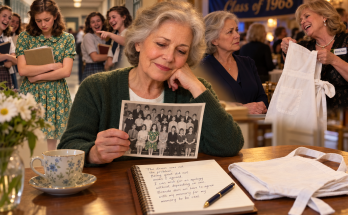
I was sitting at the kitchen table with a cup of tea and the notebook open beside me.
She asked how I was feeling.
“Better,” I said.
This time, I did not need to correct myself.
“I'm glad.”
We talked about ordinary things first.
The weather had turned cooler.
The town square was preparing for an autumn event.
Eleanor had misplaced a pair of reading glasses and suspected she had left them in a room where she had already searched twice.
I laughed when she described looking everywhere except the obvious place.
“I've done that,” I said.
“Of course you have.”
There was comfort in a conversation that did not demand anything from me.
Eventually, she mentioned the reunion.
“I heard Brenda has been talking about it,” she said.
My hand stopped around the cup.
“What has she been saying?”
“Nothing dramatic, as far as I know. Someone mentioned that she thought you left early.”
“I did leave early.”
“I told them you had every right to.”
I looked down at the tea.
“Did Brenda say anything else?”
Eleanor hesitated.
“She said she hadn't meant to offend you.”
I felt the old instinct rise.
I wanted to make the situation easier.
I wanted to say that it didn't matter.
I wanted to assure Eleanor that Brenda was probably well-intentioned, that I had misunderstood, that there was no reason for anyone to feel uncomfortable.
Those were the kinds of things I had said throughout my life.
They were often meant to keep the peace.
Sometimes they only kept the truth out of sight.
“I believe she thought it was a joke,” I said carefully.
Eleanor waited.
“But that doesn't mean it wasn't hurtful.”
“No,” she replied. “It doesn't.”
I took a breath.
“I don't want people to think I'm angry about an apron.”
“Then let them think about the whole situation, not just the apron.”
I considered that.
The apron had become a symbol in my mind, but it was still only an object.
What mattered was the old pattern behind it.
Brenda had once mocked me for wearing a dress I could afford.
At the reunion, she had handed me an apron as though my place was still somewhere behind everyone else.
Maybe she had meant to be funny.
Maybe she had not considered the memory she was touching.
Maybe she had expected me to laugh because that would have made everything convenient.
None of those possibilities changed what I had felt.
“I don't want to punish her,” I said.
“Setting a boundary isn't punishment.”
“I know.”
I looked toward the shelf where I had placed the school photograph.
“I think I'm only beginning to know.”
Eleanor didn't press me.
We talked a little longer, then said goodbye.
After the call, I sat quietly for several minutes.
I realized that I had been worried about what other people might say about me.
I had imagined the reunion guests discussing my departure.
Perhaps they would describe me as sensitive.
Perhaps they would say I had misunderstood a harmless joke.
Perhaps they would forget the incident by the next morning.
I could not control any of that.
I could only control whether I joined them in pretending nothing had happened.
That evening, I wrote a few lines in the notebook.
I can believe someone did not intend to hurt me and still admit that they did.
I read the sentence aloud.
It sounded reasonable.
I wondered why I had spent so many years treating those two ideas as opposites.
The next day, I received a message from Eleanor asking whether I would like to join her for a short walk later in the week.
I agreed.
I was beginning to enjoy making plans without asking myself whether they would inconvenience someone.
The walk was simple.
We met near the square and moved slowly along the pavement.
The trees had begun to lose their leaves.
A few brown ones gathered around the edges of the path.
Eleanor told me about a neighbor who had planted flowers too early and then complained when the weather changed.
I teased her that perhaps the flowers had been given better advice than the neighbor.
She laughed.
For a while, I forgot about Brenda.
That felt like progress.
Not because I had forgiven her.
Not because I had decided she was a good person after all.
I simply had other things to think about.
We stopped near a bench and sat for a few minutes.
Eleanor looked at me.
“Have you thought about what you'll say if you see Brenda again?”
“I have.”
“And?”
“I won't pretend I found the joke funny.”
“That sounds fair.”
“I also won't start a fight just to prove I can stand up for myself.”
Eleanor smiled.
“I don't think anyone is asking you to.”
I looked at the leaves moving along the pavement.
For years, I had imagined that standing up for myself required a dramatic moment.
I thought I would need to deliver a perfect sentence, make the other person understand, and walk away without a trace of doubt.
Real life was less tidy.
Sometimes standing up for myself meant saying no.
Sometimes it meant leaving a room.
Sometimes it meant telling one trusted person what had happened instead of hiding it from everyone.
And sometimes it meant accepting that another person might never understand why I had been hurt.
I could not force Brenda to see the past as I saw it.
I could not make her apologize in a way that would satisfy every part of me.
I could not return to Oakridge High and give the girl in the green dress a different day.
But I could stop abandoning that girl whenever somebody made me uncomfortable.
That was something I could do.
When Eleanor and I parted, she hugged me.
“Call me if you need to talk.”
“I will.”
I meant it.
At home, I made dinner and ate by the kitchen window.
The school photograph rested on its shelf.
The notebook lay beside it.
I looked at both while the evening light faded.
There was no need to turn the reunion into the most important event of my life.
It had been an uncomfortable evening.
It had also shown me something I had spent a long time avoiding.
I was still capable of being hurt by the past.
I was also capable of responding differently than I once had.
I had refused the apron.
I had spoken honestly.
I had walked away without apologizing for my decision.
Those acts had not made me unkind.
They had not made me difficult.
They had made me honest.
I closed the curtains and washed my cup.
Then I returned to the table and opened the notebook one last time that evening.
Beneath the earlier sentences, I wrote:
I do not have to make my pain smaller to make other people comfortable.
I placed the pen beside the page.
The words stayed where I had put them.
For once, I did not cross them out.
Click here to continue reading: PART 13: I Began to Understand That Being Quiet Had Never Meant I Agreed
The Woman Who Once Made Me Ashamed of My Clothes Had No Idea What My Life Had Become
Part 12 of 20