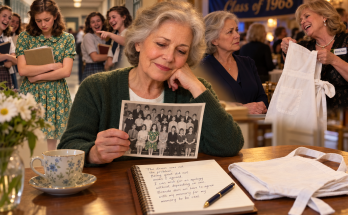
I did not take the apron.
I also did not push it away.
I simply stood there while Brenda held it between us.
The pause lasted only a few seconds, but I felt every one of them.
She tilted her head.
“What is it?”
I looked at her.
“Nothing.”
The answer came too quickly.
It was the answer I had used as a girl whenever someone asked whether I was upset.
Nothing.
No problem.
It doesn't matter.
Those words had protected me from having to explain feelings I could barely understand myself.
They had also protected the people who caused them.
Brenda lowered the apron slightly.
Around us, the reunion continued.
A waiter passed with a tray.
Someone at a nearby table called across the room to an old friend.
The music played softly through the speakers.
Life had not stopped because I was uncomfortable.
That was one of the things adulthood eventually taught me.
The world rarely pauses for your private pain.
Brenda appeared to interpret my silence as permission to continue.
“I only thought you might be willing to help,” she said. “You know how busy these events get.”
I wondered why she had chosen me.
There were dozens of people in the ballroom.
Several classmates had spent years organizing community events, church dinners, and fundraisers. Others had volunteered for charities or managed large households.
Brenda had not approached any of them.
She had come to me.
Perhaps she believed I would be too embarrassed to refuse.
Perhaps she had remembered the girl who never defended herself.
Or perhaps she had not thought about it at all.
I could not know.
What I did know was that the apron had become something larger than a piece of cloth.
It represented an old arrangement between us.
Brenda spoke.
I endured it.
She laughed.
I pretended not to care.
She moved on.
I went home and remembered every word.
I had repeated that arrangement for years, even after Brenda disappeared from my daily life.
I had allowed people to interrupt me in meetings because I did not want to appear difficult.
I had accepted unfair assumptions because correcting them seemed exhausting.
I had occasionally watched someone else receive credit for work I had done and told myself that the outcome mattered more than the recognition.
Sometimes that was true.
Sometimes it was an excuse.
I had to admit that.
When I was younger, I had thought that being strong meant never showing that anyone had hurt me.
Now I understood that silence could be a form of surrender.
Not always.
But sometimes.
I looked down at the apron again.
The white fabric had a crease near the waistband.
A loose thread hung from one corner.
It was an ordinary object, and I resented how much attention I was giving it.
I had spent decades handling problems far more serious than this.
I had faced business losses, difficult negotiations, and decisions that affected people's livelihoods.
I had signed documents that made my hands shake.
I had still signed them.
Why was I finding it so difficult to answer Brenda?
The question made me angry.
Not at her.
At myself.
I finally moved my hands.
Brenda appeared to expect me to accept the apron.
Instead, I placed one hand lightly against its folded edge and guided it back toward her.
“No, thank you.”
My voice was quiet.
But it was clear.
Brenda blinked.
“What?”
“I won't be working in the kitchen.”
She gave a short laugh.
“Oh, Martha. Don't be so serious.”
I felt my face grow warm.
There it was again.
The old trick.
If I objected, I was oversensitive.
If I remained silent, she could continue.
If I became angry, she could tell everyone I had no sense of humor.
For years, I had tried to find a response that would make such people understand me.
I was beginning to realize that understanding might not be their goal.
“I wasn't being serious,” I said. “I was answering you.”
For the first time that evening, Brenda's smile faltered.
Only slightly.
Then she turned toward the women at her table.
“Well, I was only trying to help.”
One of them gave a small, uncomfortable nod.
The other continued looking at her plate.
I felt a strange mixture of relief and fear.
I had refused.
It was a small act.
It should not have mattered so much.
But I could feel the seventeen-year-old girl inside me waiting for the punishment that usually followed a refusal.
A cutting remark.
A laugh.
A whispered story repeated to the entire class.
Nothing happened immediately.
Brenda placed the apron over the back of a nearby chair.
“Suit yourself,” she said.
Then she turned away.
I remained where I was.
For several seconds, I could not decide whether I wanted to leave the ballroom or sit down.
I had imagined that standing up to Brenda would feel satisfying.
It did not.
It felt uncomfortable.
My heart was beating too fast, and I could hear my own voice repeating the words I had just spoken.
I won't be working in the kitchen.
I had said it.
I had not apologized.
That was new.
I walked toward the far side of the room, where the tables were quieter.
Eleanor found me there.
“Are you all right?”
“Yes.”
She studied my face.
“Martha.”
I sighed.
“No, not entirely.”
She pulled out a chair and sat beside me.
I told her what had happened.
Not every detail.
Just enough.
Eleanor listened without interrupting.
When I finished, she looked toward Brenda's table.
“She shouldn't have done that.”
“No.”
“Was she always like that with you?”
I looked at my hands.
The question seemed simple, but answering it required me to open a door I had kept closed for a long time.
“Yes,” I said.
Eleanor did not offer a quick explanation.
She did not tell me Brenda had probably forgotten.
She did not suggest that teenagers could be cruel and adults should move on.
She simply sat beside me.
That kindness nearly undid me.
I had spent so many years expecting people to dismiss what had happened that I did not know how to respond when someone took it seriously.
I looked across the ballroom again.
Brenda was laughing with another group.
She seemed entirely comfortable.
I wondered whether she had ever felt ashamed of anything she had done.
Then I caught myself.
That was not my responsibility to discover.
I did not need to solve Brenda.
I needed to understand why I had spent so much time measuring myself against her.
When I was seventeen, I had believed that people with money possessed a kind of authority that could not be challenged.
Brenda had seemed to confirm that belief.
Her family could afford things mine could not.
She never appeared worried about the cost of school supplies, clothes, or meals.
I assumed that confidence came naturally to people who had never experienced scarcity.
I was wrong about that too.
Money could make life easier.
It could buy choices.
It could spare a person certain humiliations.
But it did not make anyone more deserving of respect.
I had known that in theory for years.
Somehow, I had never fully applied it to myself.
After my exchange with Brenda, I sat quietly and watched the hotel staff clear the tables.
One young employee moved quickly between guests, collecting plates and checking whether anyone needed anything.
A guest stopped him to complain about a missing drink.
The employee apologized and hurried away.
I felt an immediate urge to intervene.
I did not.
The situation was minor, and the employee handled it himself.
Still, watching him brought back the feeling of being seventeen and wishing someone would say that I had done nothing wrong.
I had wanted a person to stand beside me.
Someone who would look at Brenda and tell her that a dress was just a dress.
Someone who would make the hallway feel less dangerous.
No one had done that.
I could not change what happened to the girl I had been.
But I could stop treating her as if she had been foolish for feeling hurt.
That realization settled slowly.
I had not been weak because Brenda's words affected me.
I had been young.
I had been poor by comparison with her.
I had wanted to belong.
Those were not crimes.
They were ordinary human needs.
And I had punished myself for them long after the original insult had passed.
When I returned to my table, I noticed the apron resting on the chair where Brenda had left it.
The loose thread still hung from the corner.
For a moment, I considered picking it up and folding it neatly.
It was an absurd thought.
The apron was not mine.
I left it where it was.
Then I sat down beside Eleanor and began eating my dinner.
The chicken had cooled slightly.
The vegetables were better than Brenda had suggested.
And for the first time that evening, I was no longer thinking about whether I had embarrassed myself.
I was thinking about what I wanted to do next.
Click here to continue reading: PART 4: Before the Reunion Ended, I Had to Decide Whether My Old Shame Still Deserved a Place at My Table
The Woman Who Once Made Me Ashamed of My Clothes Had No Idea What My Life Had Become
Part 3 of 20