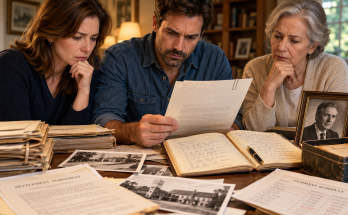
Helen asked Richard to attend another meeting after the reconciliation sheet arrived. This time, she wanted the independent accountant present so that each entry could be examined against the original bank records. The question was no longer simply whether money had moved. It was whether the foundation’s assets had been restored, whether the beneficiary’s reserve remained intact, and whether the family had treated a private obligation as though it could be postponed indefinitely.
The accountant began with the foundation’s original custodial transfer. The $1.2 million had been moved through several affiliated entities, and some of the funds had been returned. Other amounts had been used to settle obligations connected to the private investment trust or to cover costs that Richard claimed were necessary to keep the business structure operating. Several payments lacked sufficient documentation to establish that they had served a legitimate foundation purpose.
The accountant was careful not to label every unsupported transaction as theft. Some records were incomplete because of the age of the accounts, and several transfers appeared to have been reversed. However, the absence of the required signatures remained a serious problem. The foundation had not authorized Richard to bypass its safeguards merely because he believed the money would eventually be returned.
The preliminary balance showed that a substantial portion of the custodial funds had been recovered or accounted for, but the investigation still identified a material unresolved amount. The accountant could not certify the foundation’s records until the missing documentation was supplied or the unsupported transactions were treated according to the appropriate accounting rules.
Richard listened without interrupting. When the accountant finished, he said he would provide the remaining company records and would not challenge the need for an independent reconciliation.
Helen then turned to the $150,000 beneficiary reserve. The bank records showed that the money had entered Northbridge Holdings and that portions had been used to cover the private investment trust’s obligations. A later credit had been recorded, but the account statements did not demonstrate that the entire amount had been restored to an account held independently for the beneficiary.
“Where is the remaining balance?” Helen asked.
Richard’s attorney consulted his notes. “Our understanding is that the reserve was credited through the private trust’s reconciliation process. We have not yet located a statement confirming that the full amount was placed into a separate beneficiary account.”
“Then it has not been established that the reserve was fully restored,” Helen said. “We need the source and destination of the credit, the date it was made, and the authority under which it was recorded.”
Richard admitted that he had treated the reserve as part of the larger private trust structure rather than as money that had to remain separately available. He said he believed the beneficiary’s rights would be honored once the identity was confirmed. He had not considered that the repeated transfers could make the money difficult to trace or expose it to unrelated company obligations.
Grandma looked at him with disappointment. “You kept saying you were protecting the family’s interests. You never stopped to ask whether the family had the right to use that money in the first place.”
“I believed the trust structure allowed temporary transfers,” Richard replied. “I now understand that the restrictions were more specific than I treated them. I should not have proceeded without the required authorization.”
Helen reminded him that acknowledging a mistake did not settle the legal consequences. The accountant would have to determine the outstanding amount, and the lawyers would need to establish who was entitled to recover it. The beneficiary’s identity and legal status could not be assumed simply because a name appeared in an old account.
The reconciliation sheet also contained a reference to the missing sworn declaration. The notation beside Richard’s initials showed that the reserve could not be released until the declaration had been located and the identity confirmed. It appeared that Richard had known the declaration was missing or unavailable when the reconciliation was prepared.
“Why did you not tell us that the reserve depended on this document?” I asked.
“I did not know whether the document still existed,” he said. “I knew the file had been sent for review, and I believed the necessary confirmation would eventually be obtained. I did not understand that the original declaration had disappeared from the custody records.”
“But you authorized the storage transfer,” Daniel said.
“Yes. I authorized the box to be resealed after the storage company reported a problem with the seal. I did not personally remove the declaration, and I did not knowingly destroy it.”
Helen asked him to provide the original instructions he had received from the storage company and any correspondence relating to the legal review. Richard agreed. He also authorized the company’s accountants to cooperate with the independent tracing and to preserve the records while the investigation continued.
The next week, the accountant issued a more detailed report. It identified several transfers that had been reversed and separated them from transactions for which no adequate supporting documentation had been found. The report did not conclude that Richard had personally kept the money for himself. It did establish that he had authorized transfers contrary to the documented restrictions and that the records were insufficient to certify the foundation’s financial position without further corrective work.
The report also found that the beneficiary reserve had not been maintained as a fully independent account. Although a credit had been recorded in the private trust’s reconciliation, the available statements did not show that the entire $150,000 had been restored to a segregated account for the intended beneficiary.
Helen recommended that the disputed reserve be restored from a source that did not depend on the unresolved company transactions, subject to legal review and a verified accounting. Richard agreed in principle. His attorney would need to confirm the amount and arrange the transfer through an independent administrator, ensuring that the money could not be used again while the identity question remained unresolved.
Grandma supported the proposal. “The person who is entitled to that money should not have to wait for our family to finish arguing about who made which mistake.”
Helen agreed, but she stressed that the restoration must be documented properly. Paying money into a new account without verifying the beneficiary would not solve the problem. The funds needed to be held securely until the legal identity and entitlement were established.
Meanwhile, the search for the original declaration continued. The secondary storage box contained the empty envelope, the old inventory, and the note directing that the original be retained separately. The courier record suggested that a package had been delivered to Eleanor Ellis, but the contents had not been established. Martin Cole’s office records showed that a sealed package had been returned to Richard’s office, yet no itemized receipt proved that the declaration was inside.
The evidence did not establish that Richard had deliberately concealed the declaration. It did establish that he had controlled several stages of the file’s movement and had failed to maintain a reliable record of what happened to it. Helen said the investigation would continue until the custody chain was reconstructed or the document was formally treated as missing.
Grandma asked whether the declaration could still be recovered. Helen said it was possible. The package might have been stored with private correspondence, transferred to another archive, or retained by the person who received it. The search would continue, but the family could not delay every decision until the document appeared.
That was the point when the legal question changed. We no longer needed to know only who the beneficiary was. We also needed to determine what could be done to protect the beneficiary’s potential rights while the identity remained uncertain.
Helen arranged for independent counsel to review the trust agreement, the custody instructions, and the available financial records. The review would determine what steps were legally appropriate to preserve the reserve, pursue any recovery, and avoid disclosing private information to people who had no right to receive it.
The same review would examine the inheritance Grandma had given her seven grandchildren. Helen had already established that the $6 million gifts came from Eleanor’s personal assets rather than the foundation’s custodial account. That distinction remained important. The gifts were not automatically invalid simply because the family company’s financial records were under investigation.
However, the final legal review would need to confirm the terms of the gifts, the separate trust arrangements, and whether any restrictions applied to the recipients. Tyler and the other grandchildren deserved a clear explanation of what they had received and what remained subject to review. Grandma wanted the gifts to be a legacy of care, not another instrument of family control.
When Helen presented that conclusion, Grandma nodded. “I gave them the money because I wanted them to have choices. I never intended it to buy their silence or make them responsible for mistakes they did not make.”
She asked Helen to communicate that position formally to the grandchildren. The investigation into Richard’s transactions would continue separately, and no grandchild would be asked to surrender a legitimate gift merely to protect the family’s reputation.
Before we left, Richard signed an undertaking to preserve all remaining records, cooperate with the accounting, and refrain from moving funds connected to the disputed reserve. He also agreed to work with his attorney on restoring the amount determined to be outstanding, subject to the independent administrator’s instructions.
It was not forgiveness, and it was not a final resolution. But it was the first concrete commitment that placed the beneficiary’s rights ahead of the family’s convenience.
That evening, Helen sent us the independent counsel’s preliminary findings. The counsel had reviewed the 1976 agreement and concluded that the hidden beneficiary might have a legitimate claim, but the evidence was not sufficient to identify the person conclusively or determine the exact terms of the entitlement.
The report recommended one immediate step: locate the original declaration or obtain an independently verified substitute.
Without it, the family could preserve the money and correct the accounting, but it could not responsibly decide who should receive the reserve.
At the bottom of the report was a final note from Helen. The private trust records contained one more reference to the declaration, written in our grandfather’s hand and dated shortly before his death.
It named a person who had never appeared in the family’s financial records.
The name was not Eleanor Ellis.
It was Miriam Foster.
Click here to continue reading: PART 35: The Truth Our Grandfather Left Behind Finally Restored the Family’s Missing History and Gave the Hidden Beneficiary a Choice
Grandma Placed Seven Envelopes Beneath the Christmas Tree, but the Last One Carried a Warning That Changed Everything
Part 34 of 35