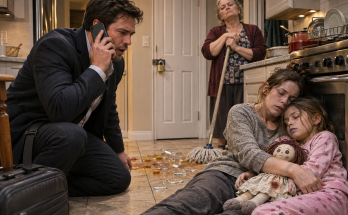
The next few days moved slowly.
I measured them by hospital visits.
By conversations with doctors.
By the amount Lily managed to eat.
By the color returning to Clara's face.
The medical team continued monitoring both of them.
Their conditions were improving, although the doctors made it clear that recovery needed to be handled carefully.
I was grateful for every small improvement.
Lily started asking for her favorite book.
Clara became strong enough to walk short distances with assistance.
Ordinary things had become important.
One afternoon, a nurse arranged for Clara and Lily to see each other.
I stood beside Clara as we entered Lily's room.
Lily immediately reached toward her mother.
“Mommy!”
Clara began crying before she reached the bed.
She sat carefully beside Lily.
Our daughter wrapped her arms around her.
Neither wanted to let go.
I stood nearby.
I didn't interrupt them.
Clara eventually pulled back enough to look at Lily's face.
“Are you feeling better?”
Lily nodded.
“I had breakfast.”
“That's wonderful.”
“And they gave me something to drink.”
Clara smiled.
It was the first proper smile I had seen since returning home.
Then Lily asked the question I had been expecting.
“Are we going back to Grandma?”
Clara looked at me.
I shook my head.
“Grandma isn't staying at our house anymore.”
Lily considered that.
“Can I have my cereal?”
“Yes.”
“Whenever I'm hungry?”
“We'll make sure you have enough to eat.”
She looked at Clara.
“Mommy too?”
Clara pressed her lips together.
“Yes, sweetheart.”
I turned toward the window.
There were moments when I couldn't look directly at either of them without becoming emotional.
That was one.
Later, I spoke with people investigating the circumstances.
I described what I had seen when I arrived home.
I explained where Evelyn had been standing.
I mentioned the mop, the soup, and the glass.
I told them about the pantry.
They asked whether I had photographs.
I showed them what I had taken.
I also explained that the kitchen had been partially cleaned before I returned.
They asked about Evelyn's statements.
I repeated her explanations as accurately as I could.
I didn't exaggerate.
I didn't need to.
The facts were troubling enough.
They asked whether I would provide the messages my mother had sent after the ambulance arrived.
I agreed.
I showed them Clara's earlier messages as well.
Reading those conversations in front of other people was uncomfortable.
My replies looked painfully casual.
“Still working.”
“Call you later.”
“Everything okay?”
I had been responding to my wife while thinking about work.
I hadn't been giving her my full attention.
One person asked whether I had known my mother was restricting access to food.
“No.”
“Had your wife expressed concerns about your mother before?”
I paused.
“Yes.”
I explained the disagreements I remembered.
I explained that I hadn't realized how serious the pattern was.
Then I added something I hadn't wanted to admit until that moment.
“I didn't take her concerns seriously enough.”
Nobody argued with me.
Nobody reassured me.
They recorded what I said and continued asking questions.
It was uncomfortable.
It was also necessary.
My mother had called several times since leaving the house.
I hadn't answered most of those calls.
That afternoon, she sent me a long message.
She said the people contacting her were misunderstanding the situation.
She said Clara had been allowed to eat.
She said putting a lock on the pantry had been a temporary measure.
She insisted she had never intended to hurt Lily.
Then she asked me to explain to everyone that she was a good grandmother.
I read the message twice.
I didn't know how she expected me to do that.
I could describe occasions when she had been kind to Lily.
I could remember birthdays and family gatherings.
I could acknowledge that my mother had done good things during her life.
None of that changed what I had found in my kitchen.
I replied with one sentence.
“I will tell them what I witnessed.”
She called immediately.
I let it ring.
Then another message arrived.
“You're choosing your wife over your mother.”
I put the phone away.
I wasn't interested in that comparison.
A child had been placed in danger.
A woman had become seriously unwell.
Those facts mattered more than Evelyn's description of our family relationships.
The hospital social worker met with Clara again.
She discussed what support would be available when we returned home.
Clara admitted she was frightened.
She wasn't frightened of the house itself.
She was frightened that Evelyn might arrive unexpectedly.
I promised we would address that.
I arranged for the locks on the house to be changed.
I also made sure Evelyn no longer had access to any spare keys.
It was a practical decision.
Something I could actually do.
When I told Clara, she nodded.
“Thank you.”
I wished she didn't feel the need to thank me for something so basic.
But I understood why she did.
She had spent days feeling powerless inside her own home.
She needed more than promises.
She needed to see that circumstances had changed.
I began making arrangements for time away from work.
My colleagues needed explanations.
I gave them only what was necessary.
There had been a serious family emergency.
My wife and daughter were recovering.
I would be unavailable while I cared for them.
I had once believed that missing an important business obligation would create an enormous problem.
Now I understood how small that problem was compared with the alternative.
A few days earlier, I had been worried about finishing a presentation.
Now I was delighted because Lily had asked whether she could wear her own pajamas.
I brought them from the bag.
She examined them carefully.
“Daddy, you remembered.”
“Of course.”
I didn't say that I had forgotten more important things.
She didn't need to carry my guilt.
She needed her father.
Clara and I had a difficult conversation that evening.
She told me she had been thinking about our marriage.
I felt my stomach tighten.
“Are you thinking of leaving?”
She looked at me for a long moment.
“I don't know what I'm thinking yet.”
I nodded.
She explained that her anger wasn't directed only toward Evelyn.
She was angry with me too.
She had trusted me when I said my mother would make things easier.
She had believed I would listen if something went wrong.
When she tried to reach me, I hadn't been available.
“I felt like nobody would believe me.”
I looked down.
“I believe you.”
“Now.”
That single word hurt because it was accurate.
Now.
After the ambulance.
After the hospital.
After seeing our daughter struggle.
I hadn't given Clara that same certainty before.
“I should have believed you when you first told me she was making you uncomfortable.”
Clara wiped her face.
“Yes.”
We sat quietly.
I didn't ask her to put the experience behind her.
I didn't ask her to decide anything about our future while she was still recovering.
I told her I would respect whatever time she needed.
She looked toward the hospital window.
“I just want Lily to feel safe.”
“So do I.”
We agreed that would be our priority.
Everything else could be addressed when we were ready.
The following morning, the hospital team discussed discharge planning.
They explained what Clara and Lily would need after returning home.
Follow-up appointments.
Continued monitoring.
Appropriate nutrition.
Rest.
Support for the emotional effects of what had happened.
I wrote everything down.
I didn't want to rely on memory.
When I visited Lily, she was sitting up in bed.
She was drawing on a piece of paper.
I asked what she was making.
“Our house.”
She had drawn a square building with windows and a large door.
Three people stood outside.
She pointed to them individually.
“Mommy. Me. You.”
I smiled.
“That's a nice picture.”
She studied it for a moment.
Then she added something beside the smallest figure.
A little doll.
“Miss Button,” she explained.
I looked at the drawing.
“Of course.”
She continued coloring.
There wasn't a fourth person in the picture.
I didn't ask why.
Later that day, I received another call concerning the investigation.
I was told that Evelyn had given an account of what had happened.
The matter was still being examined.
I understood that I wouldn't know the complete outcome immediately.
But I also knew that my mother's explanations would no longer be the only account anyone heard.
Clara had spoken.
I had spoken.
The medical findings and the circumstances inside our home would be considered.
Whatever followed, I intended to cooperate.
That evening, I returned to the house to prepare for Clara and Lily's eventual arrival.
I checked the refrigerator.
I bought fresh groceries.
I replaced the empty fruit bowl with apples and bananas.
I put Lily's cereal on a shelf she could easily reach with our help.
Then I stood in front of the pantry.
The padlock had been removed from the door.
The small metal fittings were still visible.
I touched the mark where the lock had been attached.
I considered covering it.
Instead, I left it alone until the investigators confirmed that nothing further was needed.
I opened the pantry.
Boxes.
Cans.
Crackers.
Pasta.
Things I had never considered particularly meaningful before.
I closed the door without locking it.
Then I returned to the hospital.
Clara was awake.
Lily was drawing another picture.
I sat between their beds for a while.
We talked about home.
About what Lily wanted to wear.
About which book she wanted me to read that evening.
Clara asked whether the house was ready.
“Yes.”
She looked at me.
“Everything?”
I understood what she meant.
“The locks have been changed. Your mother-in-law won't be able to enter.”
Clara nodded slowly.
Then she reached for my hand.
I didn't mistake that gesture for complete forgiveness.
It was something smaller.
Something I hadn't earned the right to expect, but something she was willing to offer.
I held her hand carefully.
Lily looked up from her drawing.
“Daddy?”
“Yes?”
“Can we have breakfast together when we get home?”
I smiled.
“Absolutely.”
She returned to her picture.
I looked at Clara.
For the first time since the business trip, we were talking about going home together.
And this time, I understood that making our home safe was my responsibility too.
Click here to continue reading: PART 9: When My Wife and Daughter Finally Came Home, I Discovered That Removing the Lock Was Easier Than Undoing What It Had Done
I Thought Leaving My Mother With My Family Was an Act of Kindness Until I Walked Through My Front Door
Part 8 of 10