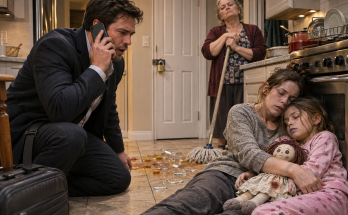
The following morning, I returned home.
Clara and Lily remained in the hospital.
I needed clothes, chargers, and a few personal things for them.
I also needed my mother out of the house.
When I opened the front door, Evelyn was sitting in the living room.
She had made herself coffee.
She looked toward me.
“Have you calmed down?”
I put my keys on the table.
“Pack your things.”
She stared at me.
“What?”
“You can't stay here anymore.”
My mother placed her cup on the table.
“You're throwing me out?”
“Yes.”
“Because Clara had one of her episodes?”
I walked past her toward the kitchen.
The pantry door was open.
The padlock lay on the counter.
Someone had cleaned part of the floor.
The broken glass was gone.
I looked around for Miss Button.
“Where's Lily's doll?”
My mother appeared behind me.
“I put it aside.”
“Where?”
She pointed toward a chair.
The doll was resting on the seat.
The stain remained across its white dress.
I picked it up carefully.
Then I placed it inside a clean bag, remembering that the hospital staff had advised me to preserve anything potentially relevant.
My mother watched.
“What are you doing?”
“Taking it with me.”
“It's filthy.”
“I know.”
She crossed her arms.
“Michael, you're behaving as though I've committed some terrible crime.”
I looked at her.
“My daughter could have died.”
“Oh, don't exaggerate.”
I had expected denial.
Some excuse.
Perhaps even an apology followed by an excuse.
But hearing her dismiss the danger again made the decision easier.
“You need to leave.”
“Where am I supposed to go?”
“Your apartment.”
“The plumbing isn't finished.”
“Then arrange somewhere else.”
She stared at me.
For several seconds, she seemed unable to believe I wasn't negotiating.
In the past, she only needed to explain how inconvenient something would be for her.
I would start looking for solutions.
I had made that my responsibility.
This time, I didn't.
“You know I can't afford a hotel.”
“I'll help arrange temporary accommodation if necessary, but you're not staying here.”
Her expression changed.
“After everything I've done for you?”
There it was.
The familiar sentence.
She had used it throughout my adult life.
Whenever I disagreed with her, she reminded me of sacrifices she had made.
I had spent years trying to prove that I appreciated them.
I didn't need to prove anything that morning.
“Clara is my wife.”
“And I'm your mother.”
“Lily is my daughter.”
She looked away.
I asked her to tell me what had happened in the kitchen.
She said Clara had been dramatic.
I asked why she hadn't called an ambulance.
She said she hadn't believed anything was seriously wrong.
I asked why she had locked the pantry.
She repeated the explanation about waste.
Then I asked why she had told me that Clara needed to learn a lesson.
She became quiet.
“I was upset when I said that.”
“What lesson?”
She picked up her coffee cup.
“I'm not discussing this.”
I thought about Lily asking whether I would be angry if she ate something.
I couldn't imagine a lesson worth teaching a child that way.
There wasn't one.
I went upstairs.
Clara's clothes were folded in the bedroom dresser.
I collected some comfortable things for her.
Then I entered Lily's room.
Her bed was unmade.
A few toys were on the floor.
I stood there looking at the small space my daughter called her own.
The room seemed to belong to a completely different world from the hospital.
I found her favorite pajamas.
I added a sweater, socks, and a book.
Then I remembered that she might ask for Miss Button again.
I hoped I would be able to return the doll to her soon.
Downstairs, my mother was talking on the phone.
She didn't lower her voice when I appeared.
“Apparently, I'm responsible for everything now.”
I continued packing.
“Michael has decided to take her side.”
I stopped.
Her side.
There were two people in the hospital.
One was six years old.
There shouldn't have been sides.
My mother finished her call.
She looked at the bags.
“Are you going back there?”
“Yes.”
“I'm coming with you.”
“No.”
She frowned.
“I want to see my granddaughter.”
“Not now.”
“You can't keep her from me.”
“Right now, my responsibility is to keep her safe.”
Evelyn's face reddened.
“You make me sound dangerous.”
I didn't answer.
I didn't need to.
A little later, I received a call from a hospital social worker.
She explained that the safeguarding concerns had been referred for further investigation.
I told her I was at home arranging for my mother to leave.
She advised me not to dispose of potentially relevant items or alter anything unnecessarily.
I explained what I had found when I returned.
She told me to communicate that information to the people investigating.
I agreed.
My mother was watching me when I ended the call.
“Who was that?”
“Someone from the hospital.”
“What did you tell them?”
“The truth.”
She sat down.
Her hands moved against each other.
For the first time, she seemed less certain of herself.
“Michael, families handle these things privately.”
I shook my head.
“Not this.”
“Think about what you're doing.”
“I have.”
“You could ruin my life.”
I looked at her.
I thought about Clara lying beside the stove.
I thought about Lily's lips.
“I nearly lost mine.”
My mother started crying.
Ordinarily, seeing her cry would have made me uncomfortable enough to soften whatever I was saying.
I would have offered reassurance.
I would have apologized for my tone.
That morning, I let her cry.
I wasn't trying to punish her.
I simply couldn't allow her distress to become more important than the condition of my wife and child.
She went upstairs.
I heard drawers opening.
I waited near the front door.
Eventually, she returned with her belongings.
There was no apology.
She arranged for someone to collect her.
While she waited, she tried several more times to explain what had happened.
Each explanation changed slightly.
Clara had refused food.
Clara had been unreasonable.
Lily had been difficult.
Evelyn had only wanted order in the house.
She didn't understand how things had become so serious.
I listened without agreeing.
When the car arrived, she stood near the entrance.
“You'll regret treating me like this.”
I opened the door.
“Please leave.”
She walked outside.
I watched until the car departed.
Then I closed the door.
The house became quiet.
I had expected to feel relieved.
Instead, I felt exhausted.
I walked into the kitchen again.
The padlock was still on the counter.
It looked harmless sitting there.
Something people used to secure a shed or a storage box.
I took photographs of it and the pantry door.
I didn't know which details would matter.
I wanted the people examining the circumstances to have as much information as possible.
I returned to the hospital carrying the bags.
Clara was sitting slightly upright when I entered.
She looked better than she had the previous night.
Not well.
Better.
“Did you see her?”
“Yes.”
Clara studied my face.
“She left.”
My wife looked down.
“Really?”
“Yes.”
“She isn't coming back?”
“No.”
Clara released a breath.
I had never noticed how much tension a person could carry until I saw some of it leave my wife's shoulders.
She asked what Evelyn had said.
I told her that my mother continued blaming her.
Clara nodded.
“I thought she would.”
I sat beside the bed.
“I'm not going to ask you to forgive her.”
Clara looked at me.
“And I'm not going to ask you to keep the peace.”
She began crying again.
I held her hand.
For years, I had believed maintaining peace meant preventing arguments.
I had asked Clara to overlook remarks.
I had explained away Evelyn's behavior.
I had mistaken silence for a good relationship.
The truth was that Clara had been paying for that silence.
I hadn't understood because I wasn't the person being asked to endure it.
Later, I visited Lily.
She was more alert.
A nurse had helped her with a small meal according to her treatment plan.
Lily proudly told me she had eaten.
I told her I was glad.
Then she asked whether Grandma was coming.
“No.”
She looked at the blanket.
“Is she angry?”
“That isn't something you need to worry about.”
“Because I told?”
I leaned closer.
“You can always tell me when something hurts you or scares you.”
She thought about that.
“Even if Grandma says not to?”
“Especially then.”
Lily nodded.
I sat beside her until she became sleepy.
When I returned to Clara's room, I found her looking through her phone.
She showed me the messages she had sent during my trip.
I recognized them.
The photographs.
The questions.
The request to call.
There was no need for her to explain what I had missed.
I could see it.
“I thought you would know something was wrong,” she said.
“I should have called.”
She didn't immediately tell me it was okay.
And I was grateful she didn't.
Some things shouldn't be dismissed simply because an apology has been offered.
I needed to do more than regret what had happened.
I needed to become someone my wife and daughter could rely on.
That began with listening.
Click here to continue reading: PART 8: The Doctors Were Preparing My Family for Recovery While the People Investigating Our Home Asked Questions My Mother Could No Longer Avoid
I Thought Leaving My Mother With My Family Was an Act of Kindness Until I Walked Through My Front Door
Part 7 of 10