The divorce didn't happen overnight.
There were documents to complete, arrangements to discuss, and decisions that required patience.
Some conversations with Grant were difficult.
Others were surprisingly calm.
We disagreed about certain practical matters.
We eventually found workable solutions.
Helen helped me understand the process without allowing every disagreement to become another personal argument.
I appreciated that.
I had no desire to spend the rest of my life fighting with Grant.
We had a daughter together.
Whatever happened to our marriage, we would always share that responsibility.
I wanted Ellie to see two adults behaving respectfully.
She had already seen enough of the opposite.
Grant continued attending counseling.
At first, I wasn't sure whether he would maintain the commitment once he understood that I wasn't returning.
He did.
That mattered.
Not because it changed my decision.
Because improvement was still important, even when it came too late to save our marriage.
Lacey contacted me once more during the early stages of the separation.
She sent a longer apology.
This time, she didn't explain what Grant had believed or what Margaret had said.
She wrote about her own choices.
She acknowledged that pulling the chair away had been dangerous.
She acknowledged that she should have sought help regardless of what anyone else thought.
She also acknowledged how frightening the evening must have been for Ellie.
I read the message carefully.
Then I saved it with the earlier email.
I responded briefly.
I told her I appreciated the acknowledgment.
I also told her that I wasn't interested in continuing a friendship.
There was no argument.
She replied that she understood.
That was the last conversation we had.
I didn't spend much time wondering what happened in her life afterward.
For a while, I had imagined what I might say if I saw her again.
I had imagined asking the same questions in different ways.
Eventually, I realized that I already had the answers that mattered.
She had hurt me.
She had failed to help.
She had apologized.
And I was allowed to move forward without making her part of my life again.
Margaret remained more complicated.
She was Ellie's grandmother.
She loved her granddaughter, even though some of her decisions had been terribly misguided.
I wasn't interested in punishing Ellie by removing people she loved without considering her needs.
But I insisted on boundaries.
Margaret wasn't permitted to criticize me in front of Ellie.
She wasn't to describe the separation as something I had done to Grant.
She wasn't to suggest that Ellie had exaggerated what happened at the birthday dinner.
At first, Margaret found those boundaries difficult.
She had spent years expressing her opinions about nearly every family decision.
Now she had to accept that some conversations didn't belong in front of a child.
Grant helped reinforce those expectations.
I was grateful when he did.
One afternoon, he told me that Margaret had questioned why we couldn't celebrate certain holidays together as though nothing had changed.
“What did you say?”
“I told her things have changed.”
I nodded.
It was a simple answer.
But there had been a time when he would have asked me to accommodate Margaret instead.
I noticed the difference.
I didn't pretend it meant more than it did.
By the time several months had passed, my physical recovery had progressed considerably.
The headaches became less frequent.
My balance improved.
I could manage ordinary activities without becoming exhausted as quickly.
There were still difficult days.
Sometimes I woke with discomfort.
Sometimes a sudden noise unsettled me.
But those moments no longer controlled everything I did.
I began taking longer walks.
Ellie often came with me.
She collected leaves, pointed out birds, and asked endless questions about other people's dogs.
Her interest in dogs hadn't disappeared.
If anything, it had become stronger.
“Can Purple have a real friend?”
“Purple already has lots of friends.”
“A real one, Mommy.”
I laughed.
“We'll see.”
She accepted that answer with the confidence of someone who intended to ask again tomorrow.
I loved seeing that confidence return.
For a while, she had been so careful around me.
She had watched my movements.
She had asked whether I was hurting.
She had apologized for things that didn't require apologies.
Slowly, that changed.
She started complaining when bedtime arrived.
She became frustrated when her crayons broke.
She asked for snacks shortly after finishing meals.
Those ordinary little demands made me happier than she could have understood.
She was becoming comfortable enough to be inconvenient again.
That was important.
I wanted her to know she didn't have to be endlessly helpful to deserve love.
One afternoon, her therapist told me that Ellie was making encouraging progress.
We discussed the ways she had become more relaxed.
We also discussed allowing her to ask questions whenever memories of the birthday dinner returned.
I didn't need to force conversations.
I didn't need to treat every drawing as evidence of something hidden.
I could listen when she wanted to talk.
And let her play when she wanted to play.
That advice helped me more than I expected.
I had become watchful too.
Sometimes I caught myself studying Ellie's expressions, wondering whether every little change meant she was frightened.
I had to remind myself that she was allowed to experience ordinary sadness and frustration.
Not everything was connected to that night.
Children needed room to grow beyond frightening experiences.
So did their mothers.
Eventually, I began looking for a place of my own.
Rachel had never made me feel unwelcome.
She reminded me frequently that we could remain with her as long as we needed.
But I wanted to establish a home where Ellie and I could build our own routines.
Something modest.
Something comfortable.
A place that belonged to our everyday lives rather than our recovery.
I looked at several apartments.
Some were too small.
Others were farther away than I wanted to be.
Then I found a little two-bedroom place with good natural light and a small outdoor area.
The kitchen wasn't particularly impressive.
The cupboards were older.
The living room needed fresh paint.
I liked it immediately.
Ellie came with me when I visited again.
She walked through the empty rooms.
“This one's mine?”
“If you'd like it.”
She nodded.
“Purple can sleep here.”
I looked around the small bedroom.
There was enough space for her bed, a dresser, and a little table where she could draw.
Nothing elaborate.
Everything we needed.
I signed the lease after making sure the financial and practical arrangements were manageable.
Rachel helped me prepare for the move.
Grant cooperated with collecting our belongings from the house.
He packed Ellie's books carefully.
He helped separate the things I wanted to keep.
We didn't fight over every household object.
Some things had sentimental value.
Others didn't.
I discovered that many possessions I once considered important were simply things I had become accustomed to seeing.
I took photographs.
Clothes.
Kitchen utensils.
Ellie's toys.
A few decorations I genuinely liked.
I left much of the rest behind.
When I reached the dining room, I stopped.
Grant was standing nearby.
“Do you want any of this furniture?”
I looked at the table.
At the chairs.
“No.”
He nodded.
He didn't ask me to reconsider.
I collected a small framed photograph from a nearby shelf instead.
It showed Ellie laughing on a summer afternoon.
Her hair was messy.
Her cheeks were bright.
I remembered taking it because she had been delighted by something wonderfully ordinary.
That was the photograph I wanted.
On moving day, Rachel arrived early.
She brought coffee and sandwiches.
Ellie carried her stuffed dog from room to room, announcing where everything should go.
Her ideas weren't always practical.
She wanted her books beside the refrigerator.
She wanted her crayons inside the bathroom cupboard.
We found other places.
By evening, the apartment was beginning to feel lived in.
There were boxes everywhere.
The curtains weren't installed properly.
I couldn't find the saucepan I wanted.
I made sandwiches for supper.
Ellie thought it was wonderful.
We sat together at our new kitchen table.
Rachel had helped me choose it.
It was small, with rounded corners and three sturdy wooden chairs.
I looked at those chairs before sitting down.
For a moment, I remembered the noise from Margaret's birthday dinner.
Then Ellie climbed into her own chair.
“Mommy, sit here.”
I lowered myself into the chair beside her.
Nothing moved.
Nothing happened.
Ellie picked up her sandwich.
She didn't watch me carefully.
She didn't reach for the back of my chair.
She didn't ask whether I was safe.
She simply began eating.
I looked toward Rachel.
She had noticed too.
Neither of us said anything.
I reached for my sandwich.
That ordinary meal became one of the most important meals I could remember.
Not because of what happened.
Because of what didn't.
A few weeks later, the divorce was finalized.
There were no dramatic speeches.
No shouting in a courtroom.
No moment in which everybody suddenly understood everything.
There were documents confirming a decision that had taken months of thought.
I cried afterward.
I hadn't expected to.
I had already moved.
I had established new routines.
I had accepted that my marriage was ending.
Still, seeing it made official brought a kind of sadness I couldn't avoid.
I thought about the woman I had been on my wedding day.
She had believed she was beginning a lifelong partnership.
She had been excited.
Hopeful.
Certain.
I didn't dislike that woman.
I didn't consider her foolish.
She had trusted someone she loved.
She had simply discovered that trust wasn't something she could maintain alone.
Grant called that evening.
We discussed Ellie's schedule for the following week.
Then he became quiet.
“I wish I'd done things differently.”
I looked around my apartment.
“So do I.”
He didn't ask whether I would reconsider.
He didn't tell me that we belonged together.
He simply said goodnight.
That conversation gave me a kind of closure I hadn't received from any of the earlier apologies.
He was finally acknowledging the past without trying to persuade me to change the future.
Ellie continued spending time with him.
He became more attentive to the things she told him.
At least, that was what I observed during our interactions.
He took her questions seriously.
He stopped dismissing her concerns simply because she was little.
He learned that reassurance involved more than telling someone everything was fine.
One afternoon, Ellie tripped while running toward him.
It was a minor fall.
She scraped her knee.
Grant immediately knelt beside her.
He checked the scrape and asked whether anything else hurt.
She cried for a few minutes.
Then she asked for a bandage.
He found one.
I watched from nearby.
There was nothing remarkable about his response.
It was exactly what a father should do when his child fell.
And that was why it mattered.
Ellie accepted his help without hesitation.
She didn't need to persuade him that she was hurting.
She didn't need to prove anything.
He listened.
I hoped he would continue learning.
I hoped he would become the father she deserved.
Those hopes no longer required me to remain his wife.
As the months passed, our little apartment became increasingly familiar.
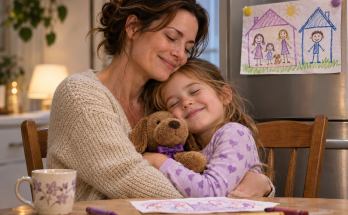
Ellie's drawings covered part of the refrigerator.
Her shoes accumulated beside the front door.
The stuffed dog somehow managed to occupy more space in her bed than she did.
Rachel visited often.
Sometimes we cooked together.
Sometimes she stayed for coffee while Ellie showed her new pictures.
I stopped apologizing for needing help.
I stopped assuming kindness had to be earned through exhaustion.
When I was tired, I rested.
When I was unhappy, I said so.
When somebody made a joke I didn't find funny, I didn't force myself to laugh.
These were small changes.
They changed nearly everything.
One evening, Ellie asked about the birthday card she had made for Margaret.
I retrieved it from a box containing photographs and important papers.
Margaret had allowed Ellie to keep it after her visit to Rachel's house.
The paper was beginning to soften along the folds.
The red circle was still bright.
So were the enormous purple shoes.
Ellie looked at it for a while.
“That's when we lived with Daddy.”
“Yes.”
She pointed at the circle.
“Our old house.”
I nodded.
Then she asked for a fresh piece of paper.
I gave her one.
She chose several crayons.
I watched her draw while I prepared dinner.
When she finished, she brought the picture into the kitchen.
There were two houses.
One contained Grant.
The other contained Ellie, me, and a small brown dog.
I smiled.
“Is that Purple?”
“Yes.”
There was also a fourth person standing outside our house.
“Aunt Rachel?”
Ellie nodded happily.
“She comes for supper.”
I looked at the drawing.
The people weren't all enclosed inside one circle anymore.
They had separate places.
Separate doors.
Room to move.
Ellie didn't seem troubled by that.
She had drawn the family she knew.
A family that looked different from the one she had imagined on Margaret's birthday.
But still a family.
I attached the drawing to the refrigerator.
She watched me.
“Do you like it?”
“I love it.”
She smiled.
Then she ran back to her toys.
I stood beside the refrigerator for several moments.
I thought about the evening she had sat beside me on the floor.
The blanket she had brought.
The little fingers holding mine.
The promises she had made because she believed being good might bring her mother back.
I wished I could return to that moment and lift her away from it.
I wished I could tell her that the grown-ups would handle everything.
I couldn't change what she had experienced.
But I could change what she experienced afterward.
I could listen when she said she was hurting.
I could take her fears seriously.
I could show her that love didn't require silence when somebody treated her badly.
Most importantly, I could allow her to be a little girl.
That evening, after supper, she helped me put away the crayons.
Then she asked whether we could read a story.
I carried a book into her bedroom.
She climbed beneath the blankets with Purple tucked under her arm.
Halfway through the story, she interrupted me.
“Mommy?”
“Yes?”
“Are you happy here?”
I closed the book.
I thought about the question.
The apartment was smaller than our old house.
I had more responsibilities to manage alone.
There were still expenses to worry about and appointments to remember.
Life wasn't perfect.
But I wasn't waiting for somebody to decide whether my feelings were reasonable.
I wasn't afraid that asking for help would make me an inconvenience.
I wasn't teaching my daughter that keeping everybody happy mattered more than keeping herself safe.
“Yes, sweetheart. I am.”
She smiled.
“Me too.”
I kissed her forehead.
Then I finished reading the story.
By the time I reached the final page, her eyes were closed.
I remained beside her for a while.
I listened to her breathing.
Her little hand rested against the stuffed dog.
She looked peaceful.
I had once believed that my greatest responsibility was preserving the family I had promised to build with Grant.
I understood now that my responsibility was something more important.
It was making sure my daughter grew up knowing what love should look like.
Love listened.
Love paid attention.
Love didn't laugh when somebody was suffering.
And when someone you loved fell, you didn't stand around waiting for them to prove they deserved your help.
You helped.
A three-year-old had understood that before the adults in our dining room did.
She shouldn't have needed to teach us.
She shouldn't have needed to be brave that night.
But I would always be grateful that she had been.
I pulled her blanket gently over her shoulder.
Then I turned off the lamp.
Before leaving the bedroom, I looked at the little girl who had once begged her father not to leave me alone.
“You don't have to save Mommy anymore,” I whispered.
She continued sleeping.
I closed the door partway and walked into the kitchen.
The dishes were waiting.
The crayons were scattered across the table.
Three wooden chairs stood exactly where they belonged.
I sat down.
There was nobody watching to see whether I was doing something wrong.
Nobody waiting for me to finish another task.
Nobody preparing to laugh.
Just a quiet home and a sleeping child.
I stayed there for a few minutes, enjoying the silence.
This time, silence meant peace.
And we were finally safe.
The End
Read more original stories on Feel Every Story.
I Thought My Husband Would Be the First Person to Protect Me Until I Saw What Made Him Laugh That Evening
Part 10 of 10