The first thing I remember clearly about the hospital was the light.
It wasn't the warm light above our dining table.
It was white and unfamiliar.
I opened my eyes, closed them, and tried again.
My head hurt.
My neck felt stiff.
There was something attached to my arm.
For several seconds, I didn't understand where I was.
Then I remembered falling.
The memory came back without warning.
The chair.
The floor.
The laughter.
I tried to sit up.
A nurse noticed immediately.
“Stay still for me.”
I stopped moving.
She came closer and spoke gently.
“You're in the hospital.”
I swallowed.
My throat felt dry.
“Ellie?”
The nurse asked whether that was my daughter's name.
I nodded slightly.
“Where is she?”
“Your husband is here. Your daughter isn't with him at the moment.”
I closed my eyes.
I wanted Ellie.
I wanted to know she was safe.
The nurse explained that the doctors were monitoring me following my injury.
She asked whether I remembered what had happened.
“Someone moved my chair.”
“Do you remember hitting your head?”
“Yes.”
“Anything after that?”
I tried to answer.
I remembered pieces.
Some were clear.
Some made no sense when I put them together.
I remembered Grant laughing.
I remembered asking for help.
I remembered Ellie's hand.
The rest came and went.
The nurse didn't pressure me to fill the gaps.
She asked me to tell her what I knew.
I was grateful for that.
At home, people had decided what I was experiencing without asking.
Here, somebody was listening.
A doctor came to examine me.
He explained that a fall involving a head injury could be serious, particularly when someone experienced a change in consciousness.
I needed continued observation.
There were assessments to complete.
He didn't pretend to know every consequence immediately.
I appreciated that, too.
I had spent too much of my marriage being told that things were fine by somebody who hadn't bothered to check.
When the examination finished, the nurse asked whether I wanted to see Grant.
My first instinct was yes.
He was my husband.
I had spent seven years turning toward him when something frightened me.
Then I remembered the laughter.
I looked at the nurse.
“Has he told you what happened?”
“He explained that you fell during dinner.”
I waited.
She didn't add anything.
“Did he tell you how long I was on the floor?”
She looked at me.
“We understand there was a delay before help was called.”
A delay.
Such a small phrase for something that had felt endless.
“How long?”
She paused before answering.
“The emergency responders were told it was approximately three hours.”
I stared at her.
Three hours.
I had known it was a long time.
I hadn't understood how long.
I tried to imagine Ellie spending three hours beside me.
Three hours of confusion.
Three hours of asking for help.
Three hours of adults insisting that nothing was wrong.
My eyes filled.
The nurse handed me a tissue.
I asked whether I could speak to Grant.
She went to bring him in.
He entered quietly.
His shirt was wrinkled.
His face looked tired.
He stood near the door for a moment before approaching the bed.
“Claire.”
I watched him.
“You're awake.”
“Yes.”
He pulled a chair closer.
The sound of its legs moving across the floor made me tense.
He noticed.
Then he stopped moving it.
“How do you feel?”
I didn't answer his question.
“Where's Ellie?”
“With Mom.”
“Is she okay?”
“She was upset.”
“Of course she was upset.”
Grant looked down.
“She didn't want me to leave.”
I swallowed.
“Did she see everything?”
He didn't answer immediately.
That was an answer by itself.
“Grant.”
“Yes.”
I turned my face away.
For several seconds, neither of us spoke.
Then he reached toward my hand.
I moved my fingers away.
He withdrew his hand.
“I didn't think it was that serious.”
I looked at him.
“What did you think it was?”
He shifted in his chair.
“I thought you were angry.”
“So you left me there?”
“I thought you were making a point.”
“For three hours?”
His eyes dropped.
“I know.”
I felt something inside me harden.
He had always been good at making a disagreement seem like a misunderstanding.
Usually, after enough discussion, I ended up apologizing for something he had done.
I didn't want to repeat that pattern.
Not this time.
“Did Ellie ask you to help me?”
Grant rubbed his face.
“She was crying.”
“Did she ask you?”
“Yes.”
“What did you tell her?”
He looked toward the window.
I waited.
He eventually answered.
“I told her you were okay.”
“But I wasn't.”
“I know that now.”
Now.
The word bothered me more than I expected.
He knew now because I had become frightening enough to convince him.
He hadn't believed me when I asked for help.
He hadn't believed Ellie when she told him I couldn't move.
He hadn't considered that the absence of an answer might mean I was unable to speak.
He had simply decided what was convenient to believe.
And continued with his evening.
“Why did Lacey pull the chair?”
“It was a stupid prank.”
“I know it was a prank. Why?”
He shook his head.
“She wasn't trying to hurt you.”
I stared at him.
I had asked why she did it.
He had answered by defending her intentions.
Even now.
Even beside my hospital bed.
“I hit my head, Grant.”
“I know.”
“You laughed.”
He closed his eyes briefly.
“I'm sorry.”
I wanted those words to make me feel better.
They didn't.
I had received apologies from Grant before.
Usually, they came after a cruel joke or an argument.
They were followed by a quiet period.
Then things returned to normal.
I didn't want normal anymore.
Not the normal we had been living.
I looked toward the door.
“Can I talk to Ellie?”
Grant took out his phone.
He contacted Margaret.
A moment later, I heard my daughter's voice.
“Daddy?”
“Mommy's awake.”
There was a sudden little gasp.
“Mommy?”
“Hi, sweetheart.”
I heard her begin to cry.
I had imagined what I would say when I finally heard her voice again.
Every carefully prepared sentence disappeared.
“I love you, Ellie.”
“Mommy, are you coming home?”
“I'm with the doctors right now.”
“I want you.”
“I want you, too.”
She asked whether I was still on the floor.
The question broke something in me.
“No, baby. I'm in a bed.”
“Can you talk?”
“Yes.”
“Can you see?”
“Yes, sweetheart.”
She was quiet.
Then she said something I hadn't expected.
“I was good, Mommy.”
I pressed the tissue against my eyes.
“You didn't have to do anything to make me better.”
“I didn't be naughty.”
“Ellie, you weren't naughty.”
“I helped you.”
“Yes. You did.”
Her little voice became unsteady.
“I told Daddy.”
I looked at Grant.
He was staring at his hands.
“I know you did.”
“I kept telling him.”
“You did the right thing.”
I needed her to hear that.
I needed those words to replace whatever she had been told while I lay there.
“You helped me, sweetheart. I'm very proud of you.”
She asked whether I still loved her.
I could barely answer.
“Always.”
I repeated it.
“Always, always.”
Grant sat silently beside the bed.
There was nothing he could say that would improve that conversation.
Eventually, Margaret took the phone.
“Claire, thank goodness.”
I didn't respond with the warmth she seemed to expect.
“How is Ellie?”
“She'll settle down.”
“She was frightened.”
“Yes, well, we all were.”
I closed my eyes.
They hadn't all been frightened for the same length of time.
Ellie had been frightened from the beginning.
Margaret had become frightened when Grant finally realized I wasn't responding.
That difference mattered.
“She needs someone to reassure her.”
“I'm looking after her.”
“Please don't tell her she was being difficult.”
Margaret sounded offended.
“Why would I say that?”
I didn't answer.
I remembered her standing above me.
I remembered her telling me not to make a fuss.
I remembered Ellie calling after her as she climbed the stairs.
I didn't have the energy to argue.
“Just tell her she did nothing wrong.”
The call ended shortly afterward.
Grant put his phone away.
He asked whether I wanted him to stay.
I looked at the bed, the equipment, and the white hospital walls.
I thought about our daughter.
I thought about how eagerly she had brought broken toys to her father.
She believed he could fix things.
I wondered what she believed now.
“I need some rest.”
Grant nodded.
“I can sit here quietly.”
“No.”
He looked at me.
“I want to be alone for a while.”
He hesitated.
Then he stood.
“I'll come back.”
I watched him walk toward the door.
He turned before leaving.
“Claire, I really am sorry.”
I didn't tell him it was all right.
I didn't tell him I understood.
I didn't tell him we would forget about it when I recovered.
Those were things I might have said before.
This time, I let him leave without comforting him.
Afterward, the nurse returned.
She adjusted something beside my bed and asked whether I needed anything.
I told her I wanted a little water.
She helped me drink.
Such a simple kindness.
It nearly made me cry again.
I had spent hours needing something far more urgent, surrounded by people who had refused to recognize it.
Now a stranger was helping me because I had asked.
I thanked her.
She smiled.
When she left, I lay looking at the ceiling.
My body hurt.
My thoughts were confused.
I didn't know how long recovery would take.
I didn't know how I would explain the evening to Ellie in a way that wouldn't make her more frightened.
I didn't even know what I wanted to say to Lacey.
But one thing had become clear.
I couldn't return to the life I had accepted before that birthday dinner.
Not without addressing what had happened.
Not without understanding why my husband had found it easier to laugh at me than to help me.
Most importantly, not without making sure Ellie never again believed that protecting her mother was her responsibility.
She deserved to be a child.
She deserved to draw pictures and ask for a dog and complain about bedtime.
She deserved adults who responded when she said something was wrong.
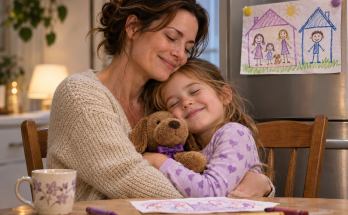
I thought about the birthday card she had made.
Three people surrounded by a red circle.
I had called it lovely that morning.
Now I understood that the safety she had drawn wasn't something I could take for granted.
It was something I had to protect.
For her.
And, finally, for myself.
Click here to continue reading: PART 5: The Morning After Margaret’s Birthday, My Husband Arrived With Flowers and an Explanation That Made Me Question Everything About Our Marriage
I Thought My Husband Would Be the First Person to Protect Me Until I Saw What Made Him Laugh That Evening
Part 4 of 10