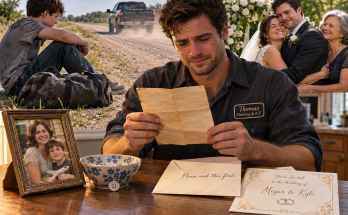
Diane was waiting on her front porch when I arrived.
She wore an old gray cardigan even though the evening was warm.
I climbed out of my van holding both letters inside the ivory wedding envelope.
She came down the steps.
Neither of us spoke.
She hugged me.
I stood there with the envelope pressed between us.
Eventually, she stepped back.
“Come inside.”
Her kitchen looked almost exactly as it had when I was thirteen.
The table had been replaced.
The coffee maker was newer.
But the little mark beside the doorway, where I had once measured my height with a pencil, was still visible.
She offered me coffee.
I shook my head.
Then changed my mind.
She filled two cups and sat across from me.
I took my mother's letter from the envelope.
Diane looked at it before touching it.
Her expression became something I couldn't quite describe.
Recognition, perhaps.
Grief.
Both.
“That's Laura's writing.”
I nodded.
She reached for the page.
“May I?”
I handed it to her.
She read slowly.
When she reached the paragraph about herself, she removed her glasses.
She pressed a tissue beneath her eyes.
“I remember talking to her about this.”
I waited.
“She wanted to make sure you had something to keep.”
“Did you know Dad had it?”
Diane put her glasses back on.
“I knew she had trusted him with it.”
“Did you ever ask him?”
“Yes.”
The answer surprised me.
“When?”
“After you came to live here.”
I looked at her.
She folded her hands around her coffee cup.
“I asked about some of your mother's belongings. Photographs, jewelry, anything she might have wanted you to have.”
“What did he say?”
“He said he'd already given me everything that mattered.”
I stared at the letter.
“Did you ask about this specifically?”
“I did.”
“And?”
“He told me she hadn't finished it.”
I sat back.
My father had lied to her.
Not just by leaving something out.
He had deliberately told her the letter didn't exist.
Diane watched my face.
“I believed him about that part, Thomas.”
I didn't respond.
“I shouldn't have.”
“It's not your fault.”
The words came out before I had thought about them.
She shook her head.
“I wish I'd asked more questions.”
I looked at her hands.
They had grown older while I wasn't paying attention.
The skin was thinner.
Her fingers were slightly bent.
These were the hands that had helped me unpack my clothes, signed my school papers, and co-signed the loan for my first van.
I couldn't blame her.
She had spent years doing everything my father hadn't.
“I wasn't angry with you.”
She nodded.
Then she told me something I had never known.
During the final months of my mother's illness, Diane had visited almost every afternoon.
Sometimes she brought food.
Sometimes she cleaned the house.
Sometimes she simply sat beside her sister.
One afternoon, while I was at school and my father was working, my mother asked Diane to promise something.
“If Ray has trouble after I'm gone, please watch Thomas.”
Diane had been surprised.
“What kind of trouble?”
My mother said she worried that grief would make Ray harder than he already was.
She knew he didn't understand me.
She had watched the way he responded when I cried or became frightened.
She had defended me more often than I remembered.
She didn't want Diane to fight with him unnecessarily.
She wanted someone to notice if I stopped being myself.
Diane told her she would.
I listened without interrupting.
My mother had known.
That was the part I struggled with.
She had understood what my father was capable of becoming.
And she had tried, from a hospital bed and a bedroom filled with medication bottles, to protect me.
“Why didn't you tell me?”
Diane looked at me.
“You were eight when she died.”
“I wasn't eight forever.”
“No.”
She lowered her eyes.
“You weren't.”
There was no defense in her voice.
She explained that after obtaining custody, she had been concerned about making me feel responsible for what happened between my parents.
She wanted me to have memories of my mother that weren't connected to my father's behavior.
As the years passed, the conversation became harder to begin.
I understood.
I didn't entirely agree with her decision.
But I understood.
I picked up my coffee.
It had gone cold.
“Did Mom know how bad things would get?”
Diane shook her head.
“I don't think anyone could have known he'd leave you somewhere like that.”
I looked toward the window.
The evening light had nearly disappeared.
“I thought she would've been disappointed in me.”
Diane frowned.
“For what?”
“For leaving.”
The words sounded childish.
But they were true.
I had spent years wondering whether my mother would have wanted me to stay with my father.
Whether she would have believed I should forgive him.
Whether refusing to return made me a bad son.
Diane reached across the table.
“Your mother wanted you safe.”
I swallowed.
“She wouldn't have asked you to stay somewhere you were being hurt.”
I looked at the letter.
“She loved Ray?”
“Yes.”
“Even knowing what he was like?”
“People can love someone and still recognize that person is doing something wrong.”
I sat with that.
It wasn't a comfortable answer.
But it sounded like the truth.
After a while, Diane asked to read Megan's letter.
I gave it to her.
She adjusted her glasses and worked through the pages.
When she finished, she placed them beside my mother's letter.
“She sounds thoughtful.”
“I don't know her.”
“No.”
“What if she's just trying to get everyone together for the wedding?”
“Then you can tell her you're not interested.”
“What if Dad's behind it?”
“Her letter suggests otherwise.”
I rubbed my forehead.
Diane waited.
Finally, I said what I had been avoiding.
“I don't want to walk into a room and have him tell everyone I'm the problem again.”
She nodded.
“Then don't.”
I looked up.
“You can meet Megan without attending the wedding. You can talk to her without talking to Ray.”
I had been treating the invitation as though it contained only two choices.
Accept the entire family.
Or reject the entire family.
Diane reminded me that I was allowed to decide what contact meant.
I wasn't thirteen anymore.
Nobody could make that decision for me.
We spent the next hour talking about my mother.
Diane told me about things I had never heard.
How Laura used to sing while washing dishes.
How she had once burned an entire birthday cake and bought another one without telling anyone.
How she used to save articles about places she hoped to visit.
I asked whether my mother had always been so patient.
Diane laughed.
“Not with me.”
For the first time that evening, I smiled.
She told me about an argument they had as teenagers over a borrowed sweater.
They hadn't spoken for three days.
Then Laura came into Diane's bedroom carrying two cups of tea.
“She didn't apologize.”
“What did she say?”
“She asked whether I'd finished being ridiculous.”
I laughed.
I could almost hear my mother saying it.
Those stories mattered.
They gave me someone larger than the frightened, sick woman I remembered from her final months.
Before I left, Diane went to her bedroom.
She returned carrying a small cardboard box.
“I've been meaning to give you this.”
Inside were photographs, an old necklace, and several postcards.
At the bottom was a ceramic bowl decorated with blue flowers.
I recognized it immediately.
“The buttons.”
Diane smiled.
“Your mother kept everything in that thing.”
I lifted it carefully.
There were still a few loose buttons inside.
One was dark blue.
Another was small and white.
I remembered sitting beside my mother while she repaired shirts.
I hadn't known the bowl survived.
“Ray gave me that box when I collected some of your things,” Diane explained.
“I kept it because I wasn't sure when you'd want it.”
I held the bowl for a long time.
Then I placed it back inside.
“I want it now.”
She nodded.
I drove home with the box secured on the passenger seat.
For once, I didn't turn on the television immediately.
I placed the bowl beside my keys.
Then I laid my mother's letter on the counter.
I read it again.
The words felt different now.
I could imagine her writing them.
I could imagine the effort it must have taken.
She had been dying.
She had known there were things she wouldn't be able to tell me in person.
And she had tried to leave those things behind.
My father had decided I shouldn't have them.
I couldn't understand why.
Perhaps he had resented what she wrote.
Perhaps he disliked the idea that she had questioned the way he treated me.
Perhaps he had simply wanted control over something that wasn't his to control.
Whatever his reason, the result was the same.
I had spent eighteen years believing my mother's voice belonged entirely to the past.
He had kept part of it hidden.
I opened Megan's letter once more.
Her number was written neatly at the bottom.
I saved it in my phone.
Then I typed a message.
Hello, Megan. This is Thomas. I received your invitation and the letters.
I stopped.
I wanted to thank her.
I also wanted to ask a dozen questions.
Instead, I added one sentence.
Thank you for giving me something that belonged to my mother.
I sent it.
A reply arrived several minutes later.
I'm so glad it reached you. I wasn't sure you would open it.
I stared at the screen.
I typed another message.
Did he know you sent it?
She answered almost immediately.
No.
Then another message appeared.
He knows it's missing, though.
I read the words carefully.
I asked whether she was comfortable talking.
She said she was.
I pressed the call button.
The telephone rang twice.
“Hello?”
Her voice was younger than I had imagined.
“It's Thomas.”
“I know.”
Neither of us knew what to say next.
Eventually, Megan spoke.
“Thank you for calling.”
“Thank you for the letter.”
I heard her breathing.
“I've wanted to talk to you for a long time.”
“Why didn't you?”
She hesitated.
“Because Dad always made it sound like you didn't want anything to do with us.”
I closed my eyes.
“That's not what happened.”
“I thought it probably wasn't.”
There was something careful about the way she spoke.
As though she had learned to measure her words around him, too.
I recognized it.
She asked if I would be willing to meet her somewhere.
Just the two of us.
No parents.
No wedding plans.
No expectations.
I looked at the ceramic bowl beside my keys.
For years, I had protected my peace by staying away from everyone connected to my father.
That had been necessary.
But Megan wasn't my father.
She had been a child growing up inside a version of events she hadn't created.
And when she discovered something that contradicted those events, she had chosen to act.
I could acknowledge that without forgetting what had happened.
“Coffee?” I suggested.
“Yes. Wherever you're comfortable.”
We arranged to meet on Saturday morning.
Before ending the call, she asked me something.
“Thomas?”
“Yeah?”
“Would you tell me what really happened when you left?”
I looked at my mother's letter.
I thought about the gravel.
The heat.
The duffel bag.
The little bell above the gas station door.
For eighteen years, my father had been allowed to tell that story without me.
I wasn't interested in convincing him anymore.
But Megan had asked.
And I was finally ready to answer.
“Yes,” I told her.
“I'll tell you.”
Click here to continue reading: PART 5: I Met My Sister for the First Time in a Coffee Shop and Discovered How Differently Our Father Had Raised Us
My Father Left Me on an Empty Road When I Was Thirteen, but Leaving Him Behind Took Much Longer
Part 4 of 10