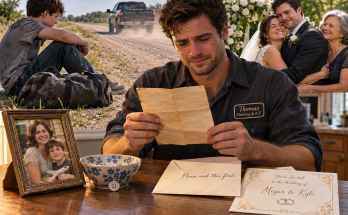
The first night at Diane's house, I slept with my shoes beside the bed.
I didn't unpack my duffel bag.
I kept expecting someone to tell me I couldn't stay.
Diane noticed the bag the next morning.
“There's room in the dresser.”
“I know.”
“Would you like some help putting your things away?”
I shook my head.
She didn't push.
She made breakfast and left me alone.
For several days, I listened whenever a car slowed outside the house.
I thought my father might come looking for me.
Part of me feared that.
Another part wanted it more than anything.
I wanted him to arrive looking worried.
I wanted him to admit that leaving me on that road had been wrong.
Mostly, I wanted him to prove that losing me mattered.
He didn't come.
Diane spent a great deal of time on the telephone that week.
She usually stepped into another room when she spoke.
Once, I heard her say my father's name.
I moved closer to the doorway.
“He's thirteen, Ray.”
A pause.
“No. You don't get to explain this away.”
Another pause.
“You could have gotten him killed.”
I backed away.
That evening, she sat beside me on the couch.
“I need to ask you something.”
I turned off the television.
She folded her hands.
“Would you like to stay here permanently?”
I looked at her.
“Can I?”
“I'm working on that.”
“Will Dad be mad?”
She took a moment before answering.
“Your father's feelings aren't your responsibility.”
Nobody had ever said that to me before.
I wasn't sure I believed it.
But I wanted to.
Within a week, Diane had started the process of obtaining emergency custody.
There were meetings.
There were papers.
There were adults asking questions in voices they probably thought sounded gentle.
I told them what had happened.
Every time I described the truck leaving, I felt ashamed.
I worried they would ask what I had done to deserve it.
Nobody did.
One afternoon, Diane came home carrying a folder.
She placed it on the kitchen counter.
I had been doing homework.
“Thomas?”
I looked up.
“Your father has agreed to let you stay with me.”
I set my pencil down.
“For how long?”
She pulled out a chair.
“Permanently.”
The word seemed too large.
“Did he say anything?”
She looked at the folder.
“He signed the papers.”
“Did he ask about me?”
She didn't answer immediately.
That was the answer.
I picked up my pencil.
“Okay.”
Diane put a hand over mine.
“You can be upset.”
“I'm not.”
I was.
I was so upset that I couldn't understand what was happening inside my chest.
But I didn't know how to be angry with someone I still wanted to love me.
So I finished my homework.
That night, I unpacked my duffel bag.
I placed my clothes in the dresser.
I put my mother's photograph on the bedside table.
Then I folded the empty bag and pushed it beneath the bed.
My father had given me away with a signature.
It took me years to stop thinking about that.
At first, I counted the days.
Then the weeks.
I wondered if he would call when school started.
When he didn't, I decided he would probably call on my birthday.
Diane baked a chocolate cake.
She bought me a new jacket and a set of books I had wanted.
After dinner, we watched a movie.
I kept looking toward the telephone.
Eventually, Diane asked whether I wanted another slice of cake.
“No, thanks.”
I went to bed early.
The telephone never rang.
Christmas came.
Then another birthday.
I received nothing from my father.
Not even a card with my name written on it.
Diane never tried to convince me he secretly cared.
She didn't make excuses for him.
She also didn't encourage me to hate him.
Whenever I asked why he hadn't called, she gave me the most honest answer she could.
“I don't know.”
Sometimes that was all she said.
Other times, she added something.
“But I know you're worth calling.”
I usually changed the subject.
Kind words embarrassed me almost as much as criticism frightened me.
I had to learn how to receive them.
Life at Diane's house developed its own rhythm.
Saturday mornings meant laundry.
Sunday afternoons meant groceries.
In winter, we put extra blankets on the beds because the old heating system struggled to warm the back rooms.
When something broke, Diane tried to fix it herself.
I started helping.
The first time I repaired a loose cabinet handle, she thanked me as though I had done something important.
I liked that feeling.
Not because I needed praise for every little thing.
Because I had been useful without being frightened.
At school, I found myself becoming interested in mechanical systems.
I liked understanding why a machine stopped working.
There was something comforting about a problem that had an identifiable cause.
A damaged wire.
A worn bearing.
A blocked filter.
Machines didn't tell you that you were too sensitive.
They didn't change their expectations depending on their mood.
At sixteen, I became an apprentice with a local heating and air-conditioning contractor.
The owner was a man named Frank.
He was impatient, drank terrible coffee, and had a habit of leaving pencils behind every time he climbed into an attic.
But he taught me.
When I made a mistake, he explained what I should have done differently.
Occasionally, he raised his voice.
He always returned to the actual problem.
He never told me a mistake meant I was worthless.
The work was difficult.
I spent summer afternoons in attics where sweat ran into my eyes.
I crawled beneath houses.
I carried equipment that felt twice as heavy at the end of a long day.
I came home exhausted.
Diane would ask how it went.
“Good.”
“Learn anything?”
“Plenty.”
And she would listen.
I began saving money.
At first, it was for a used car.
Then tools.
Then something larger that I was almost afraid to say aloud.
I wanted my own business.
When I mentioned it to Frank, he nodded.
“Learn the trade first. The business part will come.”
So I kept working.
My father missed all of it.
He missed my first paycheck.
He missed the day I received my qualifications.
He missed the afternoon I brought Diane flowers after finishing a particularly difficult job because I finally had enough money to buy something unnecessary.
I don't think he knew any of those things happened.
For a while, I still imagined telling him.
I would picture arriving at his house in a clean work shirt, carrying my certificates.
He would look surprised.
Maybe proud.
He would realize I hadn't turned out the way he expected.
Eventually, that imagined conversation became exhausting.
I stopped having it.
When I was twenty-two, I found a used service van that I thought I could afford.
The bank disagreed.
I didn't have enough credit history.
I came home from the appointment and told Diane I would keep saving.
She asked how much I needed.
I explained the loan.
She listened.
Then she said she would co-sign it.
I immediately refused.
“You can't do that.”
“Why not?”
“What if something happens?”
“Then we'll deal with it.”
I stared at her.
She smiled.
“You know what you're doing, Thomas.”
I still remember those words.
She wasn't promising that everything would work out.
She was telling me she believed I could manage if it didn't.
A few days later, we went to the bank together.
The van was white, with a dent above the rear wheel and an air conditioner that barely worked.
I loved it.
I spent an entire weekend cleaning the interior and arranging my tools.
Diane stood in her driveway while I applied lettering to the side.
“You missed a spot.”
I laughed.
“Where?”
She pointed to a window.
I cleaned it again.
Fourteen months later, I finished repaying the money associated with that first loan.
I took Diane to dinner.
She ordered the least expensive thing on the menu.
I told her she was allowed to order whatever she wanted.
She looked over her glasses.
“I like chicken.”
Some things never changed.
The business grew slowly.
One customer recommended me to another.
Small maintenance jobs became installation contracts.
Eventually, I needed help.
I hired one technician.
Then another.
There were mistakes along the way.
A customer who didn't pay.
An expensive repair to a van that should have been retired.
A month when I worried whether there would be enough money to cover payroll.
Diane listened to all of it.
Sometimes she offered advice.
Usually, she reminded me to eat dinner.
By thirty-one, I employed twelve people.
We weren't a giant company.
We had dependable contracts, a modest office, and a fleet of vehicles that seemed to require new tires at the worst possible times.
It was enough.
More than enough, considering where I had started.
I bought a house with a small backyard and a kitchen that didn't need immediate repairs.
The first evening there, I sat alone on the living room floor.
My furniture hadn't arrived.
The refrigerator was running.
The house was otherwise silent.
I thought I would feel peaceful.
Instead, I turned on the television.
Silence still bothered me.
Especially when I was alone.
It reminded me of the space that followed my father's truck disappearing around that bend.
I understood that it wasn't logical.
I was an adult.
I owned my home.
Nobody could order me out of it.
But understanding something and feeling it were different matters.
I kept the television on.
Occasionally, I looked up members of my father's family online.
I didn't do it often.
It usually left me feeling worse.
That was how I learned more about Megan.
She was my father's daughter with Cheryl.
My half sister.
She had been very young when I disappeared from that household, and we had never been introduced.
In photographs, she looked happy.
There were graduation pictures.
Pictures from family dinners.
Pictures beside a Christmas tree.
Sometimes my father appeared beside her.
His hair had become thinner.
His face had grown heavier.
But I recognized him instantly.
I noticed how he stood with his arm around Megan's shoulders.
I tried not to wonder why that had been so difficult with me.
Once, I stared at a photograph of the two of them for nearly five minutes.
Then I closed the page.
I didn't know Megan.
She hadn't done anything to me.
I reminded myself of that.
Whatever life she had enjoyed wasn't something she had stolen from me.
Still, seeing those pictures hurt.
I stopped looking.
Over the years, the blue duffel bag followed me from Diane's house to my first apartment and eventually to my own home.
I never used it.
One zipper was broken.
The fabric had faded.
I could have thrown it away.
Instead, I kept it in the garage.
I wasn't sure why.
Perhaps I needed proof that the thirteen-year-old standing on that road had actually existed.
Perhaps I hadn't completely separated myself from him.
One evening, while visiting Diane, I told her I sometimes wondered what my father thought about the life I had built.
She placed her coffee cup on the table.
“Would knowing change anything?”
“I don't know.”
“Would it make your work more valuable?”
“No.”
“Would it make you a better person?”
“No.”
She nodded.
“Then don't give him that much power.”
I knew she was right.
I went home that night and looked around my kitchen.
There was food in the refrigerator.
My bills were paid.
My employees would arrive at work the next morning expecting me to be there.
I had people who trusted me.
I had someone who loved me.
I had built a family without my father's participation.
And for the first time in years, I thought I might finally be finished waiting for him.
Click here to continue reading: PART 3: Eighteen Years After My Father Signed Me Away, an Unexpected Wedding Invitation Arrived With Something Hidden Behind the Card
My Father Left Me on an Empty Road When I Was Thirteen, but Leaving Him Behind Took Much Longer
Part 2 of 10