The morning after the final court proceedings, Tessa slept until nine.
I was already downstairs.
I had made coffee and opened the curtains.
When she entered the kitchen, her hair was untidy.
She looked rested.
“I didn't have a nightmare.”
I looked up.
“That's good.”
She nodded.
Then she poured herself some coffee.
I watched her carry the mug to the table.
Months earlier, she couldn't have managed that.
Now she did it without asking me to help.
She sat across from me.
“What are we doing today?”
“Whatever you want.”
She thought about it.
“Nothing.”
I laughed.
“Nothing sounds good.”
For months, our calendar had been filled with appointments, meetings, and obligations connected to the attack.
That day, there was nothing written on it.
We stayed home.
We ate breakfast late.
We watched television.
Tessa spent part of the afternoon sitting near the window with a book.
It was exactly the kind of day we used to have without appreciating it.
Now I appreciated every minute.
The legal consequences continued affecting the Dawson family.
Their relatives had become divided.
Some finally recognized the seriousness of what had happened.
Others continued blaming Tessa.
We heard considerably less from them.
That was fine with us.
Margaret could no longer organize family gatherings around her demands.
She could no longer appear unexpectedly at our hospital room or doorstep.
The court's restrictions mattered.
Whenever somebody attempted to pass along an inappropriate message, we followed the established procedures.
We didn't conduct arguments through relatives.
We didn't negotiate privately.
We didn't participate in discussions about whether Tessa should have behaved differently.
Those conversations belonged to the past.
One afternoon, a relative contacted us to say Margaret was struggling with her circumstances.
Tessa listened quietly.
Then she responded.
“I hope she's getting whatever help she needs.”
The relative seemed encouraged.
“Does that mean you're ready to forgive her?”
Tessa shook her head, although the woman couldn't see her.
“No.”
She explained that wishing her mother well didn't mean reopening the relationship.
Then she ended the conversation.
I looked at her.
She appeared calm.
“Are you okay?”
“Yes.”
She put her phone down.
“I don't hate her.”
I waited.
“I just can't let her do that to me again.”
I understood.
There had been a time when I thought forgiveness was necessary for a family to remain together.
I had been wrong.
Sometimes distance was necessary for a person to remain safe.
Tessa didn't need to hate Margaret to maintain that distance.
She simply needed to recognize what Margaret had done.
The following month, Molly contacted her again.
She was complying with the requirements associated with the resolution of her case.
She had also begun taking steps to separate herself from Margaret's control.
Her message was short.
She asked how Tessa was recovering.
She didn't ask for money.
She didn't request a visit.
She didn't mention forgiveness.
Tessa read it and set the phone aside.
Later that afternoon, she responded.
I'm getting better. Thank you for asking.
That was all.
Their relationship didn't become close again overnight.
It might never become what it had once been.
But Molly had begun demonstrating that she could respect a boundary.
That was more important than any promise she could have made.
Lauren and Rachel remained responsible for their sentences.
Brooke and Kayla dealt with the consequences imposed on them.
Jenna faced the conditions of her own legal outcome.
Nobody received immunity merely because they shared a surname.
Each person had been evaluated according to their actions.
That was the outcome I had wanted from the beginning.
Not collective punishment.
Individual responsibility.
There were still people who claimed my professional position had influenced the case.
I heard the accusation more than once.
It didn't surprise me.
Margaret had needed an explanation that didn't involve accepting responsibility.
Blaming my rank was convenient.
But I had never directed Dalton's investigation.
I hadn't pressured the prosecutor.
I hadn't used departmental resources to pursue a personal vendetta.
I had cooperated as Tessa's husband.
I had provided relevant information through appropriate channels.
And I had allowed independent investigators to do their jobs.
My commanding officer eventually called me into his office.
He asked how things were at home.
“Improving.”
“Good.”
He looked over some paperwork.
“Are you ready to return to your regular responsibilities?”
I considered the question carefully.
“Yes.”
He nodded.
“Then welcome back.”
I thanked him.
Before leaving, I paused near the door.
“Sir?”
He looked up.
“Thank you for giving me the time.”
He set down his pen.
“Your wife needed you.”
I nodded.
Then I returned to my office.
The folders were still there.
The telephone.
The keyboard.
The little box of paper clips.
Everything looked familiar.
But I was different.
I thought more carefully about what people might be experiencing when they reported problems involving their families.
I listened more closely when somebody said they were afraid of upsetting a relative.
I no longer heard the phrase family matter quite the way I had before.
Sometimes it described a private disagreement.
Sometimes it described something much more serious.
The difference mattered.
And people deserved to be heard before anyone decided which one it was.
At home, Tessa continued attending rehabilitation appointments.
Her progress wasn't perfectly steady.
There were good weeks.
There were setbacks.
Some mornings, her wrists felt stiff.
Certain movements remained painful.
Her doctors explained that healing could continue for a considerable period.
Some effects might last longer than either of us wanted.
Tessa listened.
Then she asked what she could do to maintain her progress.
She worked patiently.
I saw her practicing movements she'd once performed without thought.
Opening her fingers.
Turning her wrists within comfortable limits.
Handling ordinary household objects.
Every improvement took effort.
One evening, she opened a jar by herself.
I was standing at the sink.
“Wyatt.”
I turned.
She held up the jar.
“Look.”
I smiled.
“Well done.”
She laughed.
Then she cried.
I understood both reactions.
The jar wasn't important.
What it represented was.
She placed it on the counter and wiped her own eyes.
I remembered sitting beside her hospital bed with a tissue in my hand.
I remembered the sentence in her courtroom statement.
For a while, she hadn't been able to wipe her own tears.
Now she stood in our kitchen doing exactly that.
I turned away briefly.
I had a few tears of my own.
The financial consequences took longer to resolve.
There were medical expenses and other documented losses.
Restitution payments were governed by the court's arrangements.
We didn't expect those payments to repair everything.
Money couldn't restore the months Tessa had spent recovering.
It couldn't compensate fully for the fear she'd experienced.
But the financial responsibility no longer rested entirely on her shoulders.
That mattered.
We kept careful records.
The folder she had assembled remained in a cabinet.
The medical bills.
The financial statements.
The appointment records.
The impact statement.
We didn't look at them every day.
Eventually, weeks passed without either of us opening that cabinet.
One Saturday morning, Tessa asked whether we could take a short trip.
Nothing elaborate.
She wanted to get away for a night or two.
“Where?”
“Somewhere quiet.”
We chose a place within comfortable driving distance.
I made the arrangements.
She packed her own bag.
When we arrived, there was a little porch overlooking some trees.
Tessa sat outside with a cup of coffee.
I joined her.
We listened to the wind moving through the branches.
For a while, neither of us spoke.
Then she turned toward me.
“Do you remember the trip I canceled?”
I nodded.
It had been one of the dates I'd recognized while reviewing her financial statements.
“I really wanted to go.”
“I know that now.”
She looked at her coffee.
“Lauren needed money that week.”
I waited.
“Mom told me taking a vacation while my sister was struggling would be selfish.”
She shook her head.
“I believed her.”
I reached toward her hand.
She took mine.
“I'm glad we're here.”
“So am I.”
We spent the weekend doing very little.
We took short walks.
We ate dinner somewhere nearby.
We watched the sunset from the porch.
Tessa didn't receive calls demanding assistance.
Nobody interrupted our meals to describe a financial emergency.
She didn't have to choose between enjoying herself and proving her loyalty.
On the drive home, she looked happier than she had in a long time.
“I want to do that again.”
“We will.”
She smiled.
This time, making plans didn't frighten her.
Several months after the court proceedings, we received another communication from Margaret through an appropriate channel.
Tessa was informed about it.
She considered whether she wanted to know what it contained.
Eventually, she decided to read it.
I sat nearby while she opened the letter.
Margaret's handwriting was still neat.
The sentences were carefully arranged.
She described having time to think.
She mentioned the consequences of the incident.
She acknowledged that she regretted how matters had developed.
But she still struggled to accept her own role without adding explanations about the difficulties of managing her family.
Tessa finished reading.
Then she folded the paper.
“She still doesn't understand.”
I didn't say anything.
Tessa placed the letter inside its envelope.
“I used to think if I could explain things the right way, she'd finally understand me.”
She looked at the table.
“I spent years trying.”
I nodded.
She continued.
“I don't want to do that anymore.”
She asked me to put the letter away with the other documents.
I did.
She didn't write back.
She didn't spend the evening wondering whether refusing to respond made her cruel.
She made dinner instead.
I helped prepare the vegetables.
She handled what she could.
We laughed when I dropped a piece of onion on the floor.
Life moved forward.
Not because the past had disappeared.
Because it no longer controlled every decision.
Our anniversary arrived a few weeks later.
I bought flowers.
Tessa made a reservation at a restaurant she liked.
Before leaving, she stood in front of the mirror adjusting her blouse.
She looked at the faint marks that remained visible near one wrist.
I noticed her expression.
“Everything okay?”
She nodded.
Then she looked at me.
“I used to hate seeing those.”
I waited.
“I still wish they weren't there.”
She pulled the sleeve into place.
“But I don't want to hide all the time.”
I took her hand.
“You don't have to.”
At dinner, we talked about things that had nothing to do with the Dawson family.
Work.
The house.
Places we wanted to visit.
Things we might do during the coming year.
When the waiter offered dessert, Tessa ordered something chocolate.
She insisted we share it.
I agreed.
A couple seated nearby offered to take our photograph.
Tessa handed them her phone.
I stood beside her.
She slipped her arm around mine.
The woman counted to three.
Tessa smiled.
It was a real smile.
The same smile I remembered from the photograph I'd carried into the hospital.
When we returned home, she placed the new photograph beside the old one.
She looked at them together.
“We look older.”
I laughed.
“We are older.”
She studied the pictures.
Then she touched the newer frame.
“I like this one.”
I did, too.
The older photograph reminded me of the life we had before everything happened.
The newer one reminded me that our life hadn't ended there.
One evening, Tessa asked whether I remembered the first time I had seen Margaret at the hospital.
I told her I remembered it clearly.
“What did she say?”
“She said it had been difficult for everyone.”
Tessa shook her head.
“That sounds like Mom.”
I remembered the six daughters standing behind her.
Lauren's phone.
Rachel's folded arms.
Brooke's fading smile.
Molly looking toward the floor.
I remembered Dalton reaching for my elbow.
At that moment, I had wanted answers.
I had also wanted someone to acknowledge the terrible thing that had happened to my wife.
Margaret hadn't wanted either.
She had wanted control.
She had wanted me to accept her version of events.
She had expected Tessa to remain silent.
And when she discovered that I wouldn't cooperate with that expectation, she tried to use my position against me.
She thought being a captain meant I could make problems disappear.
She had never understood what my responsibilities meant to me.
But even more importantly, she had never understood what her daughter was capable of becoming.
Tessa wasn't the obedient little girl Margaret remembered.
She wasn't a permanent source of emergency money.
She wasn't a person who owed her family unlimited patience.
She was a woman with her own home.
Her own choices.
Her own future.
And she had earned the right to live without fearing what might happen whenever she said no.
Looking back, I sometimes regretted the years I spent misunderstanding the situation.
I'd encouraged her to attend uncomfortable family dinners.
I'd suggested giving Margaret another chance.
I'd mistaken Tessa's silence for agreement.
I couldn't change those decisions.
But I could learn from them.
I could listen when she told me something was wrong.
I could respect her choices without demanding explanations.
And I could remember that keeping a family together was never more important than keeping someone safe.
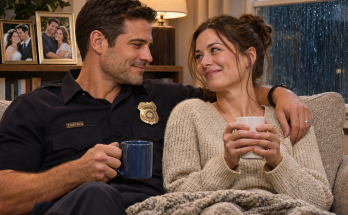
Nearly a year after the attack, we sat together in our living room.
The same room Tessa had once been afraid to enter.
She was reading.
I was working through some paperwork.
Outside, rain tapped against the windows.
Someone knocked at the front door.
Tessa looked up.
For a second, I saw the familiar tension in her face.
Then she took a breath.
“Are you expecting somebody?”
“No.”
I checked.
It was our neighbor.
He had received a package intended for us.
I thanked him and brought it inside.
Tessa looked at the box.
“What is it?”
“Something you ordered.”
She smiled.
“Oh, good.”
She opened it carefully.
Inside were two new coffee mugs.
One was blue.
The other was white.
She held up the blue one.
“Yours.”
I looked at the white one.
“And that's yours?”
“Obviously.”
We washed the mugs and made coffee.
She carried both cups into the living room.
I took mine.
“Thank you.”
She sat beside me.
The rain continued falling.
We talked about dinner.
She wanted soup.
I suggested bread.
Nothing unusual.
Nothing dramatic.
Just two people making plans for an ordinary evening in their own home.
The Dawson family had believed that hurting Tessa would teach her to obey them.
Instead, their actions exposed years of pressure that she had been taught to keep private.
Their lies failed.
Their attempts to influence the investigation failed.
Their demands for silence failed.
They faced consequences that none of them had expected when they entered our house demanding money.
But their punishment wasn't what defined our future.
Tessa's freedom did.
She had survived.
She had spoken.
She had stopped accepting responsibility for choices other people made.
And she had learned that refusing an unreasonable demand didn't make her a bad daughter.
I looked at her sitting beside me.
She was holding her new white coffee mug with both hands.
Her wrists still bothered her sometimes.
There were things she might always remember.
But she was smiling.
She caught me looking.
“What?”
“Nothing.”
She raised an eyebrow.
“Then drink your coffee before it gets cold.”
I laughed.
I took a sip.
She returned to her book.
The two anniversary photographs stood together on the nearby shelf.
Behind us, the kitchen light was still on.
Her sweater rested across the back of a chair.
Her shoes were beside the front door.
All those little things I had been terrified of losing were there.
And so was she.
Margaret Dawson had learned too late that I wouldn't use my position to conceal what her family had done.
But there was something else she had learned even later.
Tessa no longer needed her permission to be happy.
My wife turned another page.
I sat beside her, listening to the rain.
We were home.
And nobody was going to take that peace away from us again.
The End
Read more original stories on Feel Every Story.
I Asked My Wife’s Family One Simple Question Outside Her Hospital Room, but Her Mother Seemed More Concerned About My Anger
Part 10 of 10