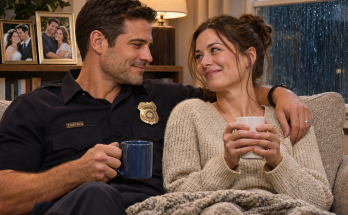
Tessa burned the first piece of toast.
She stared at it when it came out of the toaster.
Then she laughed.
“Well, that's encouraging.”
I took another slice of bread from the bag.
“Let's try again.”
She stood beside me at the kitchen counter.
Her wrists were still weak, but she could manage more than she had the previous week.
She cracked an egg with my assistance.
A little shell fell into the bowl.
Neither of us cared.
We made breakfast together.
It took almost an hour.
Before the attack, we could have done the same thing in fifteen minutes.
That morning, the extra time felt like a gift.
Tessa carried her own plate to the table.
I watched her carefully.
She noticed.
“Stop looking at me like that.”
“Like what?”
“Like I'm made of glass.”
I smiled.
“Sorry.”
She sat down.
“I need to start doing things again.”
I understood.
Protecting her didn't mean preventing her from living.
I was still learning that.
We ate our breakfast while sunlight moved across the kitchen floor.
For a little while, there was no discussion about doctors or lawyers.
No conversation about Margaret.
No mention of thirty thousand dollars.
Just breakfast.
A few days later, the prosecutor contacted us about developments in the case.
Several defense attorneys had expressed interest in negotiated resolutions.
The evidence against certain family members was substantial.
Other aspects of the case remained disputed.
We arranged another meeting.
Tessa took her folder with her.
She had organized the medical bills in chronological order.
Her appointment records were clipped together.
The statement describing her injuries rested at the back.
She carried everything herself.
I offered to hold it.
She shook her head.
“I've got it.”
I didn't ask again.
At the meeting, the prosecutor explained the proposed arrangements.
Lauren and Rachel were facing serious consequences for their direct involvement.
Brooke and Kayla were also being held accountable for their participation.
Jenna's responsibility was being considered separately, based on what the evidence established about her actions.
Molly's cooperation had been significant.
Her efforts to obtain help had also been taken into account.
But cooperation didn't erase every decision she'd made that afternoon.
Margaret's position was particularly complicated.
She hadn't simply arrived at our house by accident.
The messages established her involvement in organizing the visit.
She had encouraged her daughters to pressure Tessa into providing money.
She had remained present while the situation became violent.
And afterward, she had attempted to influence how the family described what happened.
The prosecutor explained everything carefully.
Tessa listened without interrupting.
When he finished, she opened her folder.
“Can I ask something?”
“Of course.”
“Will they have to admit what they did?”
He explained that the proposed agreements would require formal admissions relating to the offenses involved.
Tessa nodded.
“That matters to me.”
I looked at her.
She wasn't asking how long anybody would spend behind bars.
She wasn't demanding the harshest possible punishment.
She wanted them to stop lying.
After everything she had endured, that seemed like such a reasonable thing to want.
The prosecutor asked whether she had any further concerns.
Tessa looked down at her folder.
“I don't want them coming to our house.”
He explained the protective conditions being considered.
She listened.
Then she thanked him.
Outside, I offered to carry the folder again.
This time, she handed it to me.
“My wrists are getting tired.”
I took it.
There was something different about that moment.
She had accepted help because she needed it.
Not because somebody had told her she was incapable.
It was a small distinction.
But I had learned to notice those.
That evening, Margaret attempted to contact Tessa through another relative.
The woman called our home and said she had an important message.
Apparently, Margaret wanted one final opportunity to resolve the matter before the proceedings advanced.
I handed the phone to Tessa after explaining who was calling.
She listened for a moment.
Then she spoke.
“No, I don't want to meet with her.”
The relative continued talking.
Tessa remained quiet.
Finally, she interrupted.
“I understand that she's my mother.”
Another pause.
“But I'm not doing that.”
She ended the call.
Her hands were trembling slightly.
I sat beside her.
“Are you all right?”
She nodded.
“I think so.”
A moment later, she smiled.
“I didn't apologize.”
I smiled back.
“No, you didn't.”
She looked at the telephone.
“I almost did.”
I knew she had.
I'd heard it in the way her voice softened whenever the relative mentioned Margaret.
Years of conditioning didn't disappear because someone recognized them.
Tessa was learning to respond differently.
One conversation at a time.
The following week, Molly requested permission to meet with us.
Tessa considered it carefully.
She eventually agreed to a brief meeting in a public place.
We chose a quiet coffee shop.
Molly arrived early.
She looked thinner than she had at the hospital.
There were dark circles beneath her eyes.
When she saw Tessa, she began to stand.
Then she seemed uncertain about what to do.
“Hi.”
Tessa sat across from her.
“Hi, Molly.”
I ordered coffee and remained nearby.
Tessa had asked me to stay.
Molly wrapped both hands around her paper cup.
“I wanted to tell you something before court.”
Tessa waited.
“I'm not changing my statement.”
“Okay.”
“Mom keeps telling people I exaggerated.”
Tessa looked at her sister.
“Did you?”
Molly shook her head.
“No.”
“Then don't change it.”
Molly started crying.
She took a napkin from the table.
“I know what I did was wrong, too.”
Tessa said nothing.
Molly continued.
“I knew she was planning to make you give her money. I came anyway.”
I looked down at my coffee.
It was the first time I had heard Molly acknowledge her involvement so plainly.
“I thought we'd argue with you, and eventually you'd give in.”
Tessa looked at her.
“You thought I'd give in because I always did.”
Molly nodded.
“Yes.”
For a while, neither sister spoke.
The coffee shop continued operating around us.
Someone ordered a sandwich.
A young employee wiped down the counter.
Molly folded her napkin into smaller and smaller squares.
Finally, she spoke again.
“I'm sorry I helped put you in that situation.”
Tessa's eyes filled.
“Thank you for saying that.”
Molly looked hopeful.
But Tessa continued.
“It doesn't mean everything's okay between us.”
“I know.”
“I need you to understand that.”
Molly nodded.
This time, she didn't ask for forgiveness.
She didn't ask when they could return to being sisters the way they had been before.
She accepted what Tessa had said.
When we left, Molly remained seated with her unfinished coffee.
Tessa was quiet on the drive home.
Eventually, she spoke.
“That was the first real apology.”
I glanced toward her.
“It sounded like one.”
She looked out the window.
“I wish Mom could do that.”
I didn't know what to say.
I wished the same thing.
Not for Margaret's benefit.
For Tessa's.
Several weeks passed before the next significant court proceedings.
During that time, Tessa's physical recovery continued.
Some of the supports around her wrists were removed.
Her doctors remained cautious about her progress.
She still experienced pain.
There were days when she woke feeling discouraged before she'd even left the bed.
On those days, I learned not to insist that everything was improving.
Sometimes she simply needed someone to acknowledge that it was difficult.
One evening, we sat together while she prepared her victim impact statement.
She had already written most of it.
She wanted to make a few changes.
“Read that part again.”
I read the paragraph describing her inability to use her hands during the first weeks after the attack.
She listened.
Then she shook her head.
“Add something.”
“What?”
She thought about it.
“I couldn't even wipe my own tears.”
I looked at her.
She continued.
“I had to ask somebody every time.”
I wrote the sentence exactly as she said it.
She looked over the remaining pages.
There was another section about waking in the hospital and being afraid her mother might enter the room.
She wanted that included, too.
She didn't want the statement to describe only physical injuries.
She wanted the court to understand what those injuries had done to her sense of safety.
When we finished, she placed the pages inside the folder.
“That's enough.”
“Are you sure?”
“Yes.”
She closed it.
“I don't want to spend another night writing about them.”
I understood.
We put the folder away and watched a movie.
Tessa fell asleep halfway through.
I turned down the volume and covered her with a blanket.
The morning of the court appearance, she dressed carefully.
She chose a plain blue blouse.
It took her several attempts to fasten one of the buttons.
I offered to help.
She shook her head.
Then she managed it.
She looked at herself in the mirror.
“Do I look all right?”
“You look fine.”
She adjusted the sleeve.
“I don't want them thinking I'm weak.”
I walked over.
“You don't have to demonstrate anything to them.”
She looked at me through the mirror.
“I know.”
We left together.
At the courthouse, the victim services representative met us again.
She explained the arrangements.
Some matters had been resolved through guilty pleas.
Others had required further proceedings before responsibility could be determined.
The individual outcomes reflected the evidence relating to each defendant.
I watched Margaret enter the courtroom.
She looked older.
Not because much time had passed.
Because she no longer carried herself with the same certainty.
Lauren sat nearby.
Rachel looked straight ahead.
Brooke and Kayla avoided looking toward Tessa.
Jenna appeared nervous.
Molly remained apart from the others.
I sat beside my wife.
When the established facts were presented, I heard details I already knew.
The financial demand.
The coordinated visit.
The refusal to leave Tessa alone.
The phone being taken from her.
The assault.
The medical consequences.
Hearing everything described in that setting was different from discussing it privately.
Nobody called it a misunderstanding.
Nobody described Tessa as overly sensitive.
Nobody suggested that twenty-seven fractures were simply the unfortunate result of a family disagreement.
The facts were stated plainly.
I watched Margaret lower her head.
Then it was Tessa's opportunity to speak.
She stood with her folder.
Her hands shook.
She looked at the pages.
For several seconds, she said nothing.
I wanted to stand beside her.
But she had chosen to do this herself.
I remained seated.
“My name is Tessa.”
Her voice was quiet.
She paused.
“I was hurt in my own home by people I trusted.”
Margaret looked toward her.
Tessa continued reading.
She described the hospital.
She described being unable to move without pain.
She spoke about needing help to eat, dress, and wash herself.
She described the fear she felt when returning home.
Then she reached the sentence we'd added.
“For a while, I couldn't even wipe my own tears.”
I lowered my eyes.
There were tears on my face.
I didn't bother wiping them away.
Tessa continued.
“I want the people responsible to understand that refusing to give them money was my right.”
She looked up from the paper.
“I wasn't being selfish.”
Her voice became steadier.
“I wasn't betraying anybody.”
She took another breath.
“I was saying no.”
Margaret began crying.
Tessa looked back at her statement.
She didn't stop.
She explained that she wasn't seeking revenge.
She wanted protection.
She wanted accountability.
She wanted to live without being afraid of the consequences of making her own decisions.
When she finished, she returned to her seat.
I reached toward her hand.
She took mine.
Carefully.
The judge addressed the individual defendants and the seriousness of their conduct.
The court imposed consequences that reflected their respective offenses and circumstances.
Lauren and Rachel received custodial sentences.
Brooke and Kayla also faced substantial legal penalties for their involvement.
Jenna received a lesser sentence reflecting the conduct established against her, together with strict conditions.
Molly's cooperation and efforts to obtain help were considered in resolving her responsibility, alongside her acknowledgment of wrongdoing.
Margaret received a custodial sentence for her established criminal involvement.
There were also protective restrictions intended to prevent further intimidation or unwanted contact.
Restitution was addressed through the court's orders.
I listened to everything.
I had imagined this moment many times.
In those imaginings, I always expected to feel some enormous sense of satisfaction.
I didn't.
I felt relieved.
And sad.
Tessa squeezed my hand.
Margaret turned toward us.
Her face was wet with tears.
For a moment, I thought she might finally say something to her daughter.
Something honest.
But the proceedings continued, and she was directed to leave with the appropriate officers.
Tessa watched her mother go.
Then she looked down at her folder.
“It's over?”
“The main proceedings are finished.”
She nodded slowly.
Outside, the air felt cold.
We stood near the courthouse steps.
She looked toward the parking lot.
“I thought I'd feel different.”
“How?”
“I don't know.”
She wiped her cheek.
“Happier, maybe.”
I understood.
Justice couldn't give her back the afternoon she'd lost.
It couldn't remove every scar.
It couldn't turn Margaret into the mother she'd wanted.
But it had accomplished something important.
The truth had been acknowledged.
The consequences no longer belonged only to Tessa.
We walked toward the car.
She handed me the folder.
This time, I took it without asking.
When we arrived home, she placed her shoes beside the wall.
Then she went into the kitchen.
She opened the cupboard.
“Coffee?”
I smiled.
“Please.”
She reached for two mugs.
Her movements were slow.
I stayed close without interfering.
She managed to place both mugs on the counter.
Then she looked at me.
“I did it.”
I wasn't sure whether she meant the coffee mugs or the courtroom.
Perhaps she meant both.
I nodded.
“You did.”
Click here to continue reading: PART 10: After the Courtroom Emptied and the Dawson Family Could No Longer Demand Our Silence, Tessa and I Began Rebuilding the Ordinary Life We Loved
I Asked My Wife’s Family One Simple Question Outside Her Hospital Room, but Her Mother Seemed More Concerned About My Anger
Part 9 of 10