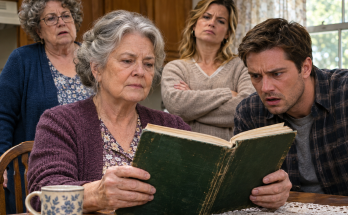
Nearly a month passed before Brandon brought up buying the house again.
He had made his second rent payment on time.
There hadn't been an argument.
There hadn't even been a discussion about the amount.
I deposited the check and recorded it in my notebook.
I was beginning to settle into a routine.
Then, one Saturday morning, Brandon called.
“Mom, have you got a minute?”
“I've got several.”
He laughed.
It was nice hearing him laugh without there being something uncomfortable underneath it.
“Courtney and I have been talking about the house.”
I waited.
“We'd still like to buy it.”
“All right.”
“Would you consider selling?”
I looked toward the brown envelope.
“I'd consider discussing it.”
“That's better than nothing.”
I smiled.
“I suppose it is.”
We arranged to meet the following afternoon.
After hanging up, I sat quietly for a while.
I knew I would need to think carefully.
Selling the house would mean giving up a steady source of income.
Keeping it meant continuing to look after a property where my son lived.
Neither decision was insignificant.
I had no intention of making either one simply because Brandon wanted an answer.
I telephoned Willadean.
She answered on the third ring.
“What's happening?”
“Brandon wants to buy the house.”
“Do you want to sell it?”
“That's what I'm trying to decide.”
She was quiet for a moment.
“Then you don't have an answer yet.”
I laughed softly.
“You make things sound so simple.”
“Sometimes they are.”
After our conversation, I took out Harlis's green ledger.
I wanted to understand something about the original purchase.
Not the numbers.
I knew the numbers.
I wanted to remember what Harlis and I had been thinking in March 2019.
We hadn't purchased the house carelessly.
We had talked about what it could provide.
A place for Brandon.
An asset for us.
Something that would remain after the money spent buying it was gone.
At the time, I hadn't fully appreciated the importance of that last part.
Harlis had.
He understood that savings could disappear.
A property required maintenance, but it was something we could continue using to support ourselves.
I had trusted his judgment.
That didn't mean I was required to follow every decision he had made for the rest of my life.
Still, his reasoning deserved consideration.
I looked again at the original purchase price.
Sixty-eight thousand five hundred dollars.
I wondered what Brandon thought the house was worth now.
I suspected we might have different ideas.
The following afternoon, he arrived with Courtney.
They looked more relaxed than they had during our earlier meetings.
Brandon carried a folder.
Courtney had her handbag and a bottle of water.
We sat at the kitchen table.
Brandon opened the folder.
“We've been working through some numbers.”
I nodded.
“That's sensible.”
“We think we could manage a mortgage.”
“Have you spoken to a lender?”
“Not formally.”
Courtney leaned forward.
“We wanted to know what you were thinking first.”
“About the price?”
“Yes.”
I told them I hadn't established a price.
Brandon looked slightly disappointed.
“I thought we might start with what Dad paid.”
I had expected that.
I opened the green ledger.
He recognized the page.
“There it is,” he said.
“That's what your father and I paid in 2019.”
“Right.”
“But that doesn't necessarily tell us what it's worth today.”
Courtney glanced at Brandon.
“We were hoping you'd sell it to us for that amount.”
I folded my hands.
“Why?”
She looked surprised by the question.
“Because we're family.”
I nodded slowly.
We had arrived at that familiar explanation again.
I didn't want to react with irritation.
Instead, I asked them whether they would expect to purchase another house for the amount its owner had paid several years earlier.
Brandon shook his head.
“No, probably not.”
“Then you understand why I need more information.”
Courtney took a drink of water.
“We thought you might give us a family discount.”
“I might consider one.”
She brightened.
“But I need to understand what I'm discounting first.”
Her expression changed again.
Brandon looked at the folder.
“That's fair.”
I appreciated that he said it.
I explained that I would need to obtain independent information about the property's current value.
I would also need to consider how selling it would affect my finances.
Courtney asked how long that would take.
I said I didn't know yet.
Then she asked whether the rent they paid while waiting could be deducted from the eventual purchase price.
I looked at her.
“That would require a separate agreement.”
“But it would make sense.”
“Not necessarily.”
Brandon rubbed his forehead.
“Courtney, we talked about this.”
She turned toward him.
“I know.”
He looked back at me.
“Forget that part for now.”
I didn't enjoy seeing them disagree.
But I was relieved that he no longer expected me to accept every suggestion Courtney made.
We ended the conversation without agreeing on a sale.
That was fine.
There had been no promise to make one.
After they left, I wrote down the questions I needed answered.
What was the property worth?
What would I receive after the costs of selling?
How would losing the rental income affect me?
What expenses would I no longer have to cover?
I wasn't accustomed to asking those questions on my own.
Harlis and I had usually considered important financial decisions together.
Now I had to learn how to do it without him.
Over the following days, I arranged to have the property professionally assessed.
Brandon cooperated when access was needed.
He even asked whether there was anything he should prepare.
I told him to make the house reasonably accessible and answer questions honestly.
The assessment wasn't something either of us could determine by wishing for a particular result.
When I received the written report, I read it carefully.
The property was worth considerably more than we had paid for it.
That didn't surprise me.
Seeing the difference on paper did make me think.
Selling at the original purchase price would mean giving away a substantial portion of the value Harlis and I had built.
It wasn't simply a matter of returning our original investment.
It meant surrendering something that had grown over time.
I placed the report inside the brown envelope.
Then I telephoned the attorney.
We discussed what a potential sale would involve.
He recommended that I also seek suitable financial advice before making a decision that could affect my long-term security.
I followed that advice.
I gathered information about my income, expenses, savings, and the property.
I felt embarrassed at first.
I worried that my questions might sound foolish.
Then I remembered something Harlis used to do whenever he didn't understand a bill.
He asked somebody who did.
There was no shame in that.
I learned what I needed to consider.
The rental income wasn't the same as profit.
Owning a house involved taxes, insurance, maintenance, and the possibility of unexpected repairs.
Selling it would remove some responsibilities but introduce different financial considerations.
I needed to look beyond the immediate amount somebody might offer.
I returned home with a clearer understanding of my position.
For the first time, I could explain why keeping the property might benefit me without simply repeating what Harlis had said.
I was learning to understand the decision for myself.
Brandon called the next evening.
“Have you heard anything?”
“Yes.”
“What's the house worth?”
I told him I had received the assessment.
I offered to let him and Courtney examine a copy when we met.
He sounded impatient.
“Can't you just tell me?”
“I'd rather discuss it properly.”
He sighed.
“Okay.”
I knew patience wasn't his strongest quality.
It hadn't been mine, either, when I was younger.
We arranged another meeting.
This time, Courtney was the first person to arrive.
Brandon followed a few minutes later.
I placed the report on the table.
They read it together.
Courtney looked up before Brandon had finished.
“That's a lot more than sixty-eight thousand.”
“Yes.”
She returned to the report.
“Are they sure?”
“It's an independent assessment.”
Brandon turned the pages.
He examined the information about the property and the supporting comparisons.
Then he sat back.
“We couldn't afford that.”
I nodded.
“I understand.”
Courtney pointed at the original purchase entry in Harlis's ledger.
“But you didn't pay that much.”
“No.”
“Then you'd still get your money back if you sold it to us for what you paid.”
I looked at her.
“That would also mean giving up the increase in its value.”
She appeared frustrated.
“You'd be helping your son.”
“I've been helping my son for years.”
The words came out quietly.
Brandon looked down.
Courtney didn't answer.
I continued.
“Helping somebody doesn't mean I have to give away whatever they ask for.”
She folded her arms.
For a moment, I thought we were going to return to the argument that had brought them into my kitchen in the first place.
Brandon surprised me.
“She's right.”
Courtney turned toward him.
“What?”
“It's her property. We can't decide what she should sell it for.”
I watched him.
He looked uncomfortable saying it.
That made me appreciate it even more.
He wasn't agreeing because the answer suited him.
He was agreeing because he understood something he hadn't understood before.
Courtney picked up the report again.
“So that's it?”
“Not necessarily,” I said.
I explained that I hadn't made a final decision about selling.
I was willing to consider a reasonable proposal.
But I wasn't willing to jeopardize my future to make their purchase possible.
Brandon nodded.
Courtney remained quiet.
I gave them time to read the report.
When they finished, Brandon asked whether he could keep the copy.
“Certainly.”
He folded it into his folder.
Courtney looked at me.
“Did Harlis really intend for this house to provide income for you?”
I thought about the question.
“He intended for us to have some security.”
“And now that he's gone?”
“That security matters even more.”
She looked down.
I wasn't accusing her of anything.
I was explaining the part of the situation they had overlooked.
Harlis's death hadn't eliminated my need for protection.
It had increased it.
Brandon closed his folder.
“We need to work out what we can actually afford.”
“That sounds like a good idea.”
After they left, I remained at the table.
I thought about what I had said.
I had finally explained my position without feeling that I needed to soften it.
There was no cruelty in wanting enough money to support myself.
There was nothing selfish about protecting what my husband and I had earned.
I opened my notebook.
I recorded the date of the meeting.
I noted that no sale had been agreed upon.
Then I closed it.
Several evenings later, Brandon called.
He had spoken with someone about financing.
The conversation hadn't gone as he had hoped.
Even if I agreed to sell, he and Courtney would need to make changes before they could afford a purchase at a reasonable price.
“I guess we're going to have to keep renting for a while.”
“That's all right.”
He sounded disappointed.
“I really wanted to own the place.”
“I know.”
“Dad made it look easier than it is.”
I smiled sadly.
“He spent a lot of years making difficult things look easy.”
Brandon was quiet.
Then he asked me something unexpected.
“How did you two save enough to buy it?”
I leaned back in my chair.
“We saved a little at a time.”
“Just like that?”
“Not just like that.”
I told him it had taken years of making choices.
We hadn't bought everything we wanted.
We hadn't always had money left over.
We had sometimes disagreed about what was worth spending.
But we had kept working.
We had kept saving.
And when we finally had enough to make certain decisions, we tried to make them carefully.
Brandon listened.
He didn't interrupt.
When I finished, he said something that stayed with me.
“I guess I never thought about how long it took you.”
I looked at the green ledger.
“No, honey. I don't think you did.”
He didn't argue.
Before hanging up, he told me the next rent payment would arrive as usual.
I thanked him.
Then I sat quietly with my hands resting on the kitchen table.
I had spent years hoping my son would inherit something from his father.
I had thought mostly about property and money.
Now I realized there were more important things he could inherit.
Patience.
Responsibility.
Respect for another person's work.
Those things couldn't be handed over with a deed.
He would have to learn them himself.
And for the first time, I believed he might be willing to try.
Click here to continue reading: PART 7: When Courtney Finally Returned to My Kitchen Alone, She Wanted to Talk About Something That Had Nothing to Do With the House
My Son Wanted an Explanation for the Rent Letter, but His Father Had Already Written Everything Down in a Green Ledger
Part 6 of 10