Three days passed without a telephone call.
I didn't call Brandon.
That was harder than I expected.
I had spent most of my life checking whether he needed something.
Even after he became a grown man, I worried whenever I didn't hear from him.
Now I found myself walking past the telephone and deliberately leaving it alone.
I wasn't trying to teach him a lesson.
I was trying to give him the opportunity to make his own decision.
There was a difference.
On the fourth morning, I opened the green ledger again.
I needed to prepare a proper account of the property's ongoing expenses.
The attorney had advised me to keep the new arrangement separate from the old records.
I understood why.
Harlis had documented what had happened while he was alive.
It was my responsibility to document what happened afterward.
I found a new notebook.
It wasn't green.
It didn't need to be.
I wrote the property address on the first page.
4112 Highway 62.
Underneath, I wrote the date.
For a moment, I hesitated.
There was something final about beginning a record that Harlis would never write in.
I had depended on him for so long that even a simple column of figures felt unfamiliar.
I sharpened my pencil.
Then I began.
I worked through the expenses slowly.
I checked each number twice.
When I couldn't remember something, I looked at the relevant paperwork instead of guessing.
I wanted the arrangement to be fair.
Not generous enough to hurt me.
Not expensive enough to punish Brandon.
Just fair.
By lunchtime, I had finished.
I placed the new notebook beside Harlis's ledger.
Two books.
One belonged to the life we had shared.
The other belonged to the life I needed to manage now.
That afternoon, Courtney called.
“Brandon and I have been discussing everything.”
“All right.”
“We really can't take on another major expense right now.”
I put my pencil down.
“I understand.”
“Then you understand why this is difficult.”
“Yes.”
She waited.
I realized she expected me to offer a solution.
I didn't have one that involved giving up the rent.
“What exactly are you proposing, Courtney?”
“We thought you might reconsider for a few months.”
“How many?”
She hesitated.
“Until things settle down.”
I had heard variations of those words before.
Until things settled down.
Until the next paycheck.
Until circumstances improved.
The trouble was that circumstances could always provide another reason to wait.
“I need something more definite than that.”
She sounded surprised.
“Brandon said you'd probably understand.”
“I do understand. That doesn't mean I can carry the expense indefinitely.”
She became quiet.
Then she asked whether I really needed the money.
I looked at the figures in my new notebook.
“Yes.”
“But surely Harlis left you something.”
I didn't answer immediately.
It occurred to me that she was more comfortable discussing what my husband had left me than discussing what she and Brandon owed.
“My personal savings aren't part of this arrangement.”
“We're just trying to understand your situation.”
“Then understand that I'm responsible for my own future now.”
She sighed.
“Everything has become so complicated.”
I thought about the house.
The deed.
The monthly payments.
The letter.
It didn't seem particularly complicated to me anymore.
It was uncomfortable.
That wasn't the same thing.
Courtney told me they would come over the following evening.
I agreed.
After hanging up, I put the notebook away.
I didn't spend the rest of the afternoon wondering whether I had been too harsh.
For once, I allowed myself to think about something besides their problems.
I made supper.
I washed my dishes.
I sat in the living room.
When evening came, I missed Harlis just as much as I had the day before.
Standing up for myself hadn't made the grief disappear.
I was learning that two difficult things could exist together.
I could miss my husband.
I could love my son.
And I could refuse to be taken advantage of.
The following evening, Brandon arrived before Courtney.
I hadn't expected that.
He stood on the porch with his hands in his pockets.
“Can I come in?”
“Of course.”
He followed me into the kitchen.
I asked if he wanted coffee.
He said he did.
While I poured it, he looked around the room.
His eyes stopped on Harlis's empty chair.
Neither of us mentioned it.
He sat down.
For a while, he held the cup without drinking.
“Mom, did Dad ever talk to you about giving us the house?”
“Yes.”
He lifted his head.
“What did he say?”
I sat across from him.
“He wanted you to have a secure place to live.”
“That's what I remember.”
“But he didn't want us to give away everything we'd worked for.”
Brandon looked down.
“He never said it like that to me.”
“Maybe he thought you understood.”
My son rubbed his thumb against the handle of the cup.
“I thought he was helping me buy it.”
I tried to understand how he had reached that conclusion.
Perhaps he had heard what he wanted to hear.
Perhaps Harlis hadn't explained things clearly enough.
Perhaps I should have been more involved in those conversations.
I couldn't change any of that now.
“Did you ever ask how much of the house you had paid off?”
“No.”
“Did you ever ask when you'd receive the deed?”
He shook his head.
I let the silence remain.
He took a drink of coffee.
“I guess I figured it would happen eventually.”
There it was.
Not an agreement.
An assumption.
I had made assumptions myself.
I had assumed my son understood what Harlis and I had done for him.
I had assumed he would remember that kindness when we grew older.
I had assumed I wouldn't have to explain why his mother's financial security mattered.
We had all been careless in different ways.
But only one of us had been asked to give up the house.
“Brandon, I wish we'd talked about this years ago.”
He nodded.
“Me too.”
That was the closest we had come to agreeing on anything since the funeral.
I wasn't prepared to mistake it for a complete reconciliation.
Still, I appreciated hearing it.
He looked at the kitchen table.
“Where's Dad's book?”
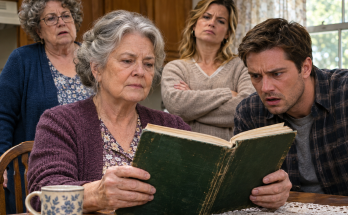
I retrieved the green ledger.
He opened it carefully.
His anger seemed to have gone somewhere else.
Now he was simply looking at his father's handwriting.
He turned through several pages.
Then he stopped.
“Dad paid for the insurance?”
“Yes.”
“All those years?”
“Yes.”
He looked at another entry.
“And these repairs?”
“Your contributions helped. Your daddy covered the difference whenever they weren't enough.”
He stared at the figures.
I let him take his time.
There were things I could explain.
There were other things he needed to discover for himself.
He turned another page.
“I didn't know he kept track of all this.”
“He kept track of everything he could.”
Brandon smiled faintly.
“Sounds like Dad.”
For a moment, he was simply my son remembering his father.
I had missed that version of him.
Then we heard Courtney at the door.
Brandon closed the ledger.
She came inside carrying several sheets of paper.
“We've written down our expenses.”
I offered her a chair.
She sat beside Brandon.
I examined the figures she had brought.
Some expenses were unavoidable.
Others were things she and Brandon would have to decide whether they could continue affording.
I didn't criticize their choices.
Their household was their responsibility.
Mine was mine.
Courtney pointed to the total.
“See what we're dealing with?”
“I see.”
“There's barely anything left.”
I returned the paper.
“Then you'll need to decide what changes make sense for you.”
She stared at me.
“That's your answer?”
“What would you like my answer to be?”
She looked at Brandon.
He didn't speak.
“I thought you might be willing to help.”
I felt tired.
Not angry.
Tired.
“Courtney, we've been helping for years.”
She opened her mouth.
Then she closed it.
I placed Harlis's ledger between us.
“This is what that help looked like.”
She didn't reach for it.
I opened my new notebook instead.
“This is what the property costs me now.”
I turned the figures toward them.
Courtney examined the page.
Brandon leaned closer.
For the first time, they were looking at my expenses rather than explaining their own.
I watched my son follow the numbers down the page.
He seemed to be calculating something.
Finally, he sat back.
“So you weren't just keeping our nine hundred dollars.”
“No.”
Courtney looked uncomfortable.
I didn't press the point.
I wasn't interested in making her admit something merely because she had been wrong.
I wanted her to understand enough that we wouldn't have the same argument next month.
She folded their expense sheet.
“What happens if we decide we can't agree to your terms?”
I answered carefully.
“Then we'll follow the proper process for ending the arrangement, and you'll need to find somewhere else.”
Brandon looked at me.
“You'd really do that?”
“I hope it doesn't come to that.”
“But you would?”
“Yes.”
I didn't enjoy saying it.
I didn't enjoy watching his face afterward.
But I couldn't make promises that would destroy the boundary I had finally established.
Courtney shook her head.
“I never imagined we'd be having this conversation.”
“Neither did I.”
She looked toward the window.
I wondered whether she was thinking about the funeral.
I wondered whether she remembered smiling at her telephone while Brandon told me that his final check would have to be enough.
I didn't ask.
She would have to think about that moment on her own.
Brandon folded his hands on the table.
“What if we pay the rent for now and talk about buying the house later?”
I considered his proposal.
“That would be reasonable, provided you understand I'm not promising to sell.”
He nodded slowly.
Courtney turned toward him.
“Brandon.”
He looked at her.
“We need somewhere to live.”
She didn't answer.
He continued.
“And we can't keep arguing that the house belongs to us when the paperwork says it doesn't.”
I had waited a long time to hear something like that.
When it finally came, I didn't smile.
I didn't tell him that I had been right.
I simply listened.
Courtney looked down at her papers.
She seemed to be working through the consequences of what Brandon had said.
Eventually, she asked to see the proposed rental terms again.
I handed her a copy.
She read them more carefully than she had before.
There were questions.
We discussed them.
Where I didn't know the answer, I told her I would obtain proper advice rather than make something up.
Nobody raised their voice.
Nobody threatened to leave.
It wasn't a particularly pleasant conversation, but it was an honest one.
That mattered to me.
When we finished, Brandon asked for another copy of the proposed agreement.
He and Courtney wanted to review it together before making a final commitment.
I agreed.
Then I placed the green ledger inside the brown envelope.
Brandon watched me.
“Could I see Dad's book again sometime?”
“Of course.”
He nodded.
“I'd like that.”
Courtney stood and collected her papers.
She thanked me for the coffee.
It was a small courtesy.
I accepted it without searching for a deeper meaning.
At the door, Brandon hesitated.
He looked at me for several seconds.
Then he asked something I hadn't heard him ask since Harlis died.
“How are you doing, Mom?”
I wasn't prepared for it.
I had imagined plenty of arguments.
I had practiced answers to questions about money and ownership.
I hadn't practiced answering that one.
“Some days are better than others.”
He lowered his head.
“I know you miss him.”
“I do.”
He looked toward the kitchen.
“I miss him too.”
For a moment, I wanted to pull him into my arms and tell him that everything would be all right.
But everything wasn't all right.
Not yet.
I put my hand on his arm.
“We'll have to learn how to manage without him.”
Brandon nodded.
Then he followed Courtney outside.
I closed the door gently.
Back in the kitchen, I found his empty coffee cup beside Harlis's chair.
I picked it up.
There was a little coffee left in the bottom.
I emptied it into the sink and washed it.
Then I returned to the table.
The rental agreement still needed to be completed.
There were decisions Brandon and Courtney hadn't made.
There were conversations we hadn't finished.
But something important had changed.
My son had stopped insisting that the house was already his.
He had begun talking about what it would mean to pay for the privilege of living there.
I opened my new notebook.
Underneath the property expenses, I wrote a brief account of our conversation.
I noted the date.
I recorded what we had discussed.
Then I put my pencil down.
Harlis had taught me the value of keeping an accurate record.
Life was teaching me something else.
I could be a loving mother without handing over everything I owned.
I could listen to my children's worries without making every one of them my responsibility.
And I could leave room for my son to become a better man without pretending he had already become one.
I placed the new notebook beside the green ledger.
For the first time since Harlis's funeral, I felt that I was beginning to understand what my future might look like.
It wouldn't be the future I had imagined.
But it would belong to me.
Click here to continue reading: PART 5: The First Payment Arrived Without a Word, but What My Son Had Written on the Check Told Me Something Had Finally Changed
My Son Wanted an Explanation for the Rent Letter, but His Father Had Already Written Everything Down in a Green Ledger
Part 4 of 10