The hardest part of that morning wasn't deciding what to do about Preston.
It was admitting why I hadn't noticed the trouble sooner.
For three years, I had stayed away from Cedar Summit Lodge.
I told myself it was because the memories were too painful.
That was true.
But it wasn't the whole truth.
I had also become comfortable letting other people handle the details.
Reports arrived.
Bills were paid.
Reservations were recorded.
Managers sent updates.
And as long as nothing looked seriously wrong on paper, I assumed the business was healthy.
I hadn't asked enough questions.
I hadn't visited often enough.
I hadn't listened closely enough to the people doing the work.
Rosa had reminded me of that.
She had spent nearly nine years at the lodge.
I had owned it much longer.
Yet she understood its daily life better than I did.
That was a difficult thing to accept.
I looked at my reflection in the truck's rearview mirror.
My hair had gone gray.
There were deeper lines around my eyes than I remembered.
I was sixty-eight years old.
I had spent decades learning how to run hotels.
And still, I had allowed myself to believe that experience meant I could stop paying attention.
Looking back, that was foolish.
The company had grown from one modest inn to seven properties.
With every expansion, my responsibilities became more complicated.
There were more rooms.
More employees.
More managers.
More decisions that I couldn't personally supervise.
I understood why delegation was necessary.
But delegation was not the same as surrendering responsibility.
Beatrice knew that.
She had always paid attention to the people behind the numbers.
If a hotel reported strong revenue, she wanted to know whether the employees were exhausted.
If guest complaints decreased, she wanted to know whether customers were genuinely happier or simply giving up.
She didn't trust a good-looking report without understanding what it represented.
I had admired that about her.
Then, after she died, I slowly stopped following her example.
I looked toward the entrance.
The hotel was beginning another day.
Guests would come and go.
Employees would clean rooms.
The front desk would answer calls.
From the outside, everything would look normal.
That was the frightening part.
A business could continue operating while its values were being damaged.
It could collect payments.
It could maintain clean rooms.
It could send polished reports to headquarters.
And still treat people badly.
Rosa's story had made that clear.
I remembered her reaction when I asked whether the mistreatment happened often.
She had turned toward the hotel.
Her face had changed.
She had looked afraid before she said a word.
I didn't know exactly what Preston had done to every employee.
I didn't know how many people had been threatened.
But I knew that Rosa had felt the consequences of questioning him.
Her hours had been reduced.
She had borrowed money for her daughter's school expenses.
And she had continued working.
Not because she approved.
Because she needed the job.
I thought about the difference between her circumstances and mine.
I could survive losing a night's accommodation.
I could survive paying an unreasonable amount.
I could even survive the embarrassment of being removed from a building I owned.
Rosa couldn't easily survive losing her income.
That made her decision to speak even more significant.
I reached for the folded blanket.
It smelled faintly of clean laundry.
Nothing expensive.
Nothing special.
Just something warm that a housekeeper had carried through the rain.
I ran my fingers over the fabric.
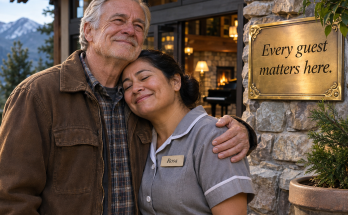
Then I thought of the plaque.
Every guest matters here.
Beatrice hadn't chosen those words to decorate a wall.
She had chosen them as a promise.
And if I allowed employees to punish people for acting on that promise, then the plaque meant nothing.
I remembered our early years in the roadside inn.
We didn't have much money.
We worked long days.
When someone complained, one of us usually had to handle it personally.
There was no large office to hide behind.
No department to blame.
No complicated chain of responsibility.
If we made a mistake, we had to face the guest.
Beatrice was better at that than I was.
She could listen to an angry customer without becoming defensive.
I often wanted to explain why something had gone wrong.
She wanted to know how the person had been affected.
That was a difference between us.
And over the years, I learned from her.
I wondered what she would have said about the previous night.
I could almost hear her.
She wouldn't have cared that Preston failed to recognize me.
She would have cared that he treated a guest as though he were worthless.
She wouldn't have been impressed by Mallory's confidence.
She would have asked why a receptionist believed she could judge people by their vehicles.
And she would have wanted to know why Rosa was afraid.
I looked at the phone again.
The information I had recorded was still there.
I had no reason to delay a review of the hotel.
The facts were serious.
The issue involved money, guest treatment, and possible retaliation against staff.
I knew that any investigation would affect the people working there.
Some might be frightened.
Some might be defensive.
Some might worry that the entire hotel would suffer because of management's decisions.
I didn't want that.
Cedar Summit Lodge was more than Preston Shaw.
It was more than Mallory.
It was the housekeepers.
The kitchen staff.
The security officers.
The people who maintained the rooms and kept the building running.
Many had worked there long before Preston arrived.
They deserved fairness too.
I made another note.
No punishment without evidence.
No assumption that every employee had participated.
No retaliation against anyone who raised concerns.
I read the words twice.
Those were not complicated principles.
But they were essential.
I knew how quickly a workplace could become frightened when management changed.
People started guessing.
Rumors spread.
Employees worried about their jobs.
I didn't want to replace one atmosphere of fear with another.
I wanted the truth established.
Then I wanted the problems corrected.
I thought about Eli again.
He had hesitated.
His hesitation stayed with me.
He had looked at the storm and warned Preston that the weather was severe.
That small moment mattered.
He hadn't stopped the order.
But he had recognized the danger.
I couldn't place him in the same category as Preston without understanding his position.
The same applied to other employees.
Rosa had told me enough to justify concern.
She hadn't given me permission to condemn everyone in the building.
I needed to remember that.
The rain had almost stopped.
Water dripped from the edge of the lodge roof.
The parking lot was wet and empty in places.
I could see my pickup reflected in a shallow puddle.
Old.
Rusty.
Unimpressive.
I smiled despite myself.
If I had arrived in a luxury car, perhaps the entire evening would have been different.
That was what made the experience so useful.
Preston had shown me how he behaved when he believed a guest had no influence.
He hadn't known who I was.
He hadn't known I could challenge his authority.
He had behaved as though the man standing before him was powerless.
And I had learned something about the management of my hotel that no written report had revealed.
But I also felt uncomfortable with the advantage I held.
I could eventually announce my identity.
I could demand access to records.
I could call company headquarters.
Most guests couldn't do any of those things.
They had to depend on the honesty of the people serving them.
That was why the conduct mattered.
A hotel should not require a guest to be powerful before treating them properly.
I remembered the couple who had checked in ahead of me.
They had been quoted one hundred eighty dollars plus tax.
I had heard it.
Then Mallory looked at me and presented a much larger estimate.
The difference had been immediate.
I hadn't changed rooms.
I hadn't requested special services.
I hadn't asked for anything beyond my reservation.
Yet my bill had changed.
I wondered how many other guests had stood at that counter trying to understand charges they hadn't requested.
I wondered how many had felt embarrassed.
How many had left.
How many had paid because they were too tired to argue.
Those were questions.
Not conclusions.
I had to be careful about that distinction.
I could not rewrite the facts simply because I was angry.
I had to find out what had actually happened.
I returned to the email Preston had sent.
Four months.
That was how long it had been since he confirmed the preservation fee was gone.
Four months during which the fee might have continued appearing on invoices.
Or perhaps it had been added selectively.
I didn't know.
Either possibility required examination.
I thought about the five additional charges on my estimate.
Mountain experience package.
Heritage preservation fee.
Exclusive arrival service.
Guest enhancement package.
Nonrefundable premium service fee.
The names sounded official.
That was part of the problem.
A guest might assume that anything printed on hotel stationery had been approved.
Someone unfamiliar with the business might not know which charges were legitimate.
The authority of the hotel made the fees appear trustworthy.
I knew better.
But I knew better only because I owned the company.
I felt my anger return.
I set the phone down.
Then I waited until I could think clearly again.
I had learned a long time ago that anger could tell you something was wrong.
It could not always tell you what to do next.
I needed more than anger.
I needed evidence.
A proper review.
And a willingness to accept whatever it showed.
Even if some of the blame led back to me.
That was the part I couldn't avoid.
I had hired people to manage my hotels.
I had approved systems for reporting.
I had made decisions about how often I would visit.
And after Beatrice died, I had stepped away from places that reminded me of her.
I couldn't change the past three years.
I couldn't bring her back.
I couldn't recover all the conversations I had avoided.
But I could decide what kind of owner I would be from that morning forward.
I looked toward the lodge one more time.
I had arrived hoping to remember Beatrice in room 312.
Instead, I had remembered something more important.
How she expected people to be treated.
I was no longer going to measure Cedar Summit Lodge only by its financial results.
I would measure it by whether people could trust the promises we made.
And I knew that examination had to begin with the decisions Preston Shaw had been making.
Click here to continue reading: PART 8: I Finally Understood That Revealing My Identity Would Not Be Enough, Because the People Preston Had Hurt Needed More Than an Apology
I Arrived at the Hotel I Owned During a Terrible Storm, but the Woman Behind the Desk Treated Me Like a Stranger
Part 7 of 10