I had been thinking about one room.
One reservation.
One terrible night.
Rosa's explanation forced me to think about other people.
She told me that Mallory paid attention to the appearance of guests before deciding how to handle their arrival.
A vehicle could make a difference.
So could clothing.
Even the number of people arriving together could affect how they were treated.
I listened without interrupting.
I wanted to understand exactly what Rosa had observed.
She wasn't describing a simple misunderstanding.
She was describing something deliberate.
A guest could make a reservation at the ordinary rate.
The booking could be arranged before the guest ever arrived.
But once that person reached Cedar Summit Lodge, Mallory might decide that the guest didn't appear wealthy enough.
Then the promised room would suddenly become unavailable.
That was what Rosa told me.
I sat there trying to absorb it.
The room didn't necessarily disappear.
The guest simply wasn't wanted.
At least, that was the meaning of what I was hearing.
I thought about my own arrival.
Mallory had looked at me.
Then she had looked toward the parking area.
My pickup was old.
The rust was easy to see under the lights.
I was wearing ordinary clothes.
I looked tired from the drive.
Nothing about me suggested money.
And just like that, the room I expected to receive at the advertised price had become a fourteen-hundred-dollar problem.
I had assumed there was an outrageous charge that needed explaining.
Now I had another possibility to consider.
Perhaps the price itself was a way of discouraging me from staying.
Rosa hadn't told me that was the exact method used in every case.
I couldn't claim to know that yet.
But the connection was difficult to ignore.
I replayed my conversation with Mallory.
The way she had looked me over.
Her lack of interest in reviewing the rate.
Her suggestion that I spend the night in my truck.
Then Shaw's arrival.
His refusal to resolve the disagreement.
The decision to call security.
None of those things felt isolated anymore.
They fit a pattern.
A pattern Rosa was afraid to describe.
I looked at her hands again.
The bandage on her finger was still there.
She had come outside to bring me warmth.
Instead, she had found herself explaining why the lodge had become a place where some visitors were unwelcome.
I asked whether she was certain about the guests being turned away.
She had already been careful with her account.
She wasn't presenting guesses as facts.
She described what she had seen and what she had been told.
That mattered to me.
I didn't want to accuse someone on the strength of a misunderstanding.
I had operated hotels too long to believe every complaint automatically proved wrongdoing.
Reservations could fail.
Computers could make mistakes.
Rooms could become unavailable for legitimate reasons.
But those possibilities didn't explain judging guests by their clothing.
They didn't explain inspecting their vehicles to decide whether they belonged.
And they certainly didn't explain threatening the job of an employee who questioned management.
I looked toward the lodge.
The building was the same one Beatrice and I had purchased all those years earlier.
The walls were the same.
The lobby furniture she selected remained inside.
The black piano still stood beside the fireplace.
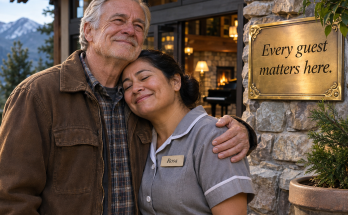
And the brass plaque she designed was still near the entrance.
I remembered how pleased she had been when the restoration was complete.
We had worked hard to turn an aging inn into a place people wanted to visit.
But Beatrice had never believed appearance was a measure of someone's value.
We had been young when we stayed there on our wedding night.
We certainly hadn't arrived with great wealth.
I wondered what would have happened if the people working there back then had judged us by our clothes.
Would we have been treated like an inconvenience?
Would someone have decided we didn't look important enough to stay?
The thought hurt more than I expected.
Because Beatrice had loved that place long before we could afford to own it.
It had become part of our life because someone had welcomed us when we were ordinary guests.
Now Rosa was describing a system that seemed designed to do the opposite.
I felt anger.
Then disappointment.
Then something harder to admit.
Guilt.
I had trusted that Cedar Summit Lodge remained the kind of hotel my wife and I intended it to be.
I had trusted Shaw to manage the property.
I had trusted the daily routines I no longer personally supervised.
And I had allowed that trust to stand in place of knowing what was happening.
Rosa had paid a price for asking questions.
Her hours had been reduced.
She had needed to borrow money to cover her daughter's school expenses.
Meanwhile, I had been able to spend years believing everything was fine.
I could have revealed my identity that moment.
I could have told Rosa that she was speaking to Edmund Hale, the man who owned the lodge.
I imagined her reaction.
She might have stopped talking.
She might have worried that she had said something wrong.
She might even have feared that her job was in danger again.
I didn't want that.
She had trusted a stranger with something that could affect her livelihood.
I wasn't going to use my position to frighten her.
So I remained quiet about who I was.
I listened.
And I thought.
The manager's list disturbed me because it suggested that the unfair treatment had been organized.
This was no longer simply about Mallory's attitude.
It was no longer about a single argument at reception.
According to Rosa, Shaw had identified people he didn't want staying in the hotel.
Mallory then used a guest's appearance to decide whether a reservation should be honored.
And when Rosa questioned management, she was warned to stay out of its decisions.
Those were three different pieces of information.
Together, they suggested something deeply wrong.
I wasn't ready to say I understood everything.
I didn't.
I had not seen the list myself.
I had not reviewed the reservation records.
I had not heard Shaw explain his decisions.
And I didn't yet know how many guests might have been affected.
I had Rosa's account.
I had my own experience.
That was enough to take the problem seriously.
It was not enough to pretend every question had been answered.
I asked myself what Beatrice would have wanted me to do.
I knew the answer.
She would have wanted me to listen to Rosa first.
Not because Rosa was an employee.
Because Rosa was telling me something I needed to hear.
Then she would have wanted the truth established.
All of it.
Not the convenient version.
Not whatever explanation would protect the hotel's reputation.
The actual truth.
I looked down at the food Rosa had brought.
It was such a simple act.
She had seen a cold man in a truck and decided he shouldn't be left without help.
She didn't know whether I had money.
She didn't know what I did for a living.
She didn't know that I owned the building behind her.
None of those things had mattered.
She helped because I needed help.
That was the exact kind of behavior Beatrice and I had wanted from the people who worked in our hotels.
And the person showing it was the person management had made afraid to speak.
I thought about the difference.
Shaw held authority.
Mallory controlled the front desk.
Rosa cleaned rooms.
Yet Rosa was the one who had treated me like a human being.
The contrast was painful.
I had spent the evening feeling insulted by the way I was treated.
Now I felt ashamed that Rosa had been placed in such a difficult position.
She had done the right thing by questioning what she saw.
She had apparently suffered for it.
And still, in the middle of the night, she was willing to help a man she barely knew.
I didn't want to make promises I couldn't yet explain.
I didn't want to draw attention to her before I understood what was happening.
So I thanked her for being willing to speak.
I meant it.
Not as a polite formality.
As one person recognizing that another had taken a risk.
For the first time since arriving, I felt I had learned something useful.
The lodge's problem wasn't that it had charged one man an unreasonable amount.
The problem was that certain guests were allegedly being judged before they ever reached their rooms.
Their reservations were worth less if they looked less wealthy.
Their appearance could decide whether they were welcome.
I had driven six hours expecting an ordinary overnight stay.
Instead, I was sitting in my truck, hearing how the property I owned might be treating other travelers.
The room price no longer seemed like the most important thing.
Neither did the embarrassment of being removed by security.
Those things mattered.
But they had happened to me.
And I had the power to respond when I was ready.
Other guests might not.
Someone who saved for a trip might arrive and find their reservation refused.
Someone traveling a long distance might have nowhere else to stay.
Someone with limited money might accept humiliating treatment because they believed there was nothing they could do.
I couldn't say exactly what had happened to those people.
Rosa hadn't given me their individual stories.
But I understood the kind of harm the practice could cause.
I looked through the wet windshield.
Cedar Summit Lodge stood beyond the parking lot.
The place where Beatrice and I had spent our wedding night.
The place we had purchased eleven years afterward.
The place she had helped restore, choosing every detail she believed would make people feel comfortable.
I had always thought of it as part of what she left behind.
Now I was confronting the possibility that I had allowed that legacy to be damaged.
I wanted to go inside and demand an explanation.
I wanted Mallory to account for the price.
I wanted Shaw to explain the list.
But I also knew that announcing myself without understanding the facts could end the conversation before I learned what I needed.
Rosa was still standing near my truck.
She was cold.
She had already said more than she was comfortable saying.
I wasn't going to keep pressing her that night.
I thanked her again for the food.
I thanked her for the blanket.
And I thanked her for telling me what she knew.
Then I sat quietly, thinking about the words she had used.
Guests who didn't appear to have enough money.
Reservations that were suddenly refused.
A manager who didn't want questions.
A housekeeper whose hours had been reduced.
I had come to Cedar Summit Lodge believing I understood the business Beatrice and I had built.
I understood the buildings.
I understood the finances.
I understood how to fill rooms and maintain a property.
What I had failed to understand was what happened when I wasn't there.
That night changed the questions I needed to ask.
I no longer cared only about receiving my room at the correct rate.
I needed to know why Shaw maintained that list.
I needed to understand why Mallory judged arriving guests by their appearance.
And I needed to find out whether Rosa's punishment had been meant to stop other employees from speaking.
I didn't have those answers yet.
I wasn't going to pretend I did.
But I had made one decision.
I would not dismiss what Rosa had told me.
I would not treat her fear as an inconvenience.
And I would not allow my own comfortable assumptions about Cedar Summit Lodge to stand in the way of finding out what had happened there.
I looked once more at the blanket she had brought.
It was still around me.
Then I looked at the building beyond the rain.
For years, I had thought ownership meant making sure the property was cared for.
That night, I began to understand that it also meant making sure the people inside it were treated properly.
Guests.
Employees.
Everybody.
Rosa had reminded me of that without knowing who I was.
And I knew I could no longer look at my hotel the same way.
Click here to continue reading: PART 5: I Thought the Worst Thing Preston Shaw Had Done Was Throw Me Into the Storm, Until Rosa Explained How His List Worked
I Arrived at the Hotel I Owned During a Terrible Storm, but the Woman Behind the Desk Treated Me Like a Stranger
Part 4 of 10