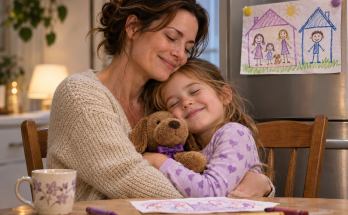
Ellie drew until the purple crayon became too small to hold comfortably.
She asked Rachel for another one.
Rachel found an entire box in a kitchen drawer.
My daughter looked delighted.
I watched her spread the crayons across the table without asking whether the mess would bother anybody.
At home, I would have reminded her to keep everything neat.
That afternoon, I let her enjoy herself.
I was beginning to notice how often I had confused keeping things orderly with keeping people happy.
A few days later, Helen contacted me about the temporary separation arrangements.
We discussed practical matters.
Ellie's schedule.
Household expenses.
Communication with Grant.
There were decisions I had never imagined making.
I had once believed that the biggest difficulty in raising our daughter would be agreeing on which school she should attend.
Now I was discussing how to make sure she felt comfortable moving between two homes.
I found that difficult.
Not because I thought separation was necessarily wrong.
Because Ellie hadn't chosen any of it.
She hadn't chosen Lacey's joke.
She hadn't chosen her father's response.
She hadn't chosen the hours of uncertainty that followed.
Yet she was living with the consequences.
Helen reminded me that my responsibility was to make thoughtful decisions rather than pretend nothing had changed.
I needed to hear that.
That evening, Grant called.
He asked whether I had received the proposed arrangements.
I told him I had.
“Is this really necessary?”
“I think it is.”
He was quiet for a moment.
“Mom says we're letting one bad evening ruin everything.”
I closed my eyes.
Margaret still described it that way.
One bad evening.
As though we had burned the dinner or argued over the birthday cake.
“Grant, I don't want to discuss our marriage through your mother.”
“She's just trying to help.”
“Then she needs to let us handle this ourselves.”
He sighed.
I waited for the familiar argument.
It didn't come.
Instead, he asked when he could see Ellie.
We agreed on a visit the following afternoon.
Afterward, I wrote the arrangement down.
I wanted everything involving our daughter to be clear.
No arguments about what someone had promised.
No confusion that would leave Ellie waiting beside a window for somebody who wasn't coming.
The next afternoon, Grant arrived carrying a small stuffed dog.
Ellie was thrilled.
She hugged it immediately.
“It's my puppy!”
Grant smiled.
“What's his name?”
She considered the question seriously.
“Purple.”
The dog was brown.
Grant laughed.
I smiled despite myself.
For a moment, everything felt familiar.
Our daughter was happy.
Grant was enjoying her happiness.
Nobody was arguing.
I understood why people sometimes returned to relationships that had caused them pain.
The good moments were real.
They could make the bad ones seem farther away.
But distance wasn't the same as resolution.
Grant spent nearly two hours playing with Ellie.
They built a tower from wooden blocks and read one of her favorite books.
When the visit ended, she asked whether he was staying for supper.
“Not today, sweetheart.”
“Why?”
He looked at me.
I answered gently.
“Daddy has some things to do at his house.”
Ellie accepted that.
She hugged him and carried her stuffed dog upstairs.
Grant remained near the front door.
“She's getting used to this.”
I nodded.
“She needs a routine.”
He looked uncomfortable.
“I hate that she calls it my house.”
I understood what he meant.
It had been our house.
Our kitchen.
Our bedroom.
Our daughter's home.
But changing the words wouldn't change what had happened inside those walls.
“I'm not asking you to stop being her father.”
“I know.”
He looked down.
“I've been thinking about what you said.”
I waited.
He explained that he had started remembering details from the birthday dinner.
Things he hadn't considered important at the time.
He remembered Ellie asking him to pick me up.
He remembered telling her that I was upset.
He remembered Lacey returning the chair to its place.
He remembered continuing to drink his wine.
His voice became quieter.
“I don't understand why I did that.”
I looked at him carefully.
“Have you spoken to someone about it?”
He shook his head.
I suggested that he consider doing so.
Not because I believed a few appointments would restore our marriage.
Because I wanted Ellie to have a father who understood why his behavior had frightened her.
Grant said he would think about it.
I didn't ask for a promise.
Promises had become difficult for me to trust.
After he left, Rachel found me standing near the window.
“You okay?”
“I think so.”
She handed me a cup of tea.
I told her that Grant seemed to be remembering things differently.
Rachel listened.
Then she asked whether anything had changed for me.
I thought about the question.
“I believe he's beginning to understand.”
“And what do you want?”
That was harder.
I had spent years concentrating on what Grant wanted.
What Margaret expected.
What would keep everybody comfortable.
Being asked what I wanted still felt unfamiliar.
“I want to stop being afraid of going home.”
Rachel nodded.
She didn't suggest that going back was the only way to accomplish that.
Over the following weeks, my headaches gradually became less frequent.
I still attended follow-up appointments.
Some days were better than others.
I learned to stop when I became tired rather than forcing myself to finish everything.
At first, resting made me feel guilty.
There was always laundry to fold.
Something to clean.
Something I could do for Rachel in return for her kindness.
One afternoon, she found me attempting to carry a basket of clothes upstairs.
She took it from me.
“You can leave that.”
“I wanted to help.”
“You can help when you're feeling better.”
I almost argued.
Then I remembered lying beneath my dining table, unable to lift my own hand.
I let Rachel carry the basket.
It shouldn't have felt like an achievement.
But it did.
Ellie continued attending her appointments.
She gradually became more comfortable with the therapist.
She liked the wooden animals and the picture books.
Sometimes she drew pictures.
Sometimes she simply played.
At home, she began spending longer periods without checking where I was.
One morning, I realized she had been playing upstairs for almost half an hour.
She hadn't called to ask whether I was all right.
She hadn't hurried downstairs to see if I had fallen.
She had simply been playing.
I went upstairs and found her arranging toys around her stuffed dog.
“Purple's having a birthday.”
“Is he?”
She nodded.
“He needs cake.”
I sat beside her.
She handed me an imaginary plate.
We pretended to eat together.
Then she brought out two little toy chairs.
For a moment, I became tense.
Ellie placed a doll in one chair.
She placed another doll beside it.
Nothing happened.
She continued playing.
I felt an unexpected happiness.
Recovery was happening in small ways.
Sometimes so small that I almost missed it.
Around that time, Margaret began sending me messages again.
Most of them concerned Ellie.
She wanted photographs.
She wanted to know when she could visit.
I understood that she missed her granddaughter.
I also needed her to understand that visits couldn't become opportunities to change Ellie's understanding of what had happened.
I explained that to her plainly.
Her response arrived several minutes later.
She said she would never deliberately upset her granddaughter.
I believed she probably meant it.
But deliberate harm wasn't the only kind of harm.
I knew that better than most.
Margaret eventually agreed to respect the boundaries I had established.
Her first visit took place while Rachel and I were present.
She brought Ellie a new dress.
Ellie thanked her and immediately showed her the stuffed dog.
Margaret smiled.
For a while, the visit was pleasant.
Then Ellie began drawing at the kitchen table.
Margaret noticed the birthday card sitting beside the crayons.
“Is that the card you made me?”
Ellie nodded.
“You left it.”
Margaret picked it up.
She studied the three figures inside the red circle.
“I thought I'd lost this.”
Ellie pointed at the smallest person.
“That's me.”
Margaret smiled.
Then Ellie pointed at my figure.
“Mommy got hurt on your birthday.”
The room became quiet.
Margaret looked toward me.
I said nothing.
Ellie continued coloring.
“I helped her.”
Margaret looked back at her.
“Yes, you did.”
I hadn't expected that answer.
Ellie glanced up.
“I told everybody.”
Margaret swallowed.
“I remember.”
“Grandma didn't help.”
Margaret sat very still.
I could see that she wanted to explain.
Perhaps she wanted to say she hadn't understood.
Perhaps she wanted to remind Ellie that everyone had been frightened.
Instead, after a long pause, she reached toward her granddaughter.
“Grandma should have helped.”
Ellie looked at her.
“Yes.”
Margaret's eyes filled.
“I'm sorry, darling.”
Ellie returned to her drawing.
She didn't comfort Margaret.
She didn't tell her everything was fine.
She simply accepted what her grandmother had said and continued coloring.
I watched the exchange with a strange mixture of sadness and relief.
It was the first time Margaret had acknowledged her responsibility without asking someone else to carry it.
After the visit, she approached me privately.
“I didn't realize how much she remembered.”
“She remembers enough.”
Margaret nodded.
Then she apologized to me.
Not for the misunderstanding.
Not for the unfortunate ending to her birthday.
For walking upstairs when I needed help.
I listened.
“Thank you for saying that.”
She looked hopeful.
“Does that mean we can put this behind us?”
I shook my head.
“It means I appreciate that you apologized.”
Her expression fell slightly.
I felt sorry for her.
But I didn't change my answer.
Accepting an apology didn't require me to return to the circumstances that had made it necessary.
Margaret left shortly afterward.
The following week, Grant told me he had arranged to speak with a counselor.
He didn't provide many details.
I didn't ask for them.
That was something he needed to do for himself.
He said he wanted to become a better husband and father.
I told him I hoped he would continue.
A few days later, he invited me to meet him at our house.
He wanted to discuss the future.
I agreed to go during the afternoon while Ellie stayed with Rachel.
Standing outside the front door was harder than I expected.
The house looked exactly as it always had.
The same flowerpots.
The same welcome mat.
The same little mark near the doorframe where Ellie's toy had struck it months earlier.
I had once associated those things with comfort.
Now I found myself hesitating before going inside.
Grant opened the door.
“Come in.”
I stepped into the hallway.
The dining room was visible from where I stood.
I looked at the floor.
My stomach tightened.
Grant noticed.
“We can talk in the living room.”
I agreed.
The furniture hadn't changed.
Our photographs were still on the shelves.
A picture from our wedding stood beside one of Ellie's first birthday.
I sat on the sofa.
Grant brought two glasses of water.
He placed mine on the coffee table.
Then he handed me a folded letter.
“I wrote some things down.”
I opened it.
The letter contained an apology.
A more complete one than anything he had offered before.
He acknowledged laughing when I fell.
He acknowledged ignoring Ellie's requests.
He acknowledged leaving me without medical attention because he had decided I was exaggerating.
He didn't blame Lacey.
He didn't blame Margaret.
He didn't blame me.
I read the letter slowly.
When I finished, I folded it again.
“Thank you.”
Grant looked at me.
“I mean every word.”
I believed he meant them.
That was what made the conversation difficult.
He asked whether we could attend counseling together.
He wanted another chance.
He said we could rebuild our family.
I looked toward the wedding photograph.
I remembered how certain I had been about our future on that day.
I remembered the promises.
I remembered how safe I had felt standing beside him.
Then I remembered Ellie holding my hand on the floor.
I looked back at Grant.
“I don't know how to trust you again.”
He leaned forward.
“I'll earn it.”
I wanted that answer to be enough.
But I had spent the weeks since Margaret's birthday discovering something about myself.
I was calmer when I didn't have to prepare for someone else's criticism.
I slept better when I wasn't worrying about whether Grant was disappointed in me.
I enjoyed time with Ellie without feeling that I needed to justify it.
I wasn't simply recovering from an injury.
I was learning what my life felt like without constantly adjusting myself to another person's expectations.
Grant waited.
I took a deep breath.
“I think our marriage needs to end.”
He stared at me.
For several seconds, neither of us moved.
Then he began crying.
I cried too.
There was no satisfaction in watching him realize what he was losing.
I had wanted our marriage to work.
I had wanted Ellie to grow up with the family she had drawn inside that red circle.
But wanting something didn't make it possible.
Grant asked whether I had stopped loving him.
I answered honestly.
“I stopped feeling safe with you.”
He lowered his head.
I didn't know whether he had expected a different answer.
I only knew that I couldn't offer one.
We remained in the living room for a long time.
Eventually, we discussed Ellie.
I told him I wanted her to have a loving relationship with both of us.
I wanted him to continue counseling.
I wanted us to communicate respectfully.
He nodded.
When I stood to leave, he walked me toward the door.
I looked into the dining room once more.
The chair was still there.
Nothing had happened to it.
It looked like an ordinary piece of furniture.
I understood then that removing the chair wouldn't have made the house feel different.
The chair hadn't decided to laugh.
It hadn't dismissed my daughter's cries.
It hadn't chosen to protect a birthday celebration instead of an injured person.
The people around it had made those decisions.
I stepped outside.
Grant remained in the doorway.
“Claire?”
I turned.
“I'm sorry.”
“I know.”
Then I walked to my car.
I cried before starting the engine.
I allowed myself that.
There was no need to pretend I wasn't grieving.
Ending a marriage didn't erase the good years.
It didn't mean every happy memory had been false.
It meant I had finally accepted that the future couldn't depend on pretending the painful memories didn't matter.
When I returned to Rachel's house, Ellie ran toward me carrying her stuffed dog.
“Mommy!”
I knelt and hugged her.
She began telling me about something she had drawn.
I listened.
Later that evening, after she fell asleep, I contacted Helen.
I told her I was ready to begin the divorce process.
Then I put my telephone away.
For the first time, the decision was mine.
Click here to continue reading: PART 10: Months After the Night My Daughter Tried to Save Me, I Finally Understood What It Meant to Give Her a Safe Home
I Thought My Husband Would Be the First Person to Protect Me Until I Saw What Made Him Laugh That Evening
Part 9 of 10