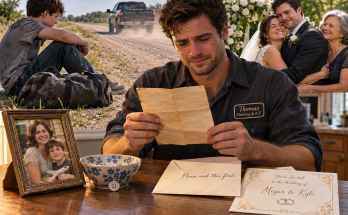
I brought the photographs home in the envelope Cheryl had given me.
I spread them across my kitchen table.
Some had dates written on the back.
Others had nothing.
I recognized the kitchen from our old house.
The curtains my mother had chosen.
The couch where I used to read.
I recognized clothes I hadn't thought about in decades.
There was one picture of me sitting on my father's shoulders.
I looked about five years old.
Both of us were smiling.
I held that photograph longer than the others.
It would have been easier if every memory of him had been terrible.
But they weren't.
There had been afternoons when he bought me ice cream.
There had been mornings when he carried me from the truck after I fell asleep.
There had been a time when I trusted him completely.
That was what made everything afterward so difficult.
I hadn't been mourning a stranger.
I had been mourning someone who had once been my whole world.
I placed the photograph beside my mother's letter.
Then I called Diane.
“Cheryl gave me some pictures.”
“That's good.”
“She knew about the letter.”
Diane became quiet.
“I suspected she might.”
“She apologized.”
“How did that feel?”
I thought about it.
“Complicated.”
Diane laughed gently.
“That's probably a reasonable answer.”
I told her what Cheryl had said.
About Ray reading the letter.
About him disliking its contents.
Diane sighed.
“Your mother saw things in you that he refused to see.”
I looked at the photographs.
“I wish she'd been there.”
“So do I.”
Neither of us spoke for a while.
Then Diane asked whether I wanted to come over on Sunday.
I told her I would.
Before hanging up, I asked another question.
“Do you remember where that gas station was?”
She became quiet.
“Yes.”
“Is it still there?”
“I think so.”
I looked toward my garage.
The blue duffel bag was inside.
“Would you show me?”
Diane didn't answer immediately.
“Are you sure?”
“Yes.”
“Then we'll go.”
On Sunday morning, I arrived at her house shortly after breakfast.
She was waiting with her handbag and a bottle of water.
We took my truck.
She directed me toward a highway I hadn't traveled in years.
The farther we drove, the more familiar the landscape became.
There were new houses in places that had once been fields.
Some old buildings had disappeared.
Others looked exactly the same.
Diane pointed toward a narrow road.
“That's where I turned when I came looking for you.”
I slowed down.
My hands tightened around the steering wheel.
I hadn't expected my body to react before my mind did.
But it had.
“Do you want to stop?” she asked.
“Not yet.”
We continued.
The gas station appeared several minutes later.
The exterior had been painted.
The old advertisement was gone.
There were newer fuel pumps beneath a metal canopy.
But I recognized the building immediately.
I pulled into the parking lot.
For a moment, I couldn't open my door.
Diane waited.
She didn't tell me to hurry.
She didn't ask what I was thinking.
Eventually, I stepped outside.
The air was cooler than it had been that August.
I walked toward the entrance.
A little electronic chime sounded when the door opened.
Not the old bell.
I noticed the difference immediately.
Inside, there were shelves of snacks and refrigerated drinks.
The counter had been replaced.
A young man stood behind the register.
He looked up.
“Morning.”
“Morning.”
I walked toward the window.
The place where I had sat eighteen years earlier was occupied by a display of bottled water.
I stood there.
I remembered holding that paper cup.
I remembered being embarrassed by my dirty shoes.
I remembered apologizing when Diane arrived.
The young man asked whether I needed help.
“No, thanks.”
I purchased two bottles of water.
Outside, I handed one to Diane.
She smiled.
We sat inside the truck.
“I wish I knew what happened to the woman who helped me.”
Diane nodded.
“She was very kind.”
“Did you ever get her name?”
“No.”
I looked back at the station.
That woman probably hadn't thought much about what she had done.
She had offered a frightened child a telephone and a glass of water.
But those small things had mattered.
I hoped someone had been equally kind to her when she needed it.
We drove farther down the road.
Eventually, the pavement gave way to gravel.
I recognized a bend.
Then a line of fence posts.
My heart began beating harder.
“Here,” I said.
Diane looked at me.
“Are you sure?”
I nodded.
There were differences.
A tree had been removed.
The fence had been repaired.
But the shape of the road was unmistakable.
I stopped the truck.
We sat quietly.
I looked at the passenger seat.
Then I looked through the windshield.
For eighteen years, I had carried that road inside my head.
It had followed me into quiet houses.
Into difficult conversations.
Into moments when someone I loved became angry.
And here it was.
Just gravel.
A fence.
A field.
Nothing had been waiting for me.
I stepped outside.
Diane followed.
We stood beside the road.
I looked toward the bend where my father's truck had disappeared.
“I waited for him.”
Diane put a hand on my shoulder.
“I know.”
“I thought he'd come back.”
She didn't answer.
I looked down at my shoes.
They were clean.
Expensive work boots I had purchased with money I earned.
I remembered the sneakers I had worn that day.
“Do you think he ever intended to?”
Diane took a long breath.
“I can't answer that.”
I nodded.
She wasn't going to invent a kinder version of events.
I appreciated her for that.
“I used to think if I'd behaved differently, he wouldn't have left me.”
Diane looked at me.
“Thomas, you were a child.”
“I know.”
“You didn't put yourself on this road.”
I stared toward the bend.
“No.”
“He did.”
Something about hearing those words in that exact place made them feel different.
I had known the facts for years.
But part of me had continued carrying responsibility that wasn't mine.
I thought about the little boy who had walked toward the highway.
He had been frightened.
Thirsty.
Exhausted.
He had still found help.
I felt proud of him.
Not because my father's lesson had worked.
Because he had survived something no child should have been asked to survive.
I stood there for another minute.
Then I turned toward my truck.
“I'm ready.”
Diane smiled.
We drove away together.
I didn't look back.
Later that afternoon, we ate lunch at her kitchen table.
She made scrambled eggs.
I laughed when I saw the plate.
“What?”
“Nothing.”
She pointed at my eggs.
“Don't complain. They're better than your first attempt.”
“They certainly are.”
Afterward, I helped repair the screen door.
The hinge had become loose.
It took fifteen minutes.
When I finished, Diane opened and closed it twice.
“Perfect.”
I gathered my tools.
She sat on the porch and watched me put them away.
“You seem different today.”
I considered that.
“Maybe.”
She waited.
“I don't think I need him to explain everything anymore.”
She nodded.
“That sounds like a good place to be.”
I didn't mean I had stopped caring.
I probably would always care.
But caring was different from waiting.
That evening, Megan called.
She wanted to know whether I would help her with something.
“The reception photographs.”
“What about them?”
“I want to include you.”
I paused.
She explained that she was making a display of family photographs.
Pictures from her childhood.
Pictures of Kyle growing up.
Pictures of relatives.
She wanted photographs of me, too.
“Your father won't like that.”
“I know.”
She sounded tired.
“He doesn't get to approve every photograph.”
I smiled slightly.
“What kind of pictures?”
“Whatever you're comfortable sharing.”
I told her about the envelope Cheryl had given me.
She was surprised.
“Mom actually gave them to you?”
“Yes.”
“I'm glad.”
I selected three photographs.
One showed me with my mother.
Another showed me standing beside my first service van.
The third showed Diane and me outside her house.
I sent them to Megan.
She called a few minutes later.
“Who's the woman beside the van?”
“Diane.”
“She helped you buy it?”
“Yes.”
“Can I invite her to the wedding?”
I hadn't considered that possibility.
“Ask her.”
“Would she come?”
“I don't know.”
Megan laughed.
“Fair enough.”
The following evening, Diane received a telephone call from Megan.
They talked for nearly forty minutes.
When Diane called me afterward, she sounded amused.
“Your sister asks a lot of questions.”
I smiled.
“She does.”
“She invited me to her wedding.”
“What did you say?”
“I said I'd come if you wanted me there.”
I looked at my mother's letter.
“I'm still thinking about it.”
“Well, think carefully.”
She paused.
“But don't make the decision based entirely on Ray.”
I understood.
That had been the difficulty.
If I attended because I wanted to prove something to him, he would still be controlling my decision.
If I stayed away only because I feared him, he would be controlling it in another way.
I needed to decide what I wanted.
The next Saturday, Megan visited my house.
I showed her the ceramic bowl with blue flowers.
She picked it up carefully.
“This was your mother's?”
“Yes.”
She looked at the buttons.
“They're still inside.”
I smiled.
“Diane kept everything.”
We sat in the living room.
I showed her more photographs.
She asked questions about people she had never met.
She wanted to know what my mother had been like.
She wanted to understand why Diane had taken me in.
She listened to everything.
Then she told me something about herself.
When she was seventeen, she had wanted to attend college several hours away.
Ray had opposed it.
He told her she was abandoning her family.
Cheryl encouraged her to stay closer to home.
Eventually, Megan changed her plans.
“I thought he was just protective.”
I looked at her.
“Maybe he was.”
She shook her head.
“Maybe he just didn't like losing control.”
I didn't disagree.
She continued.
“When I told him I wanted you at the wedding, he said I was betraying him.”
I sat back.
Those words sounded familiar.
My father had always treated another person's independence as a personal offense.
“What did you tell him?”
“That I wasn't asking permission.”
I smiled.
“Good.”
She looked at me carefully.
“Do you think I'm being cruel?”
“No.”
The answer came easily.
“You can love him without agreeing with everything he does.”
She nodded.
“I wish he understood that.”
“So do I.”
We went into the kitchen.
I made coffee.
She stood beside the counter and examined the blue ceramic bowl again.
“I think your mom would've liked Diane.”
I laughed.
“They were sisters.”
She laughed, too.
“You know what I mean.”
I did.
She meant my mother would have been grateful.
Grateful someone had stayed.
Grateful someone had kept her promise.
Grateful someone had helped her son become an adult without making him ashamed of who he was.
Before Megan left, she asked me about the wedding one more time.
“No pressure.”
I looked around my kitchen.
Then I looked at her.
“I'll come.”
Her face brightened.
“Really?”
“Yes.”
She hugged me.
I hugged her back.
“Thank you.”
I smiled.
“But I have one condition.”
“Anything.”
“I won't pretend nothing happened.”
She stepped back.
“I wouldn't ask you to.”
That was enough.
I wasn't going to my father's family gathering.
I was going to my sister's wedding.
There was a difference.
And for once, I understood it.
Click here to continue reading: PART 8: My Father Asked Me to Protect His Reputation Before the Wedding, and I Finally Told Him What His Silence Had Cost Me
My Father Left Me on an Empty Road When I Was Thirteen, but Leaving Him Behind Took Much Longer
Part 7 of 10