I wanted the telephone call to be a mistake.
That was the truth.
I wanted to discover that I had misunderstood the man.
That Margaret had simply moved to another address.
That my mother had spent an ordinary week visiting an old friend.
And that the frightening change in her appearance had nothing to do with anything more serious than a temporary illness.
I wanted all of those things to be true.
But wanting something doesn't make it happen.
I knew that.
I had spent the evening trying to convince myself otherwise.
The telephone number was still the same.
The man's answer was still clear.
Margaret had moved away eight years earlier.
And my mother had returned from a seven-day visit looking like a different woman.
Those facts did not fit together easily.
I wished they did.
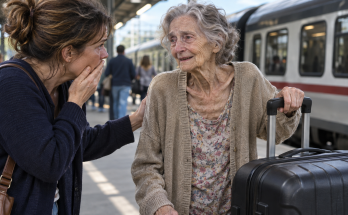
I thought about the first moment I saw Mom at the station.
For a few seconds, I had genuinely struggled to recognize her.
That memory frightened me more than anything else.
Not because I had forgotten what she looked like.
I knew her face better than almost anyone's.
But the woman approaching me seemed so much smaller than the woman who had left home.
Her clothes hung from her shoulders.
Her cheeks had lost their familiar fullness.
And the black suitcase beside her only made the change more noticeable.
I remembered looking at her and wondering how seven days could have done so much.
Seven days.
One week.
That was all.
Before the trip, Mom had enjoyed baking and Sunday dinners.
She liked food.
She had always been cheerful.
And although she was slightly overweight, there had been something reassuring about her familiar appearance.
I had never imagined that I would miss the sight of those round cheeks.
But I did.
I missed them terribly.
Because their disappearance made me afraid of what else might have changed.
I couldn't tell whether Mom had lost as much weight as it appeared.
I hadn't weighed her before she left.
I hadn't weighed her when she returned.
I only had my own eyes.
But sometimes what you see is enough to make you worry.
And I was worried.
I kept thinking about the hospital.
I had wanted to take her there as soon as I saw her.
She refused.
That refusal had left me feeling helpless.
I didn't want to frighten her.
I didn't want to make her feel as though she was no longer capable of making her own decisions.
But I couldn't pretend that her appearance was normal.
It wasn't.
And I couldn't understand why she seemed so determined to minimize it.
"My stomach hasn't been right," she had told me.
That was the explanation.
Nothing more.
A few ordinary words to describe something that looked anything but ordinary.
I had wanted to believe her.
Maybe she genuinely thought the illness was minor.
Maybe she was already feeling better.
Maybe she simply didn't want to talk about it.
I couldn't know.
And that was the problem.
Every possibility remained a possibility.
None had become an answer.
I thought about the visit itself.
Margaret.
The childhood friend.
The woman my mother had not seen for twenty years.
I wondered what they had expected from their reunion.
Perhaps they had wanted to talk about their younger days.
Perhaps they had simply wanted to see each other again before more time passed.
That had been my understanding when Mom announced the trip.
It seemed innocent.
Even lovely.
I had been happy for her.
I remembered that feeling clearly.
There had been no reason to question the visit.
Mom was eighty, but she was still entitled to enjoy her friendships.
I wanted her to have things to look forward to.
I wanted her to feel that life still held pleasant surprises.
And I had assumed that seeing Margaret would be one of them.
Now I could barely think about the visit without feeling frightened.
I didn't know whether Margaret had done anything wrong.
I didn't even know whether she was aware of my mother's condition.
The man on the telephone had said only that she no longer lived there.
He hadn't said where she was.
He hadn't mentioned my mother.
And he certainly hadn't explained the suitcase.
I had to keep reminding myself of those limits.
Otherwise, my mind began filling in the missing details.
And I didn't want to do that.
I wanted the truth.
Not a frightening explanation created from my own imagination.
I thought about the black suitcase again.
It was the one object I could connect directly to the trip.
Mom had taken a little blue bag.
She returned with something entirely different.
When I asked, she told me the blue bag had broken.
Margaret had supposedly given her the black suitcase to use.
That could have been true.
There was nothing impossible about it.
Bags break.
People help friends.
And borrowed luggage doesn't necessarily mean anything.
But I had never seen my mother cling to a suitcase quite the way she held that one when I questioned her.
At least, that was how I remembered it.
I had to be careful even with that memory.
I was frightened at the time.
Fear can change the importance of small gestures.
Perhaps her grip meant nothing.
Perhaps she was simply tired.
Perhaps the case was difficult to manage.
I didn't know.
What I knew was that she had taken it into her bedroom and locked the door.
I could still hear that lock turning in my memory.
A small sound.
A completely ordinary sound.
Yet it had stayed with me.
I wondered whether the suitcase was still exactly where she had put it.
I had no reason to believe it wasn't.
But I hadn't seen inside it.
And I had no intention of pretending I knew what it contained.
That was one boundary I refused to cross.
My mother deserved privacy.
Even when I was frightened.
Even when she wasn't answering the questions I wanted to ask.
The suitcase belonged behind her door until she chose to show me otherwise.
I understood that.
But respecting her privacy didn't mean I had to stop worrying.
Those were different things.
I was slowly learning to separate them.
I could love her without demanding to know everything.
I could trust her without pretending every explanation made sense.
And I could respect her independence while still believing she needed medical attention.
Those thoughts were uncomfortable.
They didn't solve anything.
But they helped me understand my own feelings.
I had been so focused on finding an explanation that I almost forgot why I wanted one.
I wasn't curious for the sake of curiosity.
I was frightened for my mother.
The mystery of the suitcase mattered only because it might help explain the week.
The telephone number mattered because I wanted to speak with someone who had supposedly been with her.
And Margaret mattered because she was the person my mother had gone to see.
Everything returned to Mom.
Her health.
Her safety.
Her silence.
I thought about how different things had seemed before she left.
The little blue bag had looked ordinary.
The journey was only three hours.
And the visit was supposed to last one week.
I had no reason to imagine anything troubling.
I trusted the arrangement.
I trusted my mother.
And I assumed that if something serious happened, she would tell me.
That assumption was what had changed.
I no longer knew whether she would tell me everything.
Not because I believed she was dishonest.
But because I had seen how easily she could dismiss something that frightened me.
I wondered whether she thought she was protecting me.
Perhaps she didn't want me to worry.
Parents sometimes have difficulty letting their children see them vulnerable.
I knew that.
Mom had spent so many years being the dependable one.
Maybe admitting she needed help was difficult.
Maybe she was embarrassed.
Maybe she simply had a different understanding of how ill she had been.
I couldn't decide which explanation was right.
But I could understand why an elderly parent might resist becoming the person everyone worried about.
I tried to imagine how I would feel in her place.
Eighty years old.
Coming home from a trip.
Having my child examine my face and ask whether I needed a hospital.
Perhaps I would feel overwhelmed too.
Perhaps I would want to be left alone.
That didn't mean refusing medical attention was necessarily wise.
It only meant I had to consider how she might be feeling.
I didn't want my concern to become another burden for her.
At the same time, I couldn't allow her discomfort to make me ignore what I had seen.
The change was too great.
I looked at the situation again from the beginning.
Mom had planned a visit to Margaret.
She had been away for seven days.
She returned looking alarmingly thin.
She described stomach trouble.
She refused the hospital.
Her luggage had changed.
And the number I called for Margaret reached someone who said she had moved eight years earlier.
That was everything I could state with confidence.
No more.
No less.
I found myself repeating those facts because they kept me grounded.
Whenever I began imagining terrible possibilities, I returned to what I actually knew.
It was a small discipline.
But I needed it.
I didn't want to accuse Margaret without evidence.
I didn't want to confront my mother with conclusions I couldn't support.
And I didn't want to pretend that uncertainty itself proved something sinister.
It didn't.
Still, I knew that a story with so many unanswered questions deserved attention.
I couldn't simply forget about the visit.
Not after seeing Mom at the station.
Not after hearing the man on the telephone.
Not while the black suitcase remained unexplained beyond the brief account she had given me.
I thought about the twenty years between Margaret and my mother's last meeting.
Twenty years is a long time.
A person can move several times.
Telephone numbers can become outdated.
Families can change.
And old friends can find each other again under circumstances that their children know little about.
Perhaps that was all this was.
Perhaps the telephone number had never been updated.
Perhaps Mom had visited Margaret at another place entirely.
That possibility was reasonable.
I wanted to give it proper consideration.
But it didn't explain why Mom looked so unwell.
That remained the most important question.
I wished I had asked her more about the illness at the station.
Not in an accusing way.
Just carefully.
How long had she been feeling sick?
Was she able to eat?
Did she feel any better?
I had been so shocked by her appearance that my concern came out as a plea to go to the hospital.
And when she refused, I felt stuck.
Looking back, I wished I had been calmer.
Perhaps a gentler conversation would have helped.
Perhaps it wouldn't.
I couldn't know.
But I understood that fear had made me impatient for answers.
And my impatience might make it harder for her to talk.
I didn't want that.
I wanted her to feel safe with me.
I wanted her to know that whatever had happened, I would listen.
If she had been ill, I would help her.
If the visit had been disappointing, I wouldn't judge her.
If the telephone information was outdated, I would accept that.
And if there was something she found difficult to explain, I wanted her to know she didn't have to face it alone.
Those were the things I wished I could communicate.
Simple things.
But they felt terribly important.
I wondered whether I had taken our closeness for granted.
For years, I had believed that being family meant understanding each other without much explanation.
I knew Mom's routines.
I knew what made her happy.
I knew she valued our Sunday dinners.
But I couldn't know everything unless she chose to tell me.
And perhaps I hadn't always made enough room for that.
Perhaps I had listened to the familiar parts of her life and assumed there was nothing else I needed to ask.
It was an uncomfortable thought.
But I couldn't dismiss it.
My mother had a whole life beyond the role she played in mine.
The childhood friend she wanted to visit was evidence of that.
And whatever had happened during the seven days, I needed to remember she was more than the frightened, thin woman I had seen at the station.
She was still herself.
Even if something had changed.
I thought again about the blue bag.
Such a small detail.
I hadn't expected to remember it so clearly.
But it had become the last ordinary object I associated with the trip.
The black suitcase belonged to the return.
The blue bag belonged to the departure.
Between them was a week I couldn't explain.
I wondered whether I would ever see that blue bag again.
I didn't know.
Perhaps it was broken beyond repair.
Perhaps it had been left with Margaret.
Perhaps the truth was exactly what Mom had said.
I couldn't say.
And I refused to pretend otherwise.
There was something almost painful about accepting how little information I possessed.
I wanted certainty.
I wanted a clear answer.
I wanted to know whether the visit had harmed my mother or whether her illness was an unfortunate coincidence.
But certainty couldn't be forced.
I could ask questions.
I could pay attention.
I could encourage her to seek medical care.
What I couldn't do was manufacture the missing facts.
And I couldn't let my fear turn suspicion into proof.
By the time I had worked through those thoughts, one thing had become clear.
The telephone number wasn't the answer.
The suitcase wasn't the answer either.
They were details that required explanation.
But the person who mattered was my mother.
She had come home.
She was visibly changed.
And she was reluctant to discuss what had happened.
I could not change those facts.
I could only decide how to respond to them.
I no longer wanted to interrogate her.
I wanted to understand her.
I wanted her to know that my concern came from love, not suspicion.
And I wanted to remain attentive to her health, no matter how much she tried to reassure me.
The seven days were over.
But what had happened during them was still affecting us.
I didn't know how long it would take to understand.
I only knew that I could not treat the matter as finished simply because Mom was back home.
I had believed that bringing her home from the station would mean the visit was safely behind us.
Now I understood how wrong that assumption had been.
She was home.
But the questions had come home with her.
And I had to find a way to care for her without pretending I already knew the answers.
Click here to continue reading: PART 10: My Mother Came Home After Seven Days, but I Was Left Facing a Truth About Her Life That I Had Never Wanted to Admit
I Thought My Mother Was Taking a Harmless Trip to See an Old Friend, Until I Saw What Seven Days Had Done to Her
Part 9 of 10